

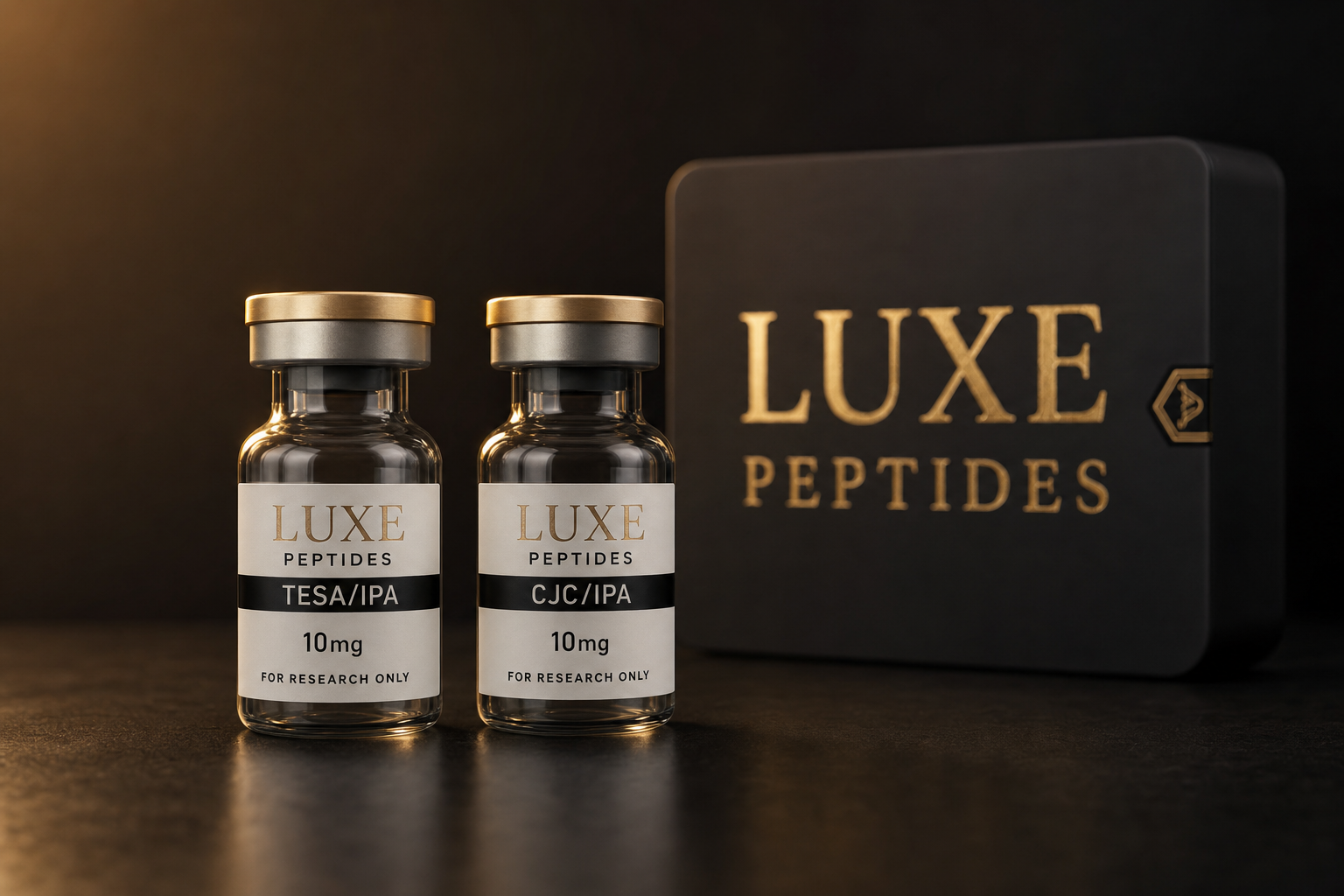
For research use only. The following is an educational summary of peptide mechanisms studied in preclinical and laboratory settings; it is not medical guidance and describes no human use.
Growth-hormone (GH) secretagogue blends pair two classes of signaling molecule that act on distinct receptors along the somatotroph axis. In the research literature, one axis is a growth-hormone-releasing-hormone (GHRH) receptor agonist and the other is a growth-hormone secretagogue-receptor (GHS-R1a, the ghrelin receptor) agonist. The two blends researchers most often compare — Tesamorelin + Ipamorelin (TESA/IPA) and CJC-1295 + Ipamorelin (CJC/IPA) — share the same GHS-R component (ipamorelin) and differ almost entirely in the GHRH analog chosen. This article describes what that single substitution changes at the receptor and pharmacokinetic level, in research models only.
The shared component: ipamorelin
Both blends use ipamorelin as the GHS-R1a agonist. In preclinical characterization, ipamorelin has been described as a selective pentapeptide secretagogue that stimulates somatotroph signaling with comparatively little effect on cortisol or prolactin release relative to earlier secretagogues such as GHRP-6 (Raun et al., 1998). Because ipamorelin is constant across the two blends, it is not the variable that distinguishes them — the GHRH analog is.
The variable component: which GHRH analog
GHRH analogs bind the GHRH receptor on pituitary somatotrophs. Native GHRH is degraded rapidly by dipeptidyl peptidase-4 (DPP-4), so research-stage analogs are engineered for protease resistance and altered half-life. This is where TESA/IPA and CJC/IPA diverge.
Tesamorelin (the GHRH side of TESA/IPA)
Tesamorelin is a stabilized analog of full-length human GHRH(1–44), modified with a trans-3-hexenoic acid group to resist DPP-4 cleavage. In the research and regulatory literature it is one of the most extensively characterized GHRH-receptor agonists, with published preclinical and clinical pharmacology describing GHRH-receptor-mediated stimulation of the somatotroph axis (Ferdinandi et al., 2007). Its structure is close to the endogenous GHRH sequence, which is the feature most often cited to distinguish it from shorter chimeric analogs.
CJC-1295 (the GHRH side of CJC/IPA)
CJC-1295 is a modified GHRH(1–29) fragment — the minimal bioactive GHRH domain — carrying substitutions that reduce enzymatic degradation. Two research forms are widely discussed: a version without the Drug Affinity Complex (“CJC-1295 no-DAC”, functionally comparable to modified GRF(1–29)) and a DAC-conjugated version designed to bind serum albumin and extend circulating half-life substantially in animal models (Teichman et al., 2006). The DAC modification is the defining pharmacokinetic feature of that construct and the main reason the two blends are dosed and studied on different time courses in the literature.
How the two blends differ at a glance
| Attribute (research context) | TESA/IPA | CJC/IPA |
|---|---|---|
| GHS-R1a component | Ipamorelin | Ipamorelin |
| GHRH-receptor component | Tesamorelin (stabilized GHRH 1–44 analog) | CJC-1295 (modified GHRH 1–29 fragment) |
| Structural basis of GHRH analog | Full-length GHRH backbone | Truncated 29-residue bioactive domain |
| Half-life driver | Hexenoyl / DPP-4-resistance modification | DPP-4-resistance; optional DAC albumin binding for extended profile |
| Reported half-life class (models) | Short-to-intermediate | Short (no-DAC) or markedly extended (DAC) |
| Depth of published characterization | Extensive preclinical + clinical pharmacology | Preclinical pharmacokinetics; less full-length clinical data |
| Mechanistic rationale for pairing | GHRH-receptor priming + GHS-R1a co-stimulation | GHRH-receptor priming + GHS-R1a co-stimulation |
Why the GHRH choice is the key difference
The mechanistic logic of pairing a GHRH agonist with a GHS-R1a agonist is the same for both blends: in preclinical work the two receptor pathways have been observed to act cooperatively on somatotroph signaling, with the GHRH arm and the ghrelin-receptor arm engaging different intracellular cascades (cAMP/PKA versus phospholipase-C pathways) that have been reported to produce additive or synergistic secretagogue signaling in animal and cell models. Because ipamorelin is held constant, any observed difference between TESA/IPA and CJC/IPA in a given study is attributable to the GHRH analog — its structure, its protease resistance, and, for CJC-1295, whether the DAC-extended form is used.
For researchers, three practical distinctions follow from that substitution:
- Structural fidelity to native GHRH. Tesamorelin is built on the full 44-residue GHRH sequence; CJC-1295 is built on the truncated 29-residue fragment. This is the core structural contrast between the blends.
- Pharmacokinetic profile. The DAC option on CJC-1295 can extend the circulating window in animal models far beyond what is reported for tesamorelin or no-DAC constructs, which is why studies of the two blends are not directly interchangeable on a time-course basis.
- Weight of published evidence. Tesamorelin carries a deeper published pharmacology record, whereas much CJC-1295 data sits at the preclinical/pharmacokinetic stage. Researchers weighing the two often factor in this difference in literature depth.
Choosing between them for a research protocol
Selection in a laboratory context generally comes down to which GHRH-receptor pharmacology a study is designed to probe: a full-length, well-characterized GHRH analog (tesamorelin) versus a truncated fragment whose defining research question is often the effect of the DAC half-life extension (CJC-1295). Product-level specifications, purity documentation, and reconstitution arithmetic for either blend can be reviewed in the linked resources below.
Researchers comparing these blends can review the IPA/TESA blend and the Ipamorelin/CJC-1295 blend product pages, or the standalone ipamorelin listing to isolate the shared GHS-R1a component. Purity and identity data are available in the COA library, and laboratory reconstitution math can be worked out with the reconstitution calculator.
Reviewed for research accuracy — published 2026-07-13.
References
- Raun K, Hansen BS, Johansen NL, et al. Ipamorelin, the first selective growth hormone secretagogue. European Journal of Endocrinology. 1998;139(5):552–561. PMID: 9849822.
- Ferdinandi ES, Brazeau P, High K, et al. Non-clinical pharmacology and safety evaluation of TH9507, a human growth hormone-releasing factor analogue. Basic & Clinical Pharmacology & Toxicology. 2007;100(1):49–58. PMID: 17214611.
- Teichman SL, Neale A, Lawrence B, et al. Prolonged stimulation of growth hormone and insulin-like growth factor I secretion by CJC-1295, a long-acting analog of GHRH, in healthy adults. Journal of Clinical Endocrinology & Metabolism. 2006;91(3):799–805. PMID: 16352683.
- Sinha DK, Balasubramanian A, Tatem AJ, et al. Beyond the androgen receptor: the role of growth hormone secretagogues — a review of GHRH and GHS-R1a pharmacology. Translational Andrology and Urology. 2020;9(Suppl 2):S149–S159. PMID: 32257855.
For research use only. Not for human or veterinary use. The compounds discussed here are intended solely for in vitro and laboratory research by qualified professionals, and nothing above describes or endorses administration to humans or animals.