

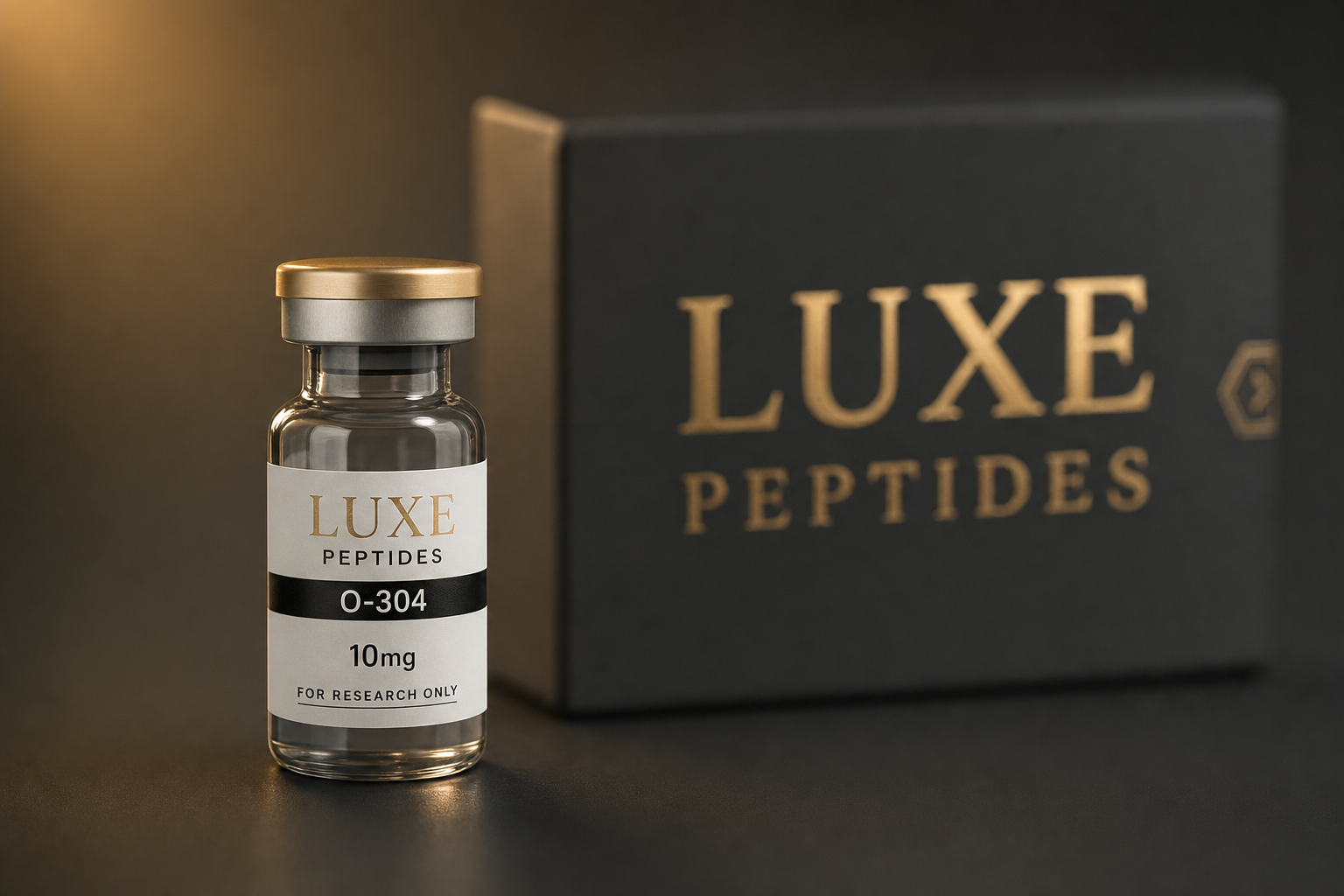
The information below is provided strictly for laboratory and educational research use only; ATX-304 (O-304) is not a drug, dietary supplement, or product for human or veterinary use.
Researchers searching for “ATX-304 peptide” or “what is ATX 304” are frequently working from a misconception worth correcting at the outset: ATX-304 is not a peptide. It is a small-molecule compound — a synthetic organic activator of AMP-activated protein kinase (AMPK) — and it is more widely referenced in the literature under its original designation, O-304 (also written O304). This guide summarizes the naming, the AMPK mechanism it is studied for, and the preclinical research contexts in which it has appeared.
ATX-304 vs. O-304: the same molecule, two designations
The two names refer to a single chemical entity. O-304 is the original research code under which the compound was first characterized as a direct pan-AMPK activator in metabolic and vascular animal models, and it remains the identifier most often used in the peer-reviewed literature. ATX-304 is a later development-stage designation applied to the same molecule as it moved into subsequent research programs. When evaluating sources, researchers should treat “O-304,” “O304,” and “ATX-304” as interchangeable labels for the same small molecule rather than as distinct compounds.
Because the “-304” suffix and the presence of the compound in metabolic research have led some vendors and search queries to file it alongside peptides such as GLP receptor agonists, it is worth restating: the mechanism described here is enzyme activation by a small molecule, not receptor agonism by a peptide.
What AMPK is, and why it is studied
AMPK is a heterotrimeric enzyme — assembled from a catalytic α subunit and regulatory β and γ subunits — that acts as a central cellular energy sensor. In research models, AMPK is described as becoming active when the cellular ratio of AMP (and ADP) to ATP rises, signaling low energy availability. Once active, the kinase has been observed in preclinical work to shift cells toward energy-producing (catabolic) pathways and away from energy-consuming (anabolic) ones: promoting glucose uptake and fatty-acid oxidation while restraining synthesis of lipids and glycogen. Canonical activation involves phosphorylation of a threonine residue (Thr172) on the α subunit by upstream kinases.
Multiple subunit combinations (isoforms) exist, and their tissue distribution differs, which is why the selectivity profile of any given activator matters to researchers designing experiments.
How ATX-304 (O-304) is described mechanistically
O-304 is characterized in the literature as a direct, pan-AMPK activator. Two features define that description:
- Direct — it is reported to bind and activate the AMPK complex itself, rather than acting indirectly by depleting cellular ATP the way older experimental tools such as metformin or AICAR are understood to work in research systems.
- Pan — it is described as activating a broad range of AMPK isoform combinations rather than a single α/β/γ assembly. Mechanistically, direct activators of this class are studied for their ability to promote AMPK activity in part by protecting the Thr172 phosphorylation site from dephosphorylation, stabilizing the active form of the enzyme.
This combination — direct binding plus broad isoform coverage — is the property that has made O-304 of interest as a research probe for AMPK biology across tissues, and it distinguishes it from more isoform-selective experimental activators.
Preclinical and early research contexts
O-304 has been examined primarily in two overlapping areas of preclinical research: metabolic and vascular/microvascular biology.
In rodent models, studies have reported that O-304 administration is associated with increased glucose uptake in skeletal muscle and altered hepatic glucose handling, consistent with the expected downstream consequences of AMPK activation. In the same body of work, researchers have also examined effects on microvascular perfusion, reporting improved capillary blood flow in animal models — a vascular readout that is mechanistically distinct from the metabolic endpoints and that has driven interest in AMPK activation beyond glucose handling alone.
Limited human data exist. An early-phase clinical study accompanying the principal preclinical report examined markers of glucose homeostasis in participants, but the human dataset is small and preliminary, and findings from it should be read as exploratory rather than established. Beyond metabolism and vasculature, AMPK activators as a class have been explored in a range of additional preclinical contexts — including skeletal-muscle and cardiac research models — where the enzyme’s role in energy balance is under investigation. Researchers should note that broad, direct AMPK activation has also been studied for potential off-target consequences in some tissues, which is an active area of experimental characterization.
ATX-304 (O-304) at a glance
| Attribute | Description (research context) |
|---|---|
| Compound class | Small molecule (not a peptide) |
| Also known as | O-304, O304, ATX-304 |
| Molecular target | AMP-activated protein kinase (AMPK) |
| Mechanism studied | Direct, pan-isoform AMPK activation; stabilization of the active (Thr172-phosphorylated) enzyme |
| Primary research areas | Metabolic (glucose uptake, hepatic glucose handling) and vascular (microvascular perfusion) models |
| Human data | Limited; early-phase, exploratory |
| Handling note | Small-molecule solid; reconstitution is laboratory arithmetic, not a dosing instruction |
Practical notes for researchers
Because O-304 is a small molecule rather than a peptide, researchers sourcing it for in vitro or animal-model work should confirm identity and purity against a certificate of analysis before use. Solubility and reconstitution parameters differ from those of the lyophilized peptides more commonly discussed in this space; any reconstitution figures should be treated purely as laboratory concentration arithmetic. Luxe Peptides publishes third-party analytics in its COA library, and the reconstitution calculator can assist with concentration math for laboratory preparation. The research compound itself is listed on the O-304 (ATX-304) product page.
References
- Steneberg P, Lindahl E, Dahl U, et al. JCI Insight. 2018;3(12):e99114. doi:10.1172/jci.insight.99114
- Hardie DG, Ross FA, Hawley SA. AMPK: a nutrient and energy sensor that maintains energy homeostasis. Nat Rev Mol Cell Biol. 2012;13(4):251–262. doi:10.1038/nrm3311
- Myers RW, Guan HP, Ehrhart J, et al. Systemic pan-AMPK activator MK-8722 improves glucose homeostasis but induces cardiac hypertrophy. Science. 2017;357(6350):507–511. doi:10.1126/science.aah5582
- Additional preclinical studies have examined direct AMPK activators across skeletal-muscle, cardiac, and vascular models; researchers are encouraged to consult primary literature indexed under “O304” and “AMPK activator” in PubMed for the most current characterization.
Reviewed for research accuracy — published 2026-07-13. This article is provided for laboratory and educational research use only. ATX-304 (O-304) is not approved for human or veterinary use, and nothing here should be interpreted as medical, therapeutic, or dosing guidance.