

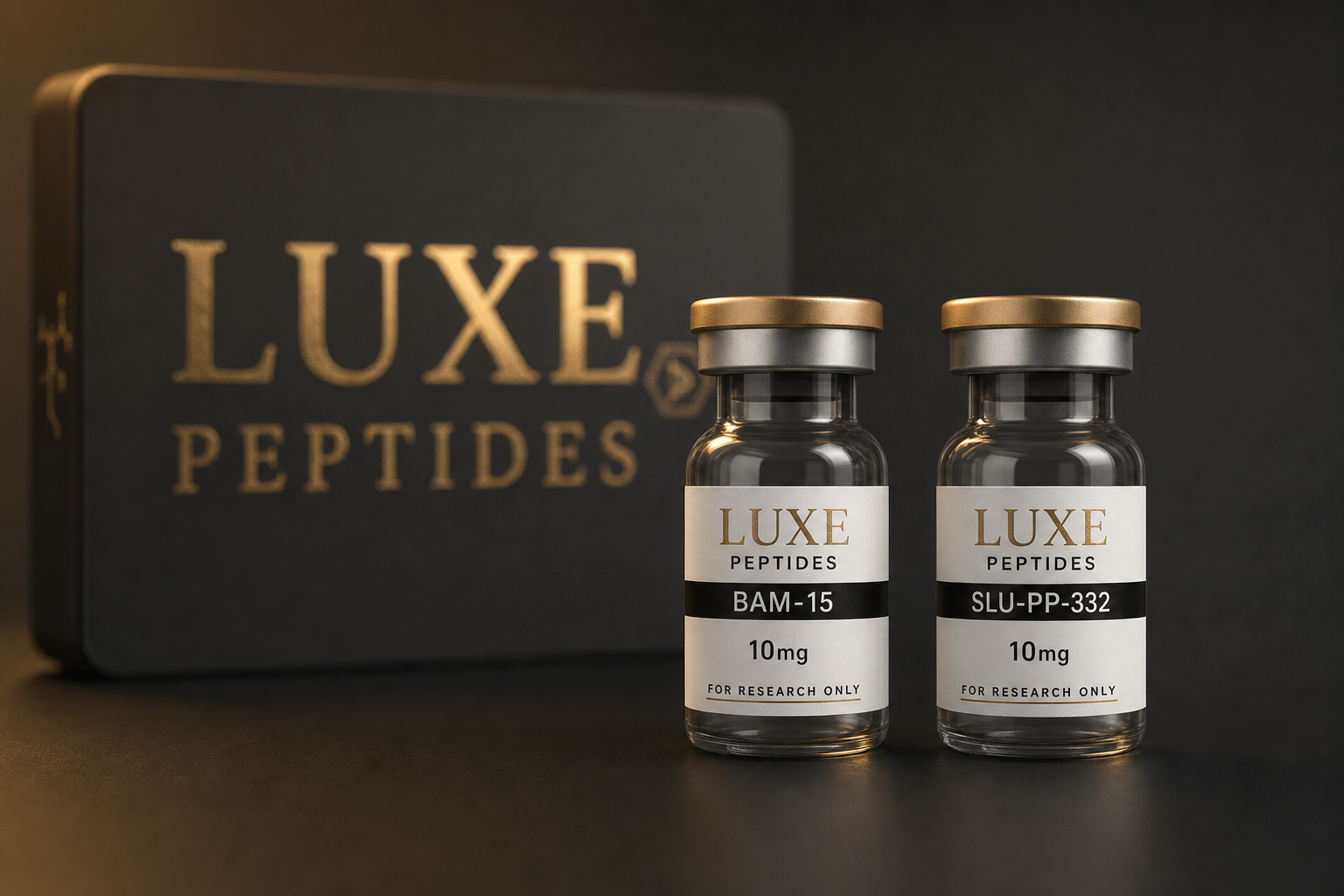
The following is provided for research and educational purposes only. BAM-15 and SLU-PP-332 are research chemicals intended solely for in vitro and preclinical laboratory use, not for human or veterinary consumption.
Researchers surveying the “exercise-mimetic” and metabolic literature frequently encounter BAM-15 and SLU-PP-332 in adjacent contexts, which invites a direct question: how do BAM-15 and SLU-PP-332 differ? The short answer is that they act at entirely different points in cellular energy metabolism. BAM-15 is a small-molecule mitochondrial uncoupler that operates at the inner mitochondrial membrane, while SLU-PP-332 is a synthetic agonist of the estrogen-related receptors (ERRs), a family of transcription factors. This article compares the two mechanisms as they have been characterized in preclinical models.
What BAM-15 is, in research terms
BAM-15 (chemically an N,N′-substituted fluorodinitroaniline) is described in the literature as a protonophore — a molecule that shuttles protons across the inner mitochondrial membrane, dissipating the proton-motive force that ATP synthase would otherwise use. In cell and animal studies it has been characterized as a mitochondrial uncoupler that reportedly increases oxygen consumption and substrate oxidation without, according to the original characterization, depolarizing the plasma membrane at the concentrations tested. Preclinical reports have examined its effects on mitochondrial respiration and on metabolic parameters in rodent models. Researchers often contrast it with the classical uncoupler 2,4-dinitrophenol (DNP); the published rationale for interest in BAM-15 is a reportedly wider separation between the concentration that uncouples mitochondria and the concentration associated with cytotoxicity in the systems studied.
What SLU-PP-332 is, in research terms
SLU-PP-332 is a synthetic agonist of the estrogen-related receptors (ERRα, ERRβ, and ERRγ), orphan nuclear receptors that regulate transcriptional programs governing mitochondrial biogenesis and oxidative metabolism. Rather than acting directly on the membrane, SLU-PP-332 has been studied as a compound that engages a receptor and, in preclinical models, is associated with changes in the expression of genes linked to oxidative fatty-acid metabolism and mitochondrial function. Because ERRs sit upstream of metabolic gene networks, investigators have described SLU-PP-332 in the exercise-mimetic research context — that is, as a tool to study, in animal and cell systems, some of the transcriptional signatures that physical activity is known to induce. All such findings to date are preclinical.
BAM-15 vs SLU-PP-332: mechanism comparison
| Attribute | BAM-15 | SLU-PP-332 |
|---|---|---|
| Molecular class | Small-molecule mitochondrial uncoupler (protonophore) | Synthetic pan-ERR (estrogen-related receptor) agonist |
| Site of action | Inner mitochondrial membrane | Nuclear receptor / transcriptional program |
| Proposed mechanism (preclinical) | Dissipates the proton gradient, uncoupling respiration from ATP synthesis | Activates ERR-driven transcription of mitochondrial and oxidative-metabolism genes |
| Timescale of effect studied | Acute / biochemical (membrane-level) | Delayed / transcriptional (gene-expression level) |
| Research framing commonly cited | Mitochondrial uncoupling agent | Exercise-mimetic candidate |
| Comparison reference in literature | Contrasted with 2,4-dinitrophenol (DNP) | Contrasted with other ERR/PGC-1α pathway modulators |
How the two mechanisms relate
The most useful way to hold the distinction is that the two compounds have been studied as if they act at opposite ends of the same energy pathway. BAM-15 is characterized as intervening at the physical membrane where the proton gradient is spent, making respiration less efficient in real time. SLU-PP-332 is characterized as intervening at the genome, where the machinery for oxidative metabolism is transcribed. In principle, one alters how existing mitochondria behave, while the other is studied for its association with the expression of mitochondrial and oxidative-metabolism genes. This conceptual complementarity is why some research groups have examined the two mechanisms side by side, and why a combined BAM-15 / SLU-PP-332 research blend exists as a distinct study article. Any combined use remains strictly a preclinical research question; no synergistic outcome should be assumed from the individual literature.
Handling and characterization notes for the laboratory
Both compounds are typically supplied as research powders and require reconstitution in an appropriate solvent for in vitro work; BAM-15 and SLU-PP-332 are both poorly water-soluble and are commonly handled in DMSO stock solutions in published protocols. Any preparation is laboratory arithmetic only and is not a dose for administration. Researchers verifying identity and purity should review the batch certificates of analysis (COAs), and those preparing stock concentrations for assays may find the reconstitution calculator useful for the underlying volume math. Product-level details for each compound are available on the BAM-15 research listing and the SLU-PP-332 research listing.
Summary
BAM-15 and SLU-PP-332 are not interchangeable and are not variants of one another. BAM-15 has been studied as a mitochondrial uncoupler acting biochemically at the inner membrane; SLU-PP-332 has been studied as an ERR agonist acting through transcriptional regulation. Both appear in the preclinical metabolic and exercise-mimetic literature, but they answer different mechanistic questions, and the available evidence for each is limited to in vitro and animal models.
Reviewed for research accuracy — July 13, 2026.
References
- Kenwood BM, et al. Identification of a novel mitochondrial uncoupler that does not depolarize the plasma membrane. Molecular Metabolism. 2014;3(2):114–123. PMID: 24634817.
- Alexopoulos SJ, et al. Nature Communications. 2020;11(1):2397. PMID: 32409697. (Title omitted; cited by authors, journal, volume and year.)
- Preclinical studies from the Burris laboratory (Saint Louis University) have characterized SLU-PP-332 as a synthetic pan-ERR agonist and examined its effects on oxidative-metabolism gene expression and exercise-associated transcriptional signatures in rodent models (2023). Consult the primary publications directly for study design and endpoints.
- Reviews of estrogen-related receptor (ERR) biology and mitochondrial biogenesis provide background on the transcriptional pathway targeted by ERR agonists; see current ERR / PGC-1α literature on PubMed.
Research use only. BAM-15 and SLU-PP-332 are not drugs, dietary supplements, or articles for human or animal consumption, and nothing above should be interpreted as medical, therapeutic, or performance guidance. Intended exclusively for licensed research settings.