

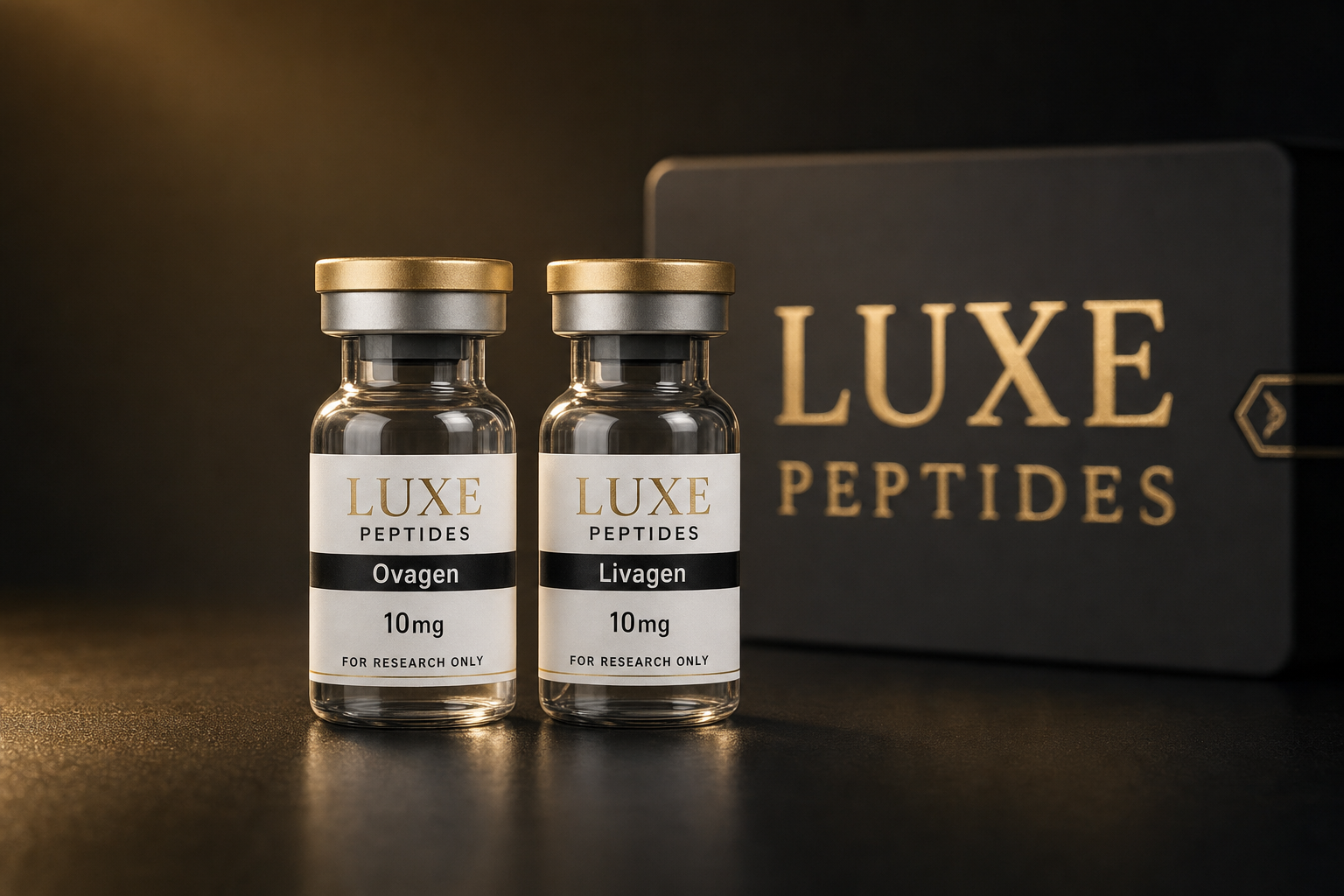
All compounds discussed here are supplied strictly for in vitro and laboratory research use only; they are not drugs, dietary supplements, or products intended for human or veterinary administration.
Ovagen is one of the most consistently misread entries in the Khavinson short-peptide catalog, and the reason is purely linguistic. The prefix reads as a reference to ovarian tissue, and a large share of the search traffic that reaches pages like this one arrives on that assumption. The assumption is incorrect. In the originating literature, Ovagen is a tripeptide — Glu-Asp-Leu, conventionally written EDL — carrying a hepatic and gastrointestinal tissue designation. Nothing in the source research assigns it to reproductive tissue of any kind.
That mismatch is worth correcting at the top rather than in a footnote. In a family whose members are distinguished from one another only by a three- or four-letter sequence, a name-driven misassumption is the quickest route to characterizing the wrong molecule.
Structure and physical identity
- Sequence: Glu-Asp-Leu (EDL), unmodified L-amino acids with free N- and C-termini
- Length: three residues
- Molecular formula: C15H25N3O8
- Nominal molecular weight: approximately 375.4 Da for the free peptide; acetate-salt material assays higher, which is why certificate mass and calculated mass rarely agree exactly
- Charge character: two acidic residues followed by a hydrophobic C-terminal leucine, giving a net-anionic peptide — structurally the opposite pole from the lysine-initiated bioregulators such as Vilon (KE) or Livagen (KEDA)
At roughly 375 Da, EDL is on the order of a tenth the mass of the mid-size research peptides that dominate the rest of the catalog. That size is central to the category’s mechanistic model rather than incidental to it: what the source literature proposes is not sustained receptor occupancy but transient access to the nuclear compartment.
The designation is hepatic and gastrointestinal
Each synthetic peptide in the Khavinson series carries an organ-system assignment inherited from the tissue fraction whose activity it was designed to reproduce, and those assignments are tabulated consistently across the group’s reviews and monographs. EDL appears in those tables under liver and gastrointestinal tract. Reports from this school describe the peptide in hepatocyte and rodent hepatic-tissue models and in gastrointestinal mucosal preparations; the endpoints reported are expression-level and histological rather than clinical, and they have not been reproduced in controlled human research.
Why the name points the wrong way
The names in this catalog are trade designations coined by the developing institute rather than systematic nomenclature, and they are under no obligation to encode the tissue assignment. Some do — Bronchogen and Cardiogen are transparent about it. Ovagen does not, and its resemblance to ovum is unrelated to how the compound is actually classified in the source work. The sequence, not the trade name, is the identifying fact.
The single-residue trap is worth spelling out, because it is the practical failure mode in this family. Ala-Glu-Asp-Leu (AEDL) is Bronchogen, designated for respiratory epithelium. Glu-Asp-Leu (EDL) is Ovagen, designated for hepatic and gastrointestinal tissue. The two share an identical C-terminal tripeptide, differ by a single N-terminal alanine, and are assigned to entirely different organ systems. Nothing about their appearance, solubility, or lyophilized mass distinguishes them at the bench.
Ovagen and Livagen
Livagen is the compound searchers most often pair with Ovagen, and the pairing is reasonable: it is the other liver-designated member of the series. Livagen is Lys-Glu-Asp-Ala (KEDA), a tetrapeptide built on the same basic N-terminal motif as Vilon (KE) and Vesugen (KED) rather than on EDL’s acidic opening. The two are liver-associated by designation but structurally unrelated, and they are not interchangeable in an experimental design.
Livagen also carries the larger primary literature of the two, and most of it concerns chromatin state rather than hepatic tissue directly: cultured human lymphocyte reports describing decondensation of heterochromatin and activation of ribosomal gene clusters following exposure to KEDA. Those are cell-culture endpoints in a small number of reports from a single group, and they are routinely overstated in secondary summaries.
Pancragen (Lys-Glu-Asp-Trp, KEDW) is included in the comparison below as the third member of the digestive-system group these two are usually cross-shopped against; its designation in the same tables is pancreatic tissue.
Comparison
| Ovagen | Livagen | Pancragen | |
|---|---|---|---|
| Sequence | Glu-Asp-Leu (EDL) | Lys-Glu-Asp-Ala (KEDA) | Lys-Glu-Asp-Trp (KEDW) |
| Residues | 3 | 4 | 4 |
| Formula | C15H25N3O8 | C18H31N5O9 | C26H36N6O9 |
| Nominal MW (free peptide) | ~375.4 Da | ~461.5 Da | ~576.6 Da |
| Tissue designation in the source literature | Liver and gastrointestinal tract | Liver | Pancreas |
| Structural class | Acidic N-terminus, hydrophobic C-terminus; net anionic | Lys-initiated KED- series tetrapeptide | Lys-initiated KED- series tetrapeptide, aromatic C-terminus |
| Where the primary reports concentrate | Hepatic and gastrointestinal tissue models | Lymphocyte chromatin and gene-activation studies | Pancreatic cell and carbohydrate-metabolism models |
The proposed mechanism, and its limits
The bioregulator literature assigns these peptides no cell-surface receptor. The proposed site of action is intracellular: fluorescently labeled short peptides have been reported to appear in the nuclei and nucleoli of cultured cells, and the same line of work described sequence-selective binding between labeled short peptides and synthetic deoxyribooligonucleotides in vitro. From those observations the group proposes that a given sequence interacts preferentially with particular promoter-region double-stranded DNA, with molecular-modeling reports suggesting accommodation in the major groove and a sensitivity to CG content and cytosine methylation state.
Applied to EDL, that model predicts a tissue-restricted transcriptional effect arising from sequence complementarity rather than from any targeting or delivery mechanism — which is also why the word “specific” in “tissue-specific peptide” describes a research framing rather than a demonstrated property. It remains a hypothesis with supporting in vitro data, not an established pathway. Independent blinded replication of the core DNA-binding and gene-expression findings is sparse, the great majority of primary reports originate from one research school and appeared in Russian-language journals, and EDL specifically has a thinner literature than the category’s reference compounds Vilon and Epitalon. None of these compounds is an approved drug in the United States or the European Union.
Verifying identity before an experiment
Because the confusable neighbors here are AEDL, KEDA, and KED, and because none of them can be told apart by eye, mass spectrometry is the decisive check — and it is a clean one, since the nominal masses are well separated: roughly 375 Da for EDL, 446 Da for AEDL, 461 Da for KEDA, and 577 Da for KEDW. HPLC purity data completes the picture. Current analytical documentation for the catalog is published in the COA library.
Handling follows the same conventions as any lyophilized research peptide: store as received per the accompanying certificate, and treat working concentration as ordinary laboratory arithmetic — mass of peptide divided by volume of diluent — using the reconstitution calculator. Those figures describe solution concentration for in vitro work and are not administration guidance of any kind.
References
- Khavinson VKh, Malinin VV. Gerontological Aspects of Genome Peptide Regulation. Karger, Basel; 2005. Monograph in which the synthesized short peptides and their organ-system designations, including EDL, are tabulated.
- Khavinson VKh. Peptides and ageing. Neuroendocrinology Letters. 2002; special issue — monograph-length review of the short-peptide bioregulator programme.
- Fedoreyeva LI, Kireev II, Khavinson VKh, Vanyushin BF. Penetration of short fluorescence-labeled peptides into the nucleus in HeLa cells and in vitro specific interaction of the peptides with deoxyribooligonucleotides and DNA. Biochemistry (Moscow). 2011;76(11).
- Anisimov VN, Khavinson VKh. Peptide bioregulation of aging: results and prospects. Biogerontology. 2010;11(2).
- Khavinson VKh, Solovyov AYu, Shataeva LK. Bulletin of Experimental Biology and Medicine. 2006 — molecular-modeling report on oligopeptide interaction with double-stranded DNA.
- Lezhava TA, Khavinson VKh, and colleagues. Bulletin of Experimental Biology and Medicine / Advances in Gerontology — reports of short-peptide-induced heterochromatin decondensation and ribosomal-gene activation in cultured human lymphocytes, the principal source for the KEDA chromatin observations described above.
- Preclinical reports describing EDL in hepatic and gastrointestinal tissue models are distributed across Russian-language gerontology and experimental-biology journals and are not consistently indexed with English-language abstracts; the primary Russian sources are the checkable record, not secondary summaries.
Reviewed for research accuracy: August 1, 2026
Research use only. The compounds described above are intended exclusively for laboratory research by qualified investigators. They are not approved for human or animal administration, diagnosis, treatment, or any other clinical application, and nothing on this page should be read as guidance for such use.