

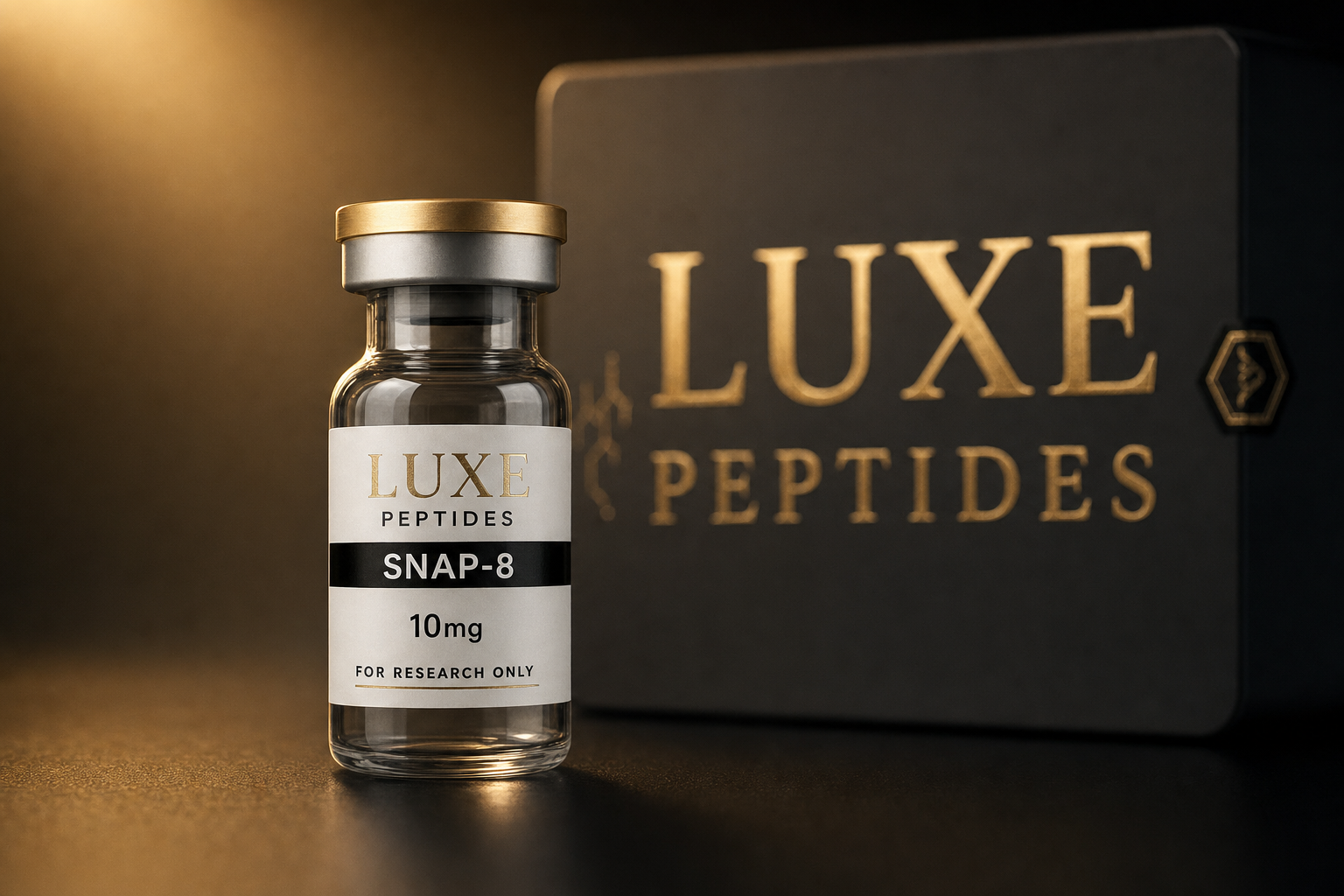
Research use only. The material below describes laboratory and preclinical findings for research reference; it is not medical, cosmetic, or human-use guidance, and the compound discussed is not for human or veterinary use.
SNAP-8, catalogued under the INCI designation acetyl octapeptide-3, is an eight-residue synthetic peptide that appears in the ingredient-science and neurobiology literature as a sequence mimetic of the N-terminal region of SNAP-25 — one of the three proteins that assemble into the neuronal SNARE complex. It is one of the more mechanistically specific claims made for a small synthetic peptide, and also one of the more frequently over-stated. This guide covers what the SNARE complex is, what the proposed in vitro mechanism for acetyl octapeptide-3 actually asserts, how that assertion is commonly contrasted with the enzymatic mechanism of botulinum neurotoxin type A (BoNT/A), and where the evidence base is thin. Product reference: SNAP-8 (acetyl octapeptide-3).
The SNARE complex in brief
SNARE proteins (soluble N-ethylmaleimide-sensitive factor attachment protein receptors) are the core machinery of regulated vesicle fusion. In the presynaptic terminal, three partners contribute four helical SNARE motifs to a single parallel four-helix bundle: syntaxin-1A and SNAP-25 on the plasma membrane, and VAMP-2 (synaptobrevin) on the vesicle membrane. SNAP-25 is unusual in contributing two motifs to the bundle rather than one, and it is anchored by palmitoylated cysteines rather than a transmembrane domain.
Assembly is generally modelled as progressive N-to-C “zippering”: the four motifs nucleate at their membrane-distal N-terminal ends and zipper toward the membranes, and the free energy released as the bundle forms is what pulls the two bilayers into contact. Crystallographic work on the assembled ternary complex resolved the bundle’s layered hydrophobic core and the central ionic layer, and biochemical reconstitution established that these three proteins are sufficient to drive fusion in defined systems. The relevant point for any small-molecule or peptide modulator is that the N-terminal nucleation step is the rate-limiting and most interference-susceptible stage of assembly.
Chemistry of acetyl octapeptide-3
The molecule is a linear octapeptide, Ac-Glu-Glu-Met-Gln-Arg-Arg-Ala-Asp-NH2 (single-letter: EEMQRRAD), with an acetylated N-terminus and an amidated C-terminus, giving a molecular weight of approximately 1,075 Da. Both terminal caps neutralise the charges that a free peptide terminus would carry and reduce susceptibility to exopeptidase trimming — a standard stabilisation strategy for short synthetic peptides.
The sequence corresponds to a segment within the N-terminal SNARE motif region of SNAP-25. It is also a two-residue extension of the better-known hexapeptide analogue acetyl hexapeptide-8 (EEMQRR), which shares the same core motif; the added Ala-Asp is the structural difference between the two, and comparative claims between them rest largely on in vitro assay data rather than on independent structural work.
The proposed mechanism: competition, not cleavage
The mechanism attributed to acetyl octapeptide-3 in the ingredient literature is competitive interference with SNAP-25 incorporation into the SNARE complex. The proposal runs as follows: because the peptide reproduces part of the SNAP-25 N-terminal interaction surface, a soluble excess of it is described as engaging the nascent syntaxin/VAMP interface and reducing the efficiency with which full-length SNAP-25 nucleates into the four-helix bundle. Assemblies formed in the presence of the peptide are described as less stable or slower to form, and in vitro assays — typically catecholamine release from chromaffin cells, the classical model system for SNARE-dependent exocytosis — have been reported to show reduced stimulated release under peptide exposure.
Several features of this proposal deserve to be stated plainly, because they are frequently lost in summary:
- It is stoichiometric, not catalytic. A competitive mimetic must be present in molar excess and occupies its target only while bound. One peptide molecule interferes with, at most, one assembly event.
- Nothing is cleaved. SNAP-25 is not modified, degraded, or permanently inactivated in this model; the proposed effect is reversible on washout.
- The buried surface is small. A SNARE motif is on the order of 60–70 residues. An eight-residue fragment reproduces a small fraction of that interface, and the affinity of such a fragment for a partially assembled complex is correspondingly modest.
- Barrier penetration is a recognised limitation. A ~1,075 Da peptide carrying two arginines and three acidic residues is a poor candidate for passive diffusion across biological membranes, which is why in vitro assay results and formulated-system behaviour are not interchangeable.
Research in this area therefore supports a mechanistic hypothesis with in vitro support, not an established quantitative effect.
Mechanistic contrast with botulinum neurotoxin type A
The comparison to BoNT/A is made constantly, and it is worth being precise about what the two mechanisms share: only the target protein. BoNT/A is a ~150 kDa bacterial protein whose light chain is a zinc-dependent endopeptidase. After receptor-mediated uptake and translocation into the cytosol of a neuron, it cleaves SNAP-25 between Gln197 and Arg198, removing nine C-terminal residues and producing a truncated protein that can no longer support productive SNARE zippering. That is a catalytic, covalent, and functionally durable event; a single light-chain molecule can process many substrate molecules.
| Property | Acetyl octapeptide-3 (SNAP-8) | Botulinum neurotoxin type A (BoNT/A) |
|---|---|---|
| Molecular class | Synthetic octapeptide, ~1,075 Da | Bacterial protein toxin, ~150 kDa |
| Molecular target | N-terminal SNARE assembly interface | SNAP-25 polypeptide chain |
| Mode of action (as described) | Competitive occupancy / mimicry | Zinc-dependent proteolysis |
| SNAP-25 covalently altered? | No | Yes — cleaved at Gln197–Arg198 |
| Stoichiometry | Stoichiometric; molar excess required | Catalytic; one enzyme, many substrates |
| Reversibility in vitro | Reversible on washout | Not reversible; requires protein turnover |
| Cell entry | Passive; poor for a charged peptide | Receptor-mediated, high-efficiency |
| Evidence base | Limited in vitro data, largely unreplicated | Extensive indexed primary literature |
The two mechanisms are placed side by side because they converge on the same protein, not because they are alternatives to one another. No equivalence of potency, kinetics, or biological consequence is implied by the comparison, and none is supported by the available data.
What the evidence base supports — and what it does not
The SNARE biology underlying the hypothesis is exceptionally well established: the complex’s composition, structure, assembly order, and its cleavage by clostridial neurotoxins are all supported by decades of indexed primary literature. The peptide-specific layer is not. Much of the primary in vitro characterisation of acetyl octapeptide-3 and its hexapeptide analogue originates in ingredient-manufacturer technical documentation and conference material rather than independently replicated, peer-reviewed studies, and independent structural evidence of the peptide bound to a partially assembled SNARE complex does not appear to have been published. Researchers designing work in this area should treat the competitive-mimetic model as a testable hypothesis and build in the controls — scrambled-sequence peptide, concentration-response range, washout arm — that the existing datasets largely lack. Analytical documentation for material on hand is in the COA library.
Laboratory handling and arithmetic
Acetyl octapeptide-3 is supplied lyophilised and is readily water-soluble owing to its two glutamates, aspartate, and two arginines. Standard practice for short synthetic peptides applies: store the lyophilised powder cold and desiccated, protect from repeated freeze–thaw cycles once in solution, and account for the methionine residue, which is oxidation-prone and can complicate mass-spectrometric identity checks on aged stock. Concentration arithmetic for stock preparation — mass of peptide over volume of diluent, converted to the molarity an assay protocol calls for — can be worked through with the reconstitution calculator. This is laboratory arithmetic for in vitro work, not administration guidance.
A different mechanistic class for comparison
Researchers surveying this category often place acetyl octapeptide-3 alongside GHK-Cu, but the two share nothing mechanistically. GHK-Cu is a copper-binding tripeptide studied for copper coordination and transcriptional modulation across broad gene sets in cultured cells — a signalling and metal-transport mechanism operating on gene expression timescales, not an interference mechanism acting on a presynaptic protein complex within milliseconds. They belong in the same catalogue, not in the same mechanistic comparison.
References
- Söllner T, Whiteheart SW, Brunner M, et al. Nature. 1993;362(6418):318–324. PMID: 8455717.
- Blasi J, Chapman ER, Link E, et al. Nature. 1993;365(6442):160–163. PMID: 8103915.
- Sutton RB, Fasshauer D, Jahn R, Brunger AT. Nature. 1998;395(6700):347–353. PMID: 9759724.
- Schiavo G, Matteoli M, Montecucco C. Physiological Reviews. 2000;80(2):717–766. PMID: 10747206.
- Jahn R, Scheller RH. Nature Reviews Molecular Cell Biology. 2006;7(9):631–643. PMID: 16912714.
- Südhof TC, Rothman JE. Science. 2009;323(5913):474–477. PMID: 19164740.
- Blanes-Mira C, Clemente J, Jodas G, et al. International Journal of Cosmetic Science. 2002;24(5):303–310. (Title omitted; the hexapeptide-analogue in vitro study most often cited in this area.)
- Primary in vitro data specific to acetyl octapeptide-3 appears largely in ingredient-manufacturer technical literature rather than indexed primary research; those datasets are cited generically here because independent replication is not available.
Reviewed for research accuracy — 1 August 2026.
Research use only. This compound is intended solely for in vitro laboratory research and is not for human or veterinary use, diagnostic use, or use in any food, drug, or cosmetic product.