

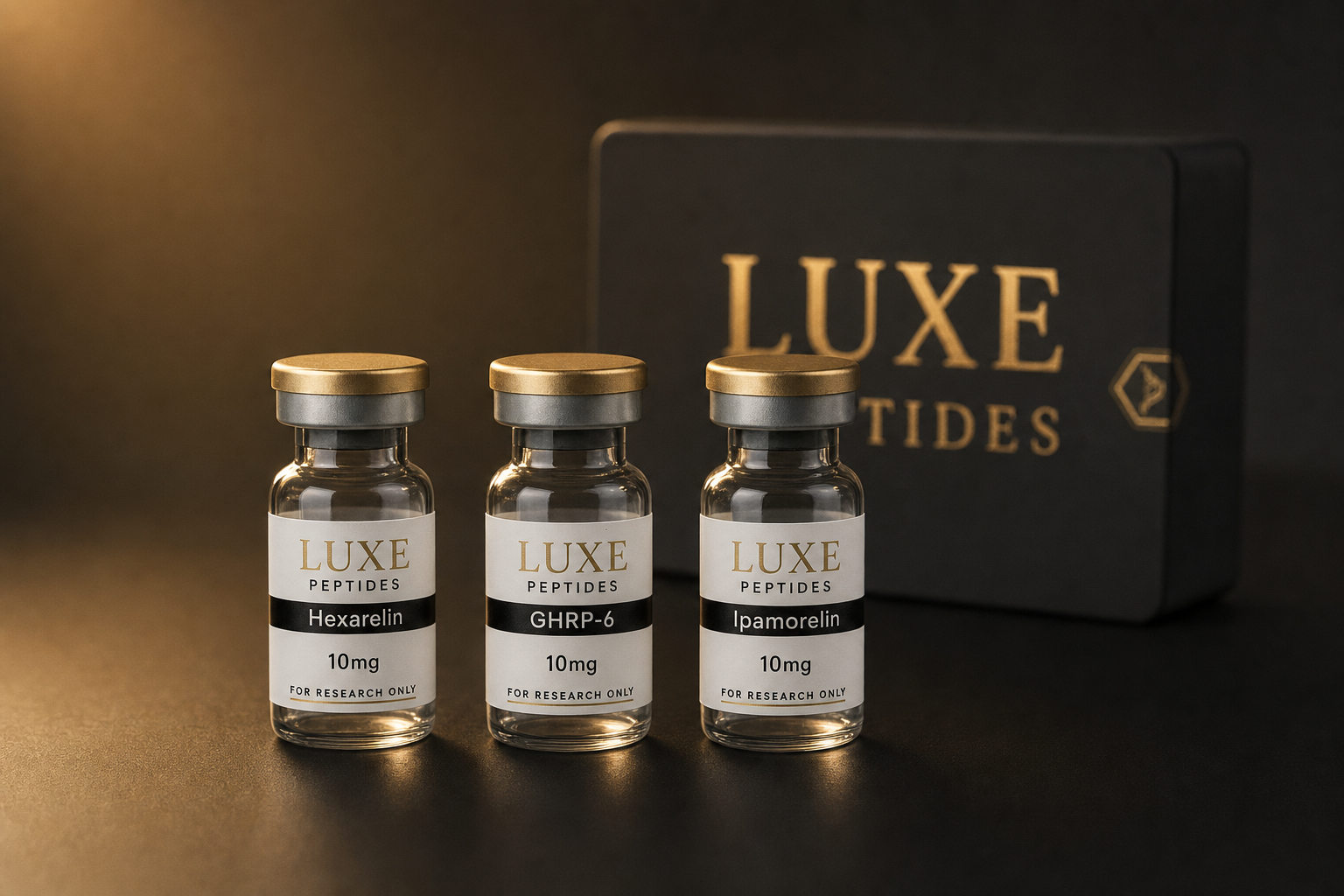
For research use only. The material below summarizes published laboratory and preclinical literature; it is not intended for human or veterinary use, and nothing here describes administration of any kind.
Hexarelin is a synthetic hexapeptide in the growth hormone-releasing peptide (GHRP) family — a class of small, non-natural molecules that stimulate growth hormone (GH) release from pituitary somatotrophs through a receptor entirely separate from the growth hormone-releasing hormone (GHRH) receptor. It is among the most extensively characterized compounds in the secretagogue literature, and it is the compound that first exposed a second, non-pituitary binding partner for this chemical class: the scavenger receptor CD36.
This guide covers receptor pharmacology only. It describes what has been reported for hexarelin in cell, tissue and animal models, and how those reports position it alongside GHRP-6 and ipamorelin in comparative preclinical work.
Structure and origin
Hexarelin is His-D-2-methyl-Trp-Ala-Trp-D-Phe-Lys-NH2. Its lineage is direct and worth stating precisely, because it explains most of the pharmacological overlap researchers observe: hexarelin is GHRP-6 (His-D-Trp-Ala-Trp-D-Phe-Lys-NH2) carrying a single methyl group at position 2 of the indole ring of the D-tryptophan residue. That one substitution has been reported to increase resistance to enzymatic degradation and to raise potency in rodent models relative to the parent hexapeptide.
Both molecules descend from the met-enkephalin-derived peptides described by Bowers and colleagues, whose 1984 work established that a short synthetic sequence could act directly on the pituitary to release GH without engaging the GHRH receptor. Ipamorelin sits in a different structural lineage: it is a pentapeptide (Aib-His-D-2-Nal-D-Phe-Lys-NH2) developed later and deliberately designed around endocrine selectivity rather than raw potency.
GHS-R1a: the shared target
The receptor these compounds share was cloned by Howard and colleagues in 1996 and named the growth hormone secretagogue receptor (GHS-R). It remained an orphan receptor until 1999, when Kojima and colleagues identified ghrelin as its endogenous acylated ligand — meaning the synthetic peptides were characterized before the natural signalling system they act on was known.
GHS-R1a is a Gq/11-coupled G-protein-coupled receptor. Ligand binding has been reported to activate phospholipase C, generate inositol trisphosphate, and mobilize intracellular calcium in somatotrophs. That pathway is mechanistically distinct from the Gs/cAMP signalling of the GHRH receptor, which is the accepted explanation for the synergistic GH release observed when both receptors are engaged in vitro and in animal models. GHS-R1a is also expressed in hypothalamic nuclei, where secretagogue binding has been associated in animal studies with reduced somatostatinergic tone — an indirect contribution to the observed response. A splice variant, GHS-R1b, is truncated and has not been shown to signal in response to these ligands.
CD36: the binding site that separates hexarelin from ipamorelin
The finding that distinguishes hexarelin in the literature emerged from cardiac tissue. Radiolabelled hexarelin binding in cardiac membrane preparations could not be displaced by GHS-R1a ligands, indicating a distinct site. Bodart and colleagues subsequently identified that site as CD36, a class B scavenger receptor better known for recognizing oxidized LDL, long-chain fatty acids and thrombospondin. Demers and colleagues later mapped the GHRP cross-linking region on CD36 directly by photoaffinity labelling.
Two points of precision matter here. First, CD36 binding is a property of the GHRP chemical class rather than of hexarelin uniquely — GHRP-6 has also been reported to interact with it — but hexarelin is by a wide margin the best characterized ligand at this site. Second, the contrast that holds cleanly is with ipamorelin, which is not a GHRP-6 analogue and has not been reported to bind CD36. Researchers comparing these three compounds therefore treat CD36 as the axis separating the GHRP-derived molecules from the selective pentapeptide.
Supporting evidence for the site being functionally real, rather than an artefact of binding assays, came from CD36-null animals, in which the coronary perfusion changes observed in wild-type isolated hearts were reported absent. Related work produced azapeptide analogues that retain CD36 affinity with minimal GH-releasing activity, which indicates the two activities are pharmacologically separable.
The three compounds side by side
| Attribute | Hexarelin | GHRP-6 | Ipamorelin |
|---|---|---|---|
| Class / length | GHRP hexapeptide (6 aa) | GHRP hexapeptide (6 aa) | Pentapeptide (5 aa) |
| Sequence | His-D-2-Me-Trp-Ala-Trp-D-Phe-Lys-NH2 | His-D-Trp-Ala-Trp-D-Phe-Lys-NH2 | Aib-His-D-2-Nal-D-Phe-Lys-NH2 |
| Primary receptor | GHS-R1a | GHS-R1a | GHS-R1a |
| Reported CD36 interaction | Yes — the best-characterized GHRP ligand at CD36 | Reported for the class; less extensively characterized | Not reported |
| Endocrine selectivity in the literature | Concurrent ACTH, cortisol and prolactin release reported alongside GH | Similar cross-release reported | GH release without concurrent ACTH or cortisol elevation in the models tested |
| Typical research framing | High-potency, pleiotropic; cardiac and CD36 pharmacology | The parent GHRP; reference compound for the class | The selectivity comparator |
Selectivity as a research variable
The selectivity row above is the practical reason all three appear together in comparative studies. Raun and colleagues characterized ipamorelin as the first selective GH secretagogue precisely because, in the models examined, it released GH without the concurrent corticotropic and lactotropic responses reported for the GHRP hexapeptides. For an investigator designing a study, that difference determines whether observed downstream changes can be attributed to the GH axis alone or must be controlled for additional pituitary output. Hexarelin’s broader endocrine profile is not a flaw in the compound; it is a confound that has to be designed around.
Receptor desensitization
Repeated or sustained GHS-R1a engagement has been reported to attenuate the GH response over time, an effect attributed in the literature to receptor downregulation together with negative feedback from IGF-1 and somatostatin. The methodological consequence is straightforward: acute-response data from single-exposure models do not extrapolate to continuous-exposure models, and comparisons drawn between studies using different exposure designs are not equivalent.
What the literature does not establish
- The physiological significance of CD36 binding outside rodent and isolated-tissue models remains unresolved.
- Cardiac observations reported in hypophysectomized rats suggest the effects are GH-independent, but the downstream signalling from CD36 is not fully mapped.
- Most human pharmacology data for hexarelin dates from the 1990s; there is no modern controlled clinical evidence base, and none of this literature supports any therapeutic conclusion.
Laboratory notes
Because the GHRP hexapeptides differ by a single methyl group, identity and purity documentation is not a formality — analytical data is the only way to distinguish them in hand. Third-party analysis for catalog compounds is published in the COA library. For preparing stock solutions of known molar concentration, the reconstitution calculator handles the arithmetic of solute mass against solvent volume as a straightforward laboratory calculation.
References
- Bowers CY, Momany FA, Reynolds GA, Hong A. On the in vitro and in vivo activity of a new synthetic hexapeptide that acts on the pituitary to specifically release growth hormone. Endocrinology. 1984;114:1537-1545. PMID: 6714155
- Deghenghi R, Cananzi MM, Torsello A, Battisti C, Müller EE, Locatelli V. GH-releasing activity of Hexarelin, a new growth hormone releasing peptide, in infant and adult rats. Life Sci. 1994;54:1321-1328. PMID: 7910650
- Howard AD, Feighner SD, Cully DF, et al. A receptor in pituitary and hypothalamus that functions in growth hormone release. Science. 1996;273:974-977. PMID: 8688086
- Kojima M, Hosoda H, Date Y, Nakazato M, Matsuo H, Kangawa K. Ghrelin is a growth-hormone-releasing acylated peptide from stomach. Nature. 1999;402:656-660. PMID: 10604470
- Raun K, Hansen BS, Johansen NL, et al. Ipamorelin, the first selective growth hormone secretagogue. Eur J Endocrinol. 1998;139:552-561. PMID: 9849822
- Bodart V, Febbraio M, Demers A, et al. CD36 mediates the cardiovascular action of growth hormone-releasing peptides in the heart. Circ Res. 2002;90:844-849. PMID: 11988484
- Demers A, McNicoll N, Febbraio M, et al. Identification of the growth hormone-releasing peptide binding site in CD36: a photoaffinity cross-linking study. Biochem J. 2004;382:417-424. PMID: 15176951
- Muccioli G, Ghè C, Ghigo MC, et al. Specific receptors for synthetic GH secretagogues in the human brain and pituitary gland. J Endocrinol. 1998;157:99-106.
- Locatelli V, Rossoni G, Schweiger F, et al. Growth hormone-independent cardioprotective effects of hexarelin in the rat. Endocrinology. 1999;140:4024-4031.
- Ghigo E, Arvat E, Muccioli G, Camanni F. Growth hormone-releasing peptides. Eur J Endocrinol. 1997;136:445-460.
Reviewed for research accuracy: August 1, 2026.
For research use only. Not for human or veterinary use. This article describes published preclinical findings and makes no claim regarding safety, efficacy, or any outcome in humans.