

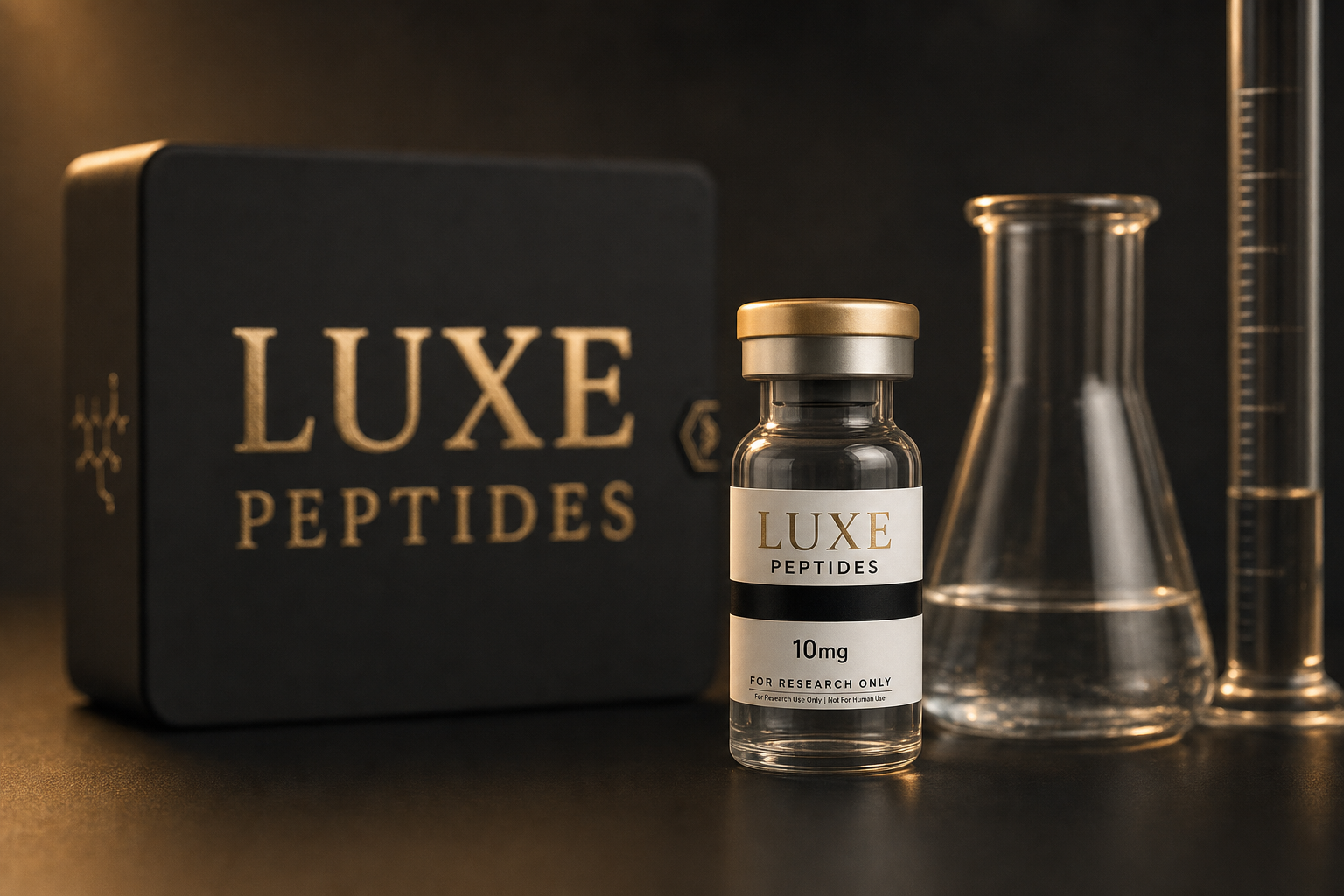
For laboratory and research use only. The following describes standard laboratory handling of research compounds and is not intended for human or veterinary use, diagnosis, or treatment.
Most research peptides ship as a lyophilized (freeze-dried) powder because the solid state is far more stable than a solution during transit and storage. Before a peptide can be used in an assay it must be reconstituted — dissolved back into a liquid at a known concentration. This guide walks through the materials, the arithmetic, and the storage practices researchers use to prepare a reconstituted stock. For rapid concentration calculations, keep the peptide reconstitution calculator open alongside this page.
What lyophilization is and why it matters
Lyophilization removes water from a frozen peptide under vacuum, leaving a dry cake or film in the vial. In this state peptide bonds and side chains are relatively protected from hydrolysis and oxidation. Reconstitution reverses that: once the powder is back in solution, chemical and enzymatic degradation pathways become active again, which is why reconstituted stocks are handled cold and used within a defined window. Confirming the identity and purity of the starting material against its certificate of analysis — see the COA library — is standard practice before any reconstitution.
Materials researchers typically assemble
- The lyophilized peptide vial, brought to room temperature while still sealed to prevent condensation on the cold powder.
- A reconstitution solvent — most commonly bacteriostatic water (sterile water with ~0.9% benzyl alcohol), which resists microbial growth in multi-draw laboratory vials. Sterile or distilled water is used where a preservative-free solvent is required.
- A graduated syringe or micropipette appropriate to the transfer volume.
- Alcohol wipes for the vial stoppers.
- Labels for recording concentration and preparation date.
Some hydrophobic peptides do not fully dissolve in water and are documented in the literature as requiring a small fraction of a co-solvent (for example dilute acetic acid or bacteriostatic saline) before dilution into the working buffer. The certificate of analysis and published solubility data for the specific sequence should guide solvent choice.
Step-by-step reconstitution procedure
The following describes bench technique for preparing a stock solution; all volumes below are laboratory arithmetic, not administration instructions.
- Equilibrate. Let both the peptide vial and the solvent reach room temperature.
- Sanitize. Wipe both rubber stoppers with alcohol and let them dry.
- Draw the solvent. Withdraw the chosen volume of bacteriostatic water into the syringe (the volume is chosen to hit a target concentration — see the math below).
- Add slowly. Insert the needle and let the solvent run down the inside wall of the vial rather than jetting directly onto the powder. Peptides are shear-sensitive; a gentle stream limits foaming and denaturation.
- Dissolve without shaking. Swirl gently or let the vial stand until the cake fully dissolves. Do not vortex or shake vigorously — agitation and air introduction can fragment or aggregate the peptide.
- Inspect. A properly reconstituted stock is clear and free of visible particulate. Persistent cloudiness suggests incomplete solubility and points back to solvent selection.
- Label immediately. Record the concentration and date on the vial before it goes into storage.
Concentration math
Reconstitution concentration is simply the mass of peptide in the vial divided by the volume of solvent added:
Concentration = peptide mass ÷ solvent volume
The practical variable a researcher controls is the solvent volume. Adding more water yields a lower concentration and a larger measured volume per unit of peptide; adding less water yields a more concentrated stock. Two worked examples, expressed in milligrams and milliliters:
| Peptide in vial | Bacteriostatic water added | Resulting concentration | Peptide per 0.1 mL |
|---|---|---|---|
| 5 mg | 2 mL | 2.5 mg/mL | 0.25 mg |
| 5 mg | 5 mL | 1.0 mg/mL | 0.10 mg |
| 10 mg | 2 mL | 5.0 mg/mL | 0.50 mg |
Concentrations are often converted to micrograms for fine measurements: 1 mg/mL equals 1000 µg/mL, so 0.1 mL of a 1 mg/mL stock contains 100 µg. Rather than working these by hand, the peptide reconstitution calculator takes the vial mass and target concentration and returns the exact solvent volume — the fastest way to avoid an arithmetic error at the bench.
Storage and stability
Storage practice follows the state of the material:
- Lyophilized powder is the most stable form. Sealed and kept cold (refrigerated for short holds, frozen at −20 °C or below for longer holds), many sequences remain stable for months to years, per manufacturer and literature stability data.
- Reconstituted stock is far less stable. Refrigerated at 2–8 °C, most reconstituted peptides are documented as usable for a matter of weeks; the benzyl alcohol in bacteriostatic water suppresses microbial growth but does not stop chemical degradation.
- Freeze–thaw cycles are a known source of degradation. Where a stock will be used over time, researchers commonly aliquot it into single-use fractions so the bulk is thawed only once. Repeated freezing and thawing is associated with peptide fragmentation and loss of measurable activity in stability studies.
Protect vials from light and record the reconstitution date on every label so age can be tracked against the assay timeline.
Common handling errors
- Directing the solvent stream onto the powder or shaking the vial, both of which promote foaming and denaturation.
- Choosing water for a peptide the literature documents as poorly water-soluble, producing a cloudy, incompletely dissolved stock.
- Leaving a reconstituted stock at room temperature between uses.
- Failing to label concentration and date, which makes downstream calculations unverifiable.
References
- Manning MC, Chou DK, Murphy BM, Payne RW, Katayama DS. Stability of protein pharmaceuticals: an update. Pharmaceutical Research. 2010;27(4):544–575. PMID: 20143256.
- Wang W. Lyophilization and development of solid protein pharmaceuticals. International Journal of Pharmaceutics. 2000;203(1–2):1–60. PMID: 10967427.
- Manning MC, Patel K, Borchardt RT. Stability of protein pharmaceuticals. Pharmaceutical Research. 1989;6(11):903–918. PMID: 2687836.
- Preclinical and analytical studies on peptide solubility and reconstitution solvent selection have examined co-solvent requirements for hydrophobic sequences; consult the compound-specific certificate of analysis for documented solubility.
For laboratory and research use only. Not for human or veterinary use. Nothing above is a dosing instruction or a recommendation to administer any compound; all volumes are laboratory calculations for preparing research stock solutions.