

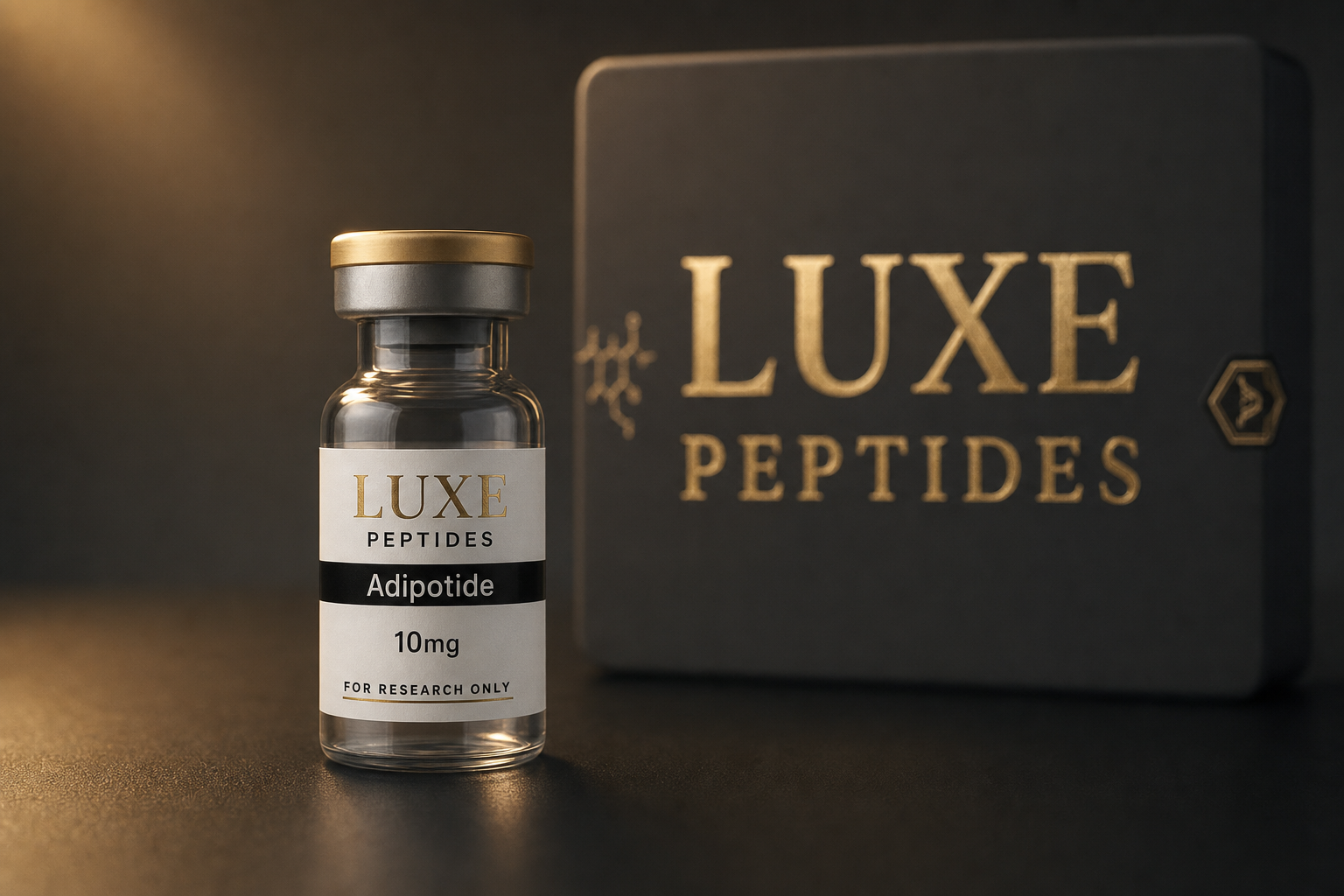
The information below is provided strictly for laboratory research and educational purposes; Adipotide (FTTP) is not approved for human or veterinary use, diagnosis, or treatment.
Adipotide, frequently written as FTTP and cataloged for research as a prohibitin-targeting peptidomimetic, is one of the more mechanistically distinctive compounds studied in adipose-vascular biology. Unlike receptor-agonist peptides, Adipotide was designed as a two-domain chimeric molecule that couples a vascular-homing motif to a proapoptotic effector. This overview summarizes what the FTTP designation refers to, how the CKGGRAKDC targeting motif is understood to engage prohibitin, and the preclinical contexts in which researchers have examined the molecule. All observations described here derive from animal-model and in vitro literature.
What the FTTP designation refers to
In the research literature, FTTP is treated as a functional label rather than a formal chemical name. The molecule is also referenced as adipotide and, in early work, as prohibitin-targeting peptide-1 (PTP-1). Structurally, it is a bipartite construct: a short targeting peptide fused through a glycinyl linker to a synthetic proapoptotic sequence. The design intent, as reported by its originators, was to direct a membrane-disrupting effector specifically toward the microvasculature that supplies white adipose tissue in research models, rather than acting on adipocytes directly.
| Structural component | Sequence / element | Reported role in research models |
|---|---|---|
| Targeting motif | CKGGRAKDC (cyclic) | Studied as a ligand that homes to prohibitin displayed on adipose-associated vascular endothelium |
| Linker | GG (glycine-glycine) | Spacer connecting the two functional domains |
| Proapoptotic domain | D(KLAKLAK)₂ | Amphipathic sequence observed to disrupt mitochondrial membranes and trigger apoptosis once internalized |
The CKGGRAKDC targeting motif and prohibitin
The targeting arm of Adipotide is the cyclic nonapeptide CKGGRAKDC. In phage-display screening of vascular beds, this motif was identified as binding prohibitin, a conserved chaperone protein that is typically mitochondrial but that has been reported on the luminal surface of endothelial cells associated with white fat in animal models. Prohibitin’s appearance as a cell-surface marker in this vascular compartment is what gave the motif its apparent selectivity in preclinical studies: researchers observed the peptide accumulating in adipose-associated vasculature rather than distributing uniformly across tissues.
It is worth emphasizing that prohibitin biology is complex and context-dependent. Its role as an accessible surface receptor has been characterized primarily in rodent and non-human primate vasculature, and the degree to which the CKGGRAKDC interaction generalizes across species remains an open research question rather than a settled fact.
The proapoptotic domain mechanism
The effector arm is D(KLAKLAK)₂, a D-amino-acid form of a synthetic amphipathic peptide. In isolation this sequence is comparatively inert toward intact cells because it does not readily cross the plasma membrane. Preclinical work indicates that once the targeting motif promotes internalization, the (KLAKLAK)₂ domain interacts with the negatively charged mitochondrial membrane, disrupting membrane integrity and initiating the intrinsic apoptotic cascade. The D-amino-acid configuration was reportedly chosen to reduce proteolytic degradation. The same proapoptotic module has been examined in other targeted constructs in the oncology literature, which is where its mitochondrial mechanism was first described.
The conceptual model that emerges from this literature is a conditional one: the effector is understood to become active predominantly where the targeting motif concentrates it. Researchers have framed Adipotide as a proof-of-concept for ligand-directed apoptosis of a supporting vascular bed rather than of the parenchymal cells themselves.
Preclinical research contexts
Two bodies of animal-model work anchor most discussion of FTTP. The foundational rodent study characterized targeted ablation of adipose vasculature and the associated changes in adipose tissue in the animal models studied, with the authors describing apparent reversibility and resorption of adipose depots. A later study extended the same targeting approach to a non-human primate model, characterizing the compound’s distribution and its handling by the kidney. The reported endpoints are properties of those specific animal models and are not evidence of any effect in humans.
These findings are frequently cited precisely because they illustrate an unusual mechanism — acting on the vascular supply of a tissue — not because they establish any outcome outside the animal models studied. Renal exposure in particular has been flagged in the primate literature as a key parameter researchers monitor, underscoring that the compound’s biodistribution is an active subject of study rather than a resolved one.
Handling and characterization for research use
Adipotide is typically supplied as a lyophilized powder for laboratory reconstitution. Researchers planning in vitro or animal-model work generally document lot identity against a certificate of analysis and calculate working concentrations as straightforward laboratory arithmetic. Luxe Peptides provides third-party analytical documentation through its COA library, and molar and mass conversions for reconstitution can be worked through with the peptide reconstitution calculator. Product details for the research material are available on the Adipotide (FTTP) listing.
Research status and limitations
Adipotide has not advanced to any approved application, and the available data remain overwhelmingly preclinical. Species differences in prohibitin surface expression, the compound’s renal handling, and questions about durability of any observed effects all remain open. For researchers, the value of FTTP lies in what it demonstrates about ligand-directed apoptosis and vascular targeting as experimental strategies — not in any inference about human physiology, which the current literature does not support.
References
- Kolonin MG, Saha PK, Chan L, Pasqualini R, Arap W. Nat Med. 2004;10(6):625–632. PMID: 15133506.
- Barnhart KF, Christianson DR, Hanley PW, et al. Sci Transl Med. 2011;3(108):108ra112. PMID: 22072637.
- Ellerby HM, Arap W, Ellerby LM, et al. Anti-cancer activity of targeted pro-apoptotic peptides. Nat Med. 1999;5(9):1032–1038. PMID: 10470080.
- Reviews of prohibitin as a multifunctional chaperone and its reported cell-surface roles provide additional background on the CKGGRAKDC target (see prohibitin biology literature in J Cell Mol Med and related journals).
Reviewed for research accuracy — 2026-07-13. This article is for laboratory research and educational use only. Adipotide (FTTP) is not a drug, supplement, or medical product and is not intended for human or animal administration, diagnosis, treatment, or prevention of any condition.