

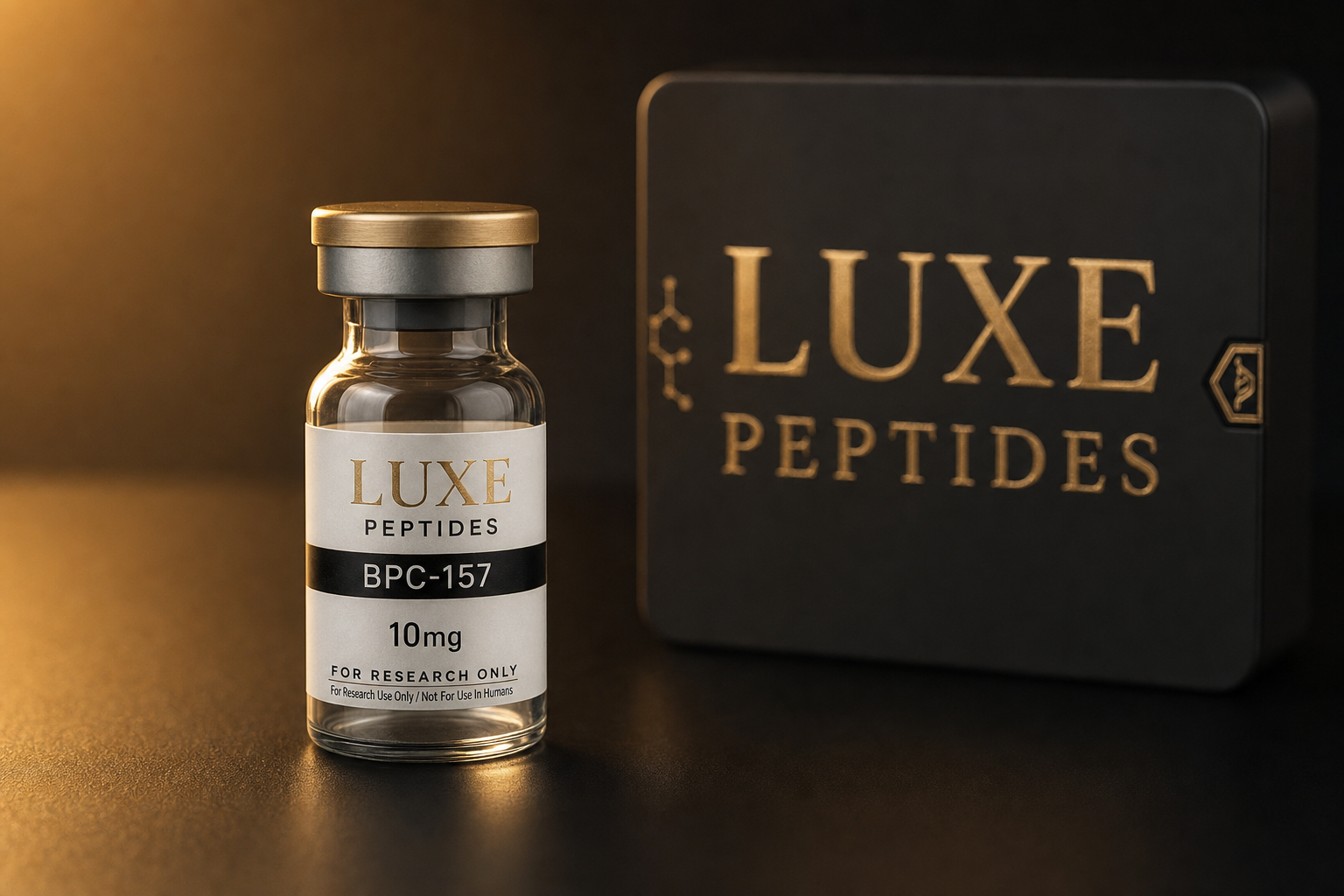
Research use only: BPC-157 is supplied strictly for in vitro and laboratory research and is not intended for human or veterinary use, food, or any diagnostic or therapeutic application.
BPC-157 is one of the most frequently studied synthetic peptides in the preclinical tissue-repair literature, with published work spanning in vitro cell culture, rodent injury models, and mechanistic signaling studies. Its prominence in the literature is not the same thing as clinical validation, and the two are easy to conflate. This overview summarizes what the peer-reviewed preclinical record actually describes, what remains unestablished, and how laboratories typically characterize and handle the material.
Molecular identity
BPC-157 is a synthetic pentadecapeptide with the sequence Gly-Glu-Pro-Pro-Pro-Gly-Lys-Pro-Ala-Asp-Asp-Ala-Gly-Leu-Val (GEPPPGKPADDAGLV), corresponding to a partial sequence of a protein isolated from human gastric juice. Its molecular formula is C62H98N16O22 with a monoisotopic mass near 1419.5 Da. The BPC designation refers only to the parent protein from which the fragment was derived; it carries no established meaning about activity in any organism.
Two physicochemical properties explain much of its experimental popularity. First, it is freely soluble in water and requires no organic co-solvent or acidification for reconstitution. Second, it has been reported to remain intact in human gastric juice in vitro for extended periods without an added protease inhibitor, which is why a large share of the rodent literature uses oral-gavage or drinking-water administration protocols alongside parenteral routes. Researchers designing comparative work should note that this route heterogeneity is a persistent confound when reading across studies.
Mechanisms examined in preclinical research
Angiogenic signaling
The best-characterized mechanistic thread involves vascular endothelial growth factor receptor 2 (VEGFR2). In endothelial cell work, BPC-157 exposure has been associated with VEGFR2 activation and internalization and with downstream Akt–eNOS signaling, with tube-formation and endothelial migration endpoints reported as concentration-dependent. Reviews from the primary research groups describe a related phenomenon in whole-animal vascular models, where collateral vessel recruitment has been observed following experimental vessel occlusion. These are model-system observations, not demonstrated outcomes in humans.
Nitric oxide system interaction
A recurring experimental design in the rodent literature pairs BPC-157 with the NOS inhibitor L-NAME and with the NO precursor L-arginine. Across these studies, the peptide is reported to counteract several L-NAME-induced effects, which the authors interpret as an interaction with NO-system regulation rather than direct NOS agonism. The mechanism remains inferential; the studies establish an interaction pattern, not a binding target.
Fibroblast outgrowth, migration, and adhesion signaling
In tendon fibroblast explant and culture systems, BPC-157 exposure has been observed to increase cell outgrowth, survival under serum-deprived conditions, and migration, with increased phosphorylation of focal adhesion kinase (FAK) and paxillin reported as the associated signaling change. A separate study from the same group reported increased growth hormone receptor expression in tendon fibroblasts following exposure, suggesting a possible sensitization mechanism rather than a direct growth-factor-like action.
Early growth response and matrix organization
Preclinical work in rodent granulation-tissue models has examined Egr-1 expression and downstream collagen organization as candidate mediators. This line of inquiry is less developed than the VEGFR2 work and rests on a smaller number of independent replications.
Central and enteric signaling
Review literature describes reported interactions with dopaminergic and serotonergic systems in rodent CNS models, framed by the authors within a gut–brain axis hypothesis. This area is largely descriptive and hypothesis-generating at present.
Reported model systems at a glance
| Model system | Reported observation | Representative source |
|---|---|---|
| Tendon fibroblast explant / culture (in vitro) | Increased outgrowth, survival, and migration; FAK–paxillin phosphorylation | Chang et al., 2011 (PMID 21030672) |
| Tendon fibroblasts (in vitro) | Increased growth hormone receptor expression | Chang et al., 2014 (PMID 25415472) |
| Endothelial cells and rodent vascular models | VEGFR2 activation and internalization; Akt–eNOS signaling; tube formation | Hsieh et al., 2017 (PMID 27847966) |
| Rodent alkali-burn model plus in vitro assays | Angiogenesis, proliferation, and migration endpoints | Huang et al., 2015 (PMID 25995620) |
| Rodent gastrointestinal and vascular models (review) | Cytoprotection; collateral vessel recruitment | Seiwerth et al., 2018 (PMID: 29998800) |
| Rodent CNS models (review) | Dopaminergic and serotonergic system interaction | Sikirić et al., 2016 (PMID: 27138887) |
What the literature does not establish
Three limitations should shape how any researcher reads this body of work.
- Publication concentration. A substantial fraction of the in vivo literature originates from a single research group and its collaborators. Independent replication exists but is thinner than the raw citation count implies, and meta-analytic aggregation of these studies is not currently meaningful.
- Human data are minimal. Early-phase human investigation of a related formulation (PL 14736) has been reported, but published, peer-reviewed human evidence remains limited. No published human study establishes safety, pharmacokinetics, or effect in a way that supports extrapolation from the rodent record.
- Endpoint heterogeneity. Concentrations, routes, vehicles, and outcome measures vary widely between studies, which makes cross-study comparison unreliable and complicates any attempt to identify a concentration–response relationship in vitro.
Investigators should also be aware that BPC-157 appears on the World Anti-Doping Agency Prohibited List under the S0 non-approved substances category, a status that is relevant to institutional and regulatory review of any research protocol involving it.
Handling and storage in the laboratory
Lyophilized BPC-157 is typically stored at −20 °C or below, protected from light and moisture, and allowed to equilibrate to room temperature before the vial is opened so that condensation does not enter the powder. Reconstituted solutions are generally held at 2–8 °C and used within a short working window; repeated freeze–thaw cycles are a common source of assay variability and are best avoided by aliquoting after reconstitution.
When adding solvent, directing it down the inner wall of the vial rather than onto the powder cake reduces mechanical stress on the peptide. Vortexing is unnecessary — gentle swirling until the cake dissolves is sufficient for a water-soluble peptide of this size.
Reconstitution is straightforward laboratory arithmetic. A 5 mg lyophilized quantity brought up in 2 mL of bacteriostatic water yields a 2.5 mg/mL stock, so a 0.1 mL withdrawal contains 250 µg of peptide. Researchers who prefer to work backward from a target concentration can use the peptide reconstitution calculator to derive the solvent volume.
Analytical verification
Because sequence identity and purity directly determine whether an experiment is interpretable, third-party analytical documentation should be checked before material enters a protocol. HPLC purity and mass spectrometry confirming the expected mass are the two minimum data points. Batch-level reports are published in the COA library, and product-specific documentation is linked from the BPC-157 product page.
References
- Chang CH, Tsai WC, Lin MS, Hsu YH, Pang JH. J Appl Physiol. 2011;110(3):774–780. PMID: 21030672.
- Chang CH, Tsai WC, Hsu YH, Pang JH. Pentadecapeptide BPC 157 enhances the growth hormone receptor expression in tendon fibroblasts. Molecules. 2014;19(11):19066–19077. PMID: 25415472.
- Hsieh MJ, et al. J Mol Med (Berl). 2017;95(3):323–333. PMID: 27847966.
- Huang T, et al. Drug Des Devel Ther. 2015;9:2485–2499. PMID: 25995620.
- Seiwerth S, et al. Curr Pharm Des. 2018;24(18):1972–1989. PMID: 29998800.
- Sikirić P, et al. Brain-gut Axis and Pentadecapeptide BPC 157: Theoretical and Practical Implications. Curr Neuropharmacol. 2016;14(8):857–865. PMID: 27138887.
- Gwyer D, Wragg NM, Wilson SL. Cell Tissue Res. 2019;377(2):153–159. PMID: 30915550.
- Additional preclinical studies have examined the interaction of BPC-157 with the L-arginine/NO pathway in rodent models using L-NAME co-administration designs; these are catalogued within the review literature cited above.
Reviewed for research accuracy — July 30, 2026.
Research use only: the material described here is intended solely for laboratory research by qualified investigators. It is not a drug, supplement, or medical device, and is not for human or veterinary consumption or administration.