

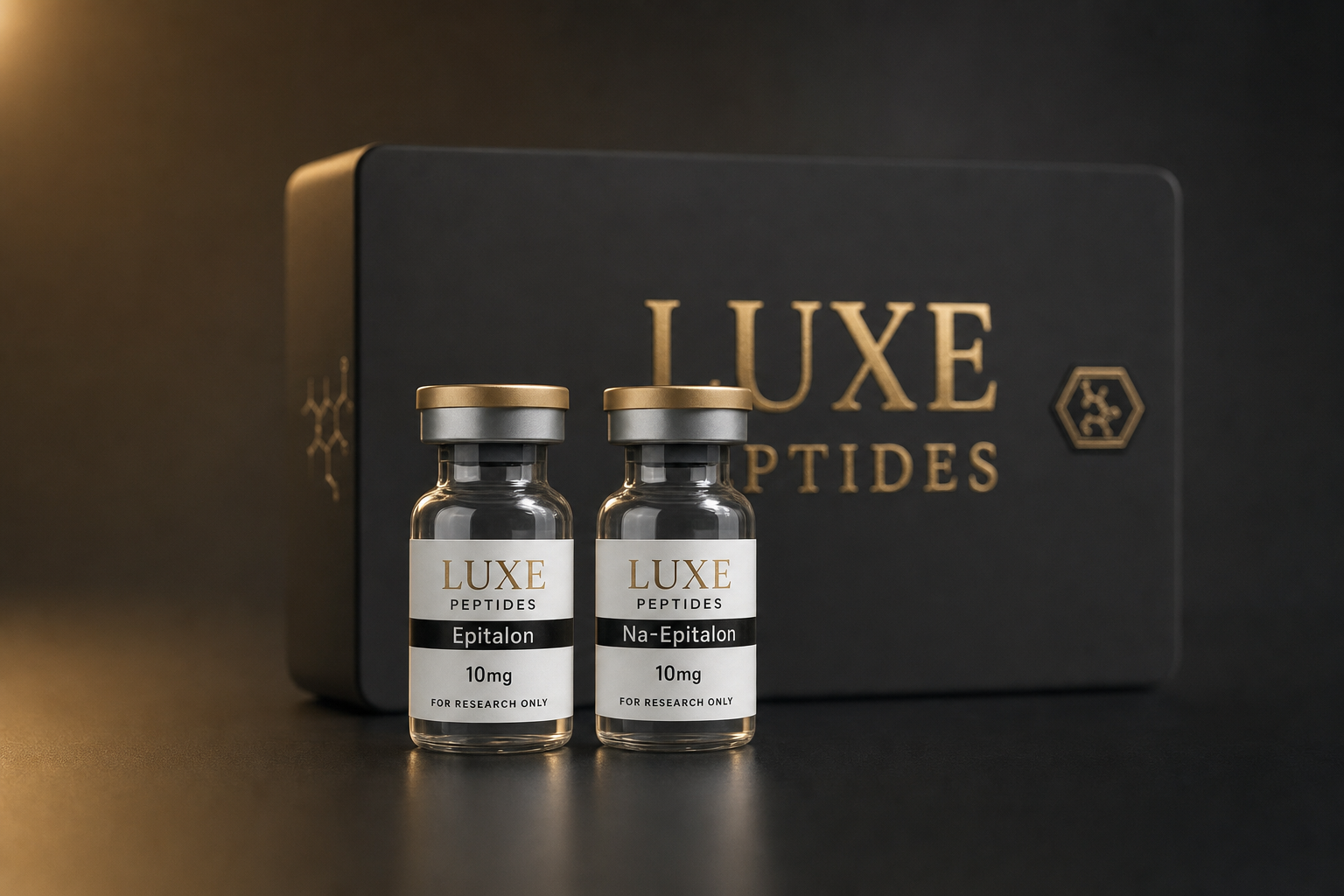
For laboratory research use only. Epitalon is not a drug, dietary supplement, or cosmetic ingredient supplied for human or veterinary use, and nothing below is a recommendation for administration to humans or animals.
Epitalon — also written Epithalon and abbreviated AEDG after its sequence — is a synthetic tetrapeptide, L-alanyl-L-glutamyl-L-aspartyl-glycine. It occupies an unusual position in the peptide literature: almost all of the published work on it comes from a single research tradition, the “peptide bioregulator” program developed at the St. Petersburg Institute of Bioregulation and Gerontology, and most of that work concerns two subjects — telomerase activity in cultured cells and pineal signaling in aged animals. This overview summarizes what that literature actually reports, what the proposed mechanism is, and where the evidence base is thin.
Chemistry and origin
AEDG is a four-residue peptide with the molecular formula C14H22N4O9 and a free-acid molecular weight near 390 Da. Three of its four residues carry carboxyl groups, making it strongly anionic at neutral pH and freely water-soluble — a useful property for solution work, though the same polarity is one reason reported pharmacokinetics show very short residence in circulation.
The peptide did not begin as a designed molecule. It was identified as an active fragment of epithalamin, a low-molecular-weight peptide preparation extracted from bovine pineal gland and studied in the Soviet and post-Soviet gerontology literature from the 1970s onward. Epitalon is the synthetic, chemically defined successor to that extract, and the distinction matters when reading citations: a substantial share of the older and more dramatic findings refer to the undefined extract, not the tetrapeptide.
The bioregulator hypothesis
No receptor for AEDG has been identified. The mechanism proposed in this literature is instead a direct nucleic-acid interaction: very short peptides are hypothesized to cross plasma and nuclear membranes and to bind DNA in a sequence-selective manner, with the peptide’s charge and side-chain geometry complementing particular base sequences and thereby modulating transcription at specific promoters. Work from the same network reported cellular and nuclear penetration of fluorescently labeled short peptides and their association with DNA, and molecular-modeling papers have proposed candidate binding sites.
This remains a hypothesis rather than an established mechanism. It has not been independently replicated at the level of structural or genome-wide binding data by laboratories outside the originating network, and researchers reading the primary reports should treat “mechanism” here as a proposed model that accounts for observed expression changes, not a resolved pathway.
Telomerase observations in cell culture
The most frequently cited result is a 2003 report in Bulletin of Experimental Biology and Medicine in which human somatic cell cultures exposed to the tetrapeptide showed induction of telomerase activity and, over serial passage, longer measured telomeres and continued division past the point where control cultures had ceased dividing. Related reports from the same group described associated changes in chromatin condensation and in the expression of proliferation-associated genes in cultured fibroblasts.
Several caveats travel with this finding and should be carried into any experimental design:
- The primary observations come from a small number of experiments in one laboratory, with limited independent replication reported since.
- Telomerase activity in these reports is measured by TRAP-type assays, which are sensitive to lysate preparation and to PCR artifacts; effect sizes and controls should be evaluated directly from the source papers.
- Induction of endogenous telomerase in a somatic culture is a different phenomenon from forced hTERT expression, and the reports do not establish which upstream step is affected.
- Findings in fetal-derived fibroblast cultures do not generalize automatically to other cell types or to intact organisms.
Pineal and neuroendocrine research
The second research thread follows from the compound’s origin. Studies in aged rats and in non-human primates have examined circadian melatonin output, reporting that animals given the pineal extract or the tetrapeptide showed nocturnal melatonin profiles and cortisol rhythm parameters that differed from untreated aged controls — described in that literature as a shift toward the pattern seen in younger animals. Related rodent work has examined pineal serotonin and N-acetyltransferase activity, gonadotropin secretion in old females, and retinal degeneration models.
Small human studies of the extract (epithalamin, not the synthetic tetrapeptide) have also been published by the same group, generally unblinded and with modest sample sizes. They are noted here only to mark the boundary of the evidence base; they do not establish any outcome, and Epitalon is supplied strictly as a research chemical.
Aging-related endpoints in animal models
Rodent colony studies from this network have reported differences in survival curves, in spontaneous tumor incidence, and in a set of biomarkers described as aging-related, in mice and rats receiving the tetrapeptide on intermittent schedules. Comparable endpoints have been examined in Drosophila. As with the cell-culture work, the great majority of these studies originate from affiliated laboratories, many were published in Russian-language journals, and blinded replication by unaffiliated groups is largely absent. That concentration of provenance is the single most important limitation of the Epitalon literature and should be weighed before designing follow-on work.
Epitalon, Na-Epitalon, and epithalamin compared
| Material | Composition | What the literature covers | Notes for researchers |
|---|---|---|---|
| Epithalamin | Undefined low-molecular-weight peptide extract of bovine pineal gland | The original 1970s–1990s pineal, melatonin-rhythm, and gerontology studies | Not a defined chemical entity; results are not directly attributable to AEDG |
| Epitalon / Epithalon (AEDG) | Synthetic tetrapeptide Ala-Glu-Asp-Gly, ~390 Da free acid | Telomerase and telomere reports in cell culture; most rodent and primate work since 2000 | The reference form — use it as the comparator when reading or replicating |
| Na-Epitalon (N-acetyl-Epitalon) | AEDG with the N-terminal amine acetylated | Very limited compound-specific published characterization | N-terminal acetylation is a standard chemical strategy for reducing aminopeptidase susceptibility; treat any assumed carryover of AEDG findings as untested |
The practical implication of the third row is worth stating plainly: the acetylated analog is a distinct chemical entity, and published data on unmodified AEDG cannot be assumed to describe it. Studies comparing the two directly are scarce.
Laboratory handling and solution arithmetic
Epitalon is supplied lyophilized. Preparing a stock solution is straightforward arithmetic: a 10 mg vial brought up in 2 mL of diluent yields 5 mg/mL, so 0.1 mL of that stock contains 0.5 mg of peptide; the same vial in 5 mL yields 2 mg/mL. The reconstitution calculator handles the conversion for other vial sizes and target concentrations.
Two details recur in method sections. First, peptide content is not the same as net vial weight — lyophilized material includes counter-ions and residual water, so molar calculations should start from the analytical documentation in the COA library rather than from label weight. Second, short peptides in solution are sensitive to repeated freeze–thaw cycles; aliquoting the reconstituted stock and keeping lyophilized material at −20 °C or below are the usual precautions.
What the evidence supports, and what it does not
Read as a whole, the AEDG literature is internally consistent and externally unverified. It describes a reproducible-within-one-network set of observations — telomerase induction in culture, altered pineal rhythm parameters in aged animals, differences in rodent aging endpoints — built on a mechanistic model (sequence-selective peptide–DNA interaction) that has not been independently confirmed. There is no identified receptor, no modern registered clinical program, and little blinded replication outside the originating institution. For a researcher, that makes Epitalon an interesting subject for independent replication rather than a settled tool compound.
Reviewed for research accuracy: July 30, 2026.
References
- Khavinson VKh, Bondarev IE, Butyugov AA. Bulletin of Experimental Biology and Medicine. 2003;135(6):590–592. (Telomerase activity and telomere length in human somatic cell cultures exposed to the AEDG tetrapeptide.)
- Khavinson VKh. Neuroendocrinology Letters. 2002;23(Suppl 3). (Monograph-length review; the primary published statement of the peptide-bioregulator framework.)
- Fedoreyeva LI, Kireev II, Khavinson VKh, Vanyushin BF. Biochemistry (Moscow). 2011;76(11):1210–1219. (Penetration of short peptides into cells and their binding to DNA.)
- Khavinson VKh, Goncharova ND, Lapin BA. Neuroendocrinology Letters. 2001;22(4). (Melatonin rhythm parameters in aged non-human primates given the pineal peptide preparation.)
- Anisimov VN, Khavinson VKh, Popovich IG, Zabezhinski MA. Biogerontology. 2003;4(4). (Rodent-colony study of aging-related endpoints; cited by authors, journal, and year.)
- Anisimov VN, Khavinson VKh. Biogerontology. 2010;11(2):139–149. (Review of the peptide-bioregulator gerontology program by its principal investigators.)
- Korkushko OV, Khavinson VKh, Shatilo VB, et al. Bulletin of Experimental Biology and Medicine. 2007;143(4). (Small unblinded human study of the pineal extract, not the synthetic tetrapeptide; cited to mark the limits of the evidence base.)
- Additional preclinical reports have examined the AEDG tetrapeptide in retinal degeneration models and in Drosophila; these are small single-network studies and are referred to here generically rather than by identifier.
Research use only. All compounds discussed are supplied strictly for in vitro laboratory and preclinical research by qualified personnel, and are not for human consumption, therapeutic use, cosmetic use, or veterinary application.