

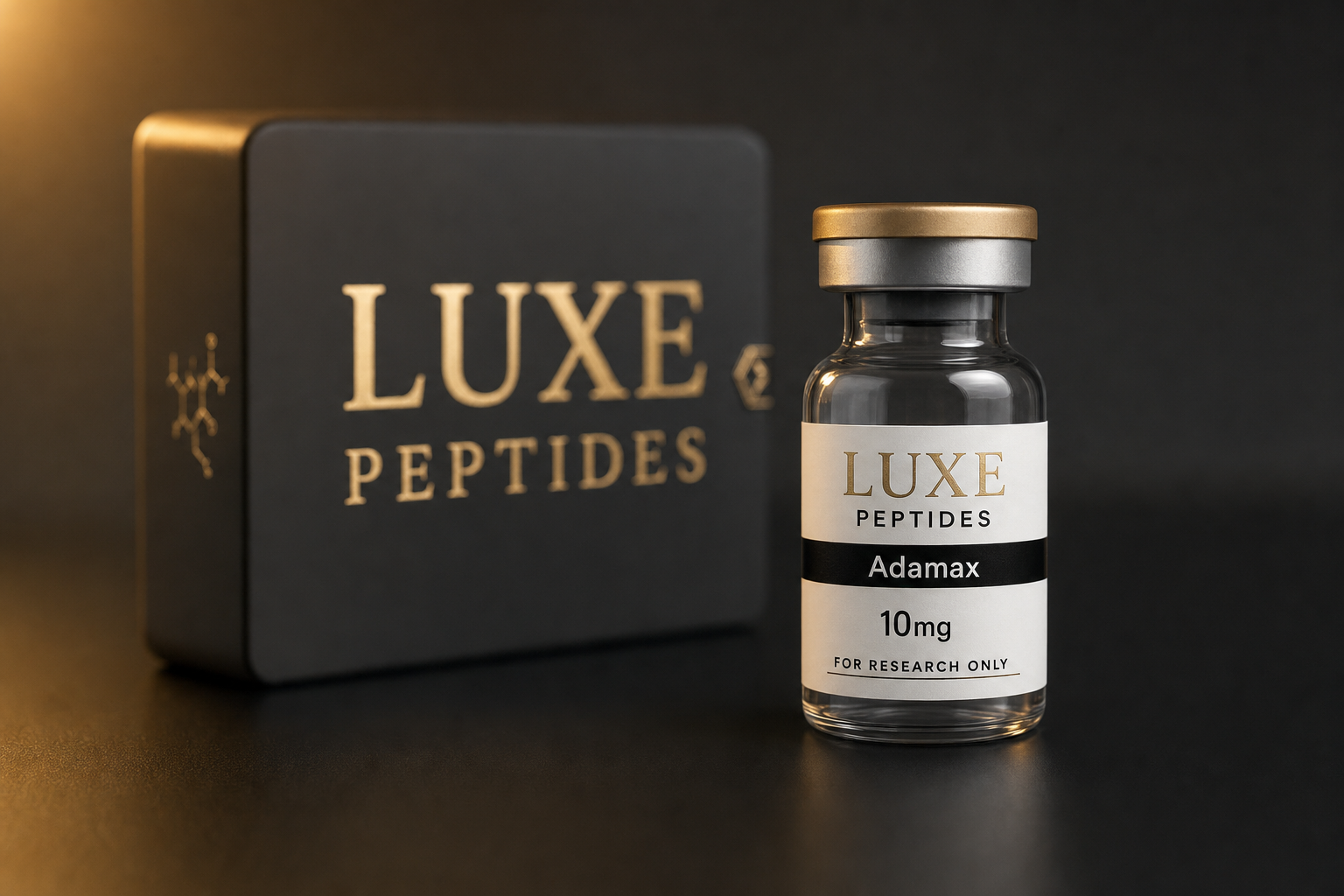
The following is provided for laboratory research purposes only; Adamax is not a drug, supplement, or article intended for human or veterinary use.
Adamax is a synthetic peptide investigated in the laboratory as a chemically modified analog of Semax. In research nomenclature it is described as an adamantane-conjugated Semax derivative: the Semax heptapeptide backbone carrying an adamantane (tricyclic hydrocarbon) moiety. This article explains what Adamax is, how the adamantane modification distinguishes it from standard Semax and N-acetyl Semax, its origin in the adrenocorticotropic hormone (ACTH) fragment family, and how it has been framed in preclinical neuropeptide research. All discussion below concerns findings in research models, not outcomes in people.
What is Adamax?
Adamax is a Semax-class research peptide in which an adamantane group is attached to the Semax sequence. Semax itself is a short synthetic peptide, so Adamax is best understood as a structural variant designed by researchers to alter the physicochemical properties of the parent molecule — chiefly its lipophilicity and its resistance to enzymatic breakdown. Investigators studying the Semax family have used side-chain and terminal modifications (including acetylation, amidation, and lipophilic conjugation) as tools to probe how structure influences peptide stability and central-nervous-system activity in animal and in vitro systems. Adamax sits in this experimental lineage as the adamantane-modified member.
The ACTH(4-7) heptapeptide origin
To understand Adamax, it helps to start with Semax. Semax is a heptapeptide with the sequence Met-Glu-His-Phe-Pro-Gly-Pro (MEHFPGP). Its N-terminal portion corresponds to the ACTH(4-7) fragment (Met-Glu-His-Phe) of adrenocorticotropic hormone, a fragment long studied for behavioral and neurotrophic activity that is independent of ACTH’s hormonal (corticosteroid-releasing) role. To that ACTH(4-7) core, researchers appended a C-terminal Pro-Gly-Pro tripeptide. This proline-rich terminus was introduced specifically to slow enzymatic degradation, since native ACTH fragments are rapidly cleaved by peptidases. The result — Semax — is a non-hormonal ACTH(4-10) analog that has been the subject of extensive preclinical neuropeptide research. Adamax and N-acetyl Semax are downstream modifications of this same scaffold.
The adamantane modification vs standard Semax and N-acetyl Semax
The three molecules share the ACTH(4-7)-derived heptapeptide core but differ in what is attached to it, and those differences are the whole point of the comparison in structure-activity research.
| Compound | Core sequence | Modification | Rationale studied in research |
|---|---|---|---|
| Semax | ACTH(4-7) + Pro-Gly-Pro (MEHFPGP) | None beyond the stabilizing C-terminal tripeptide | Baseline non-hormonal ACTH-fragment analog with improved peptidase resistance |
| N-acetyl Semax (amidate) | Same heptapeptide core | N-terminal acetylation and C-terminal amidation | Terminal capping studied for further enzymatic stability and altered pharmacokinetics in models |
| Adamax | Same heptapeptide core | Adamantane (lipophilic cage) conjugation | Increased lipophilicity studied as a route to greater membrane permeability and metabolic robustness |
Adamantane is a rigid, cage-like saturated hydrocarbon (C10H16) widely used in medicinal-chemistry research as a lipophilic anchor. Conjugating it to a peptide markedly raises the molecule’s lipophilicity. In research contexts this modification is examined for two reasons: peptides bearing bulky hydrophobic groups can show altered resistance to proteolytic enzymes, and increased lipophilicity is a classic strategy investigated for improving passage across lipid membranes. Researchers therefore study Adamax as a probe of how a lipophilic conjugate changes the behavior of the Semax backbone relative to the acetylated/amidated (N-acetyl Semax) and unmodified variants. The comparison is a structure-activity question, not a claim that any variant is superior for any human purpose.
By contrast, N-acetyl Semax (including the amidate form) modifies only the peptide termini rather than adding a large hydrophobic cage. Acetylation of the N-terminus and amidation of the C-terminus are common peptide-stabilization strategies studied to reduce recognition by exopeptidases. Laboratories comparing N-acetyl Semax amidate with the adamantane-modified Adamax are essentially contrasting two different chemical philosophies applied to the same ACTH-derived core.
Preclinical nootropic and neurotrophic research framing
The scientific interest in the Semax family stems from work on ACTH(4-10)-derived peptides as putative neuromodulators. In preclinical and in vitro research, Semax and related analogs have been examined for their association with neurotrophic signaling — in particular studies reporting changes in brain-derived neurotrophic factor (BDNF) and its receptor TrkB, as well as nerve growth factor (NGF) expression, in rodent brain tissue and cultured cells. Researchers have also investigated the family in models of cerebral ischemia and oxidative stress, and in behavioral paradigms used to study learning and attention in animals. These are the reasons the Semax scaffold is frequently described in the literature as a “nootropic” or “neurotrophic” research peptide.
It is important to frame these findings precisely. The neurotrophic and behavioral observations reported for the Semax family come from animal models, cell culture, and limited experimental settings; they describe associations and mechanisms studied under controlled research conditions. Adamax specifically is a less extensively characterized derivative, and much of the mechanistic reasoning applied to it is extrapolated from the better-studied parent peptide and from the general chemistry of adamantane conjugation. Researchers evaluating Adamax typically treat it as a tool for probing how lipophilic modification affects the stability and central activity of an ACTH(4-7)-derived peptide, rather than as an established agent with defined effects.
Identity and purity documentation
Because Adamax is a modified analog rather than the parent peptide, identity confirmation matters when interpreting any result attributed to it: mass-spectrometric identity and HPLC purity data establish that the material under study is the adamantane-conjugated compound and not unmodified Semax or a partially cleaved species. Third-party certificates for our research materials are published in the COA library.
Summary
Adamax is an adamantane-conjugated derivative of Semax, itself a stabilized ACTH(4-7)-derived heptapeptide (Met-Glu-His-Phe-Pro-Gly-Pro). The adamantane group is a lipophilic modification studied to alter membrane permeability and metabolic stability, distinguishing Adamax from the terminally capped N-acetyl Semax amidate and from unmodified Semax. Within the neuropeptide literature the Semax family is studied for associations with neurotrophic signaling (BDNF, NGF) and for behavioral and neuroprotective endpoints in animal and in vitro models. Adamax is best understood as a research-grade structure-activity variant of that scaffold.
Reviewed for research accuracy
Reviewed for research accuracy on 2026-07-30. This article describes mechanisms studied in cell and animal models and does not represent clinical guidance.
References
- Preclinical studies have characterized Semax as a non-hormonal analog of the ACTH(4-10) fragment and described its Met-Glu-His-Phe-Pro-Gly-Pro sequence and enzymatic stability (peptide structure-activity literature on ACTH-derived neuropeptides).
- Research in rodent brain tissue and cell culture has examined Semax-associated changes in brain-derived neurotrophic factor (BDNF) and its TrkB receptor, and in nerve growth factor (NGF) expression (preclinical neurotrophic-signaling studies of the Semax family).
- Medicinal-chemistry research has described adamantane conjugation as a strategy for increasing peptide lipophilicity and metabolic stability (general adamantane structure-activity literature).
- Experimental studies have investigated Semax and related ACTH(4-10) analogs in models of cerebral ischemia, oxidative stress, and animal learning/attention paradigms (preclinical neuroprotection and behavioral literature).
Research use only. Adamax is sold strictly as a laboratory research chemical for in vitro and research-model study by qualified professionals. It is not a drug, food, cosmetic, or dietary supplement, and is not intended to diagnose, treat, cure, or prevent any disease or to be administered to humans or animals.