

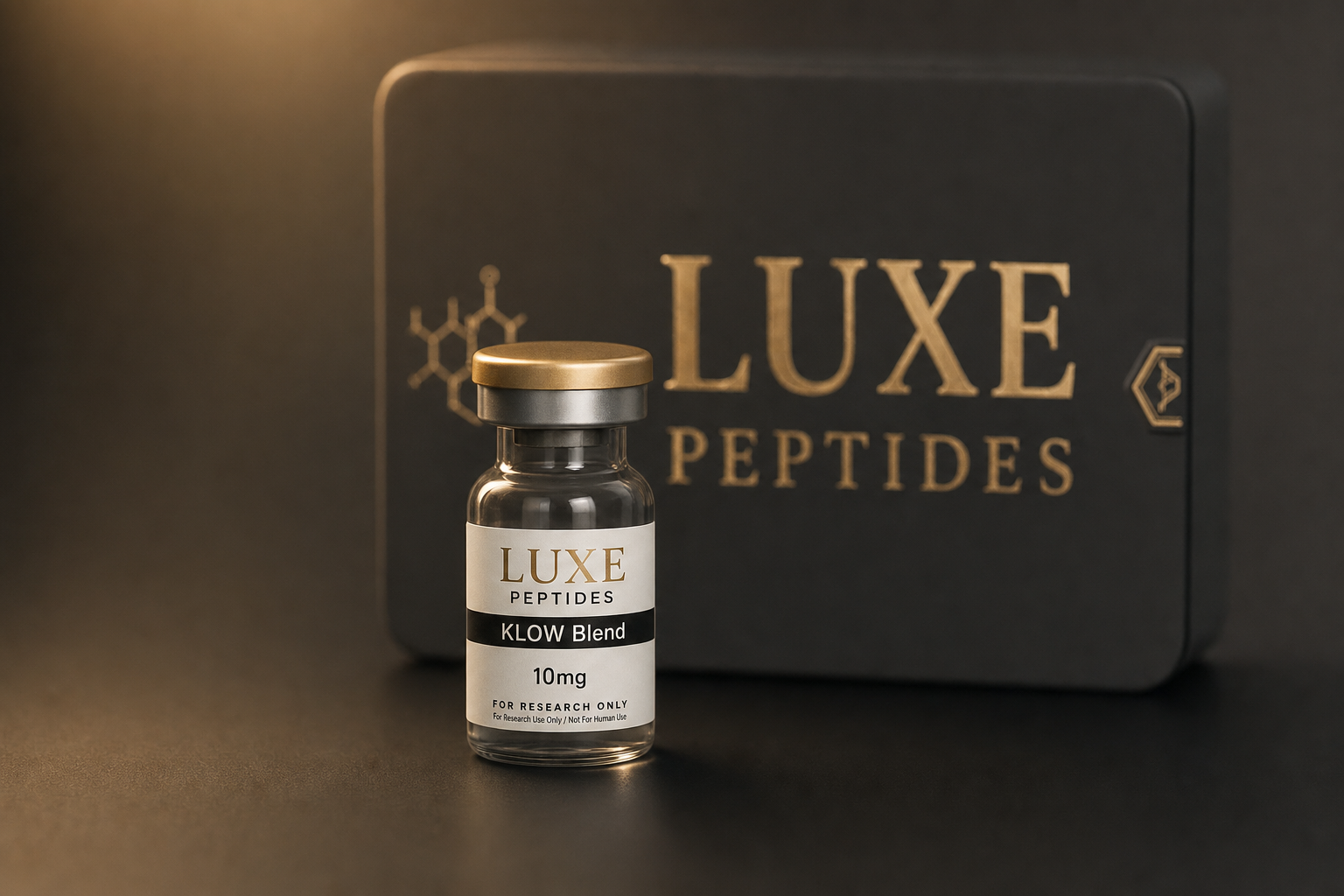
For laboratory and research use only. The compounds described here are not drugs, are not intended for human or veterinary use, and are not intended to diagnose, treat, cure, or prevent any condition.
“KLOW” is an informal name used across the research-peptide vertical for a multi-component blend built around peptides that appear frequently in tissue-repair and anti-inflammatory literature. Because the label is a vendor convention rather than a standardized formula, researchers comparing sources should confirm the exact composition of any given vial before designing an experiment. This guide describes each component’s studied mechanism and clarifies the most-searched point of confusion: which KLOW formulations include KPV and which do not.
What the KLOW blend is
KLOW refers to a co-formulated blend of short peptides and peptide fragments that have each been examined independently in models of wound healing, extracellular-matrix remodeling, and inflammation. The rationale sometimes offered in the literature for studying such peptides together is that they act through distinct, non-overlapping pathways — copper transport, cytoprotection, actin regulation, and melanocortin signaling — so researchers occasionally investigate them in combination to observe additive or independent effects in a single model. Combination data specific to KLOW as a fixed blend are limited; most of the published evidence concerns the individual components.
The KPV question: three-component vs. four-component KLOW
This is the distinction most researchers search for. Two naming conventions circulate:
- Three-component KLOW — GHK-Cu, BPC-157, and TB-500 only, with no KPV.
- Four-component KLOW — the three peptides above plus KPV, the C-terminal tripeptide of α-MSH.
Both are marketed under the same “KLOW” label, which is the source of the confusion. The Luxe Peptides KLOW blend is the four-component formulation: GHK-Cu, BPC-157, TB-500, and KPV together. Always verify the stated composition and the accompanying Certificate of Analysis against the specific catalog entry, since a blend labeled “KLOW” from another source may omit KPV entirely.
The four components at a glance
| Component | Class | Primary pathway studied | Representative research focus |
|---|---|---|---|
| GHK-Cu | Copper-binding tripeptide | Copper delivery, matrix gene expression | Extracellular-matrix remodeling in fibroblast and animal models |
| BPC-157 | Synthetic pentadecapeptide | Cytoprotection, angiogenic signaling | Soft-tissue and gut-lining injury models |
| TB-500 | Thymosin β4 fragment | Actin sequestration, cell migration | Wound-closure and tissue-migration assays |
| KPV | α-MSH C-terminal tripeptide | Melanocortin / NF-κB–linked signaling | Intestinal and epithelial inflammation models |
GHK-Cu (copper tripeptide-1)
GHK-Cu is a naturally occurring tripeptide (glycyl-L-histidyl-L-lysine) that binds copper(II) with high affinity. In preclinical and in vitro research it has been associated with modulation of genes involved in extracellular-matrix synthesis and remodeling, and studies indicate it can influence collagen and glycosaminoglycan production in cultured fibroblasts. Reviews of the peptide have examined its role as a copper carrier and its observed effects on tissue-remodeling pathways in animal and cell models. As with all components here, human clinical data are limited and the mechanisms are described in a research context only. Researchers working with the copper complex should note its distinct handling and reconstitution characteristics relative to the other peptides in the blend.
BPC-157
BPC-157 is a synthetic 15-amino-acid sequence derived from a fragment of a gastric protein. Preclinical reviews have examined its cytoprotective profile and reported, in rodent models, associations with angiogenic signaling (including nitric-oxide and VEGF-related pathways) and with markers of connective-tissue and gastrointestinal-lining recovery after experimental injury. The evidence base is predominantly animal-model work; controlled human data are minimal. Effects should therefore be described strictly as observations within specific experimental systems rather than as established outcomes.
TB-500 (thymosin β4 fragment)
TB-500 is associated with the actin-binding region of thymosin β4, a naturally occurring peptide. Thymosin β4 is a well-characterized actin-sequestering protein, and research indicates it participates in cell migration, angiogenesis, and the cellular events involved in experimental wound closure. In animal wound-healing assays, thymosin β4 has been observed to accelerate the migration of keratinocytes and endothelial cells. Studies of the TB-500 fragment focus on this actin-regulatory mechanism in cell and animal models.
KPV
KPV is the C-terminal tripeptide (lysine-proline-valine) of α-melanocyte-stimulating hormone (α-MSH). In preclinical research it has been examined for anti-inflammatory activity that appears to be independent of the classical melanocortin-1 receptor pigmentation pathway. Cell and animal studies of intestinal inflammation have reported that KPV, taken up via the PepT1 transporter, is associated with reduced pro-inflammatory signaling (including NF-κB–linked pathways) in epithelial models. Its inclusion is precisely what distinguishes the four-component KLOW blend from the three-component version described above.
Reviewed for research accuracy
Reviewed for research accuracy on 2026-07-13. This article describes mechanisms studied in cell and animal models and does not represent clinical guidance.
References
- Pickart L, Margolina A. Regenerative and protective actions of the GHK-Cu peptide in the light of the new gene data. Int J Mol Sci. 2018;19(7):1987. PMID: 29986520.
- Pickart L. The human tri-peptide GHK and tissue remodeling. J Biomater Sci Polym Ed. 2008;19(8):969–988. PMID: 18644225.
- Goldstein AL, Hannappel E, Kleinman HK. Thymosin β4: actin-sequestering protein moonlights to repair injured tissues. Trends Mol Med. 2005;11(9):421–429. PMID: 16099219.
- Malinda KM, Sidhu GS, Mani H, et al. Thymosin β4 accelerates wound healing. J Invest Dermatol. 1999;113(3):364–368. PMID: 10469335.
- Dalmasso G, Charrier-Hisamuddin L, Nguyen HT, et al. PepT1-mediated tripeptide KPV uptake reduces intestinal inflammation. Gastroenterology. 2008;134(1):166–178. PMID: 18061177.
- Peer-reviewed preclinical reviews (Sikiric et al.) have examined the cytoprotective and angiogenic mechanisms attributed to BPC-157 in rodent injury models; readers should consult the primary literature directly, as controlled human data remain limited.
For laboratory and research use only. Not for human or veterinary use. Nothing here is medical advice, and no statement should be read as describing a therapeutic effect in humans.