
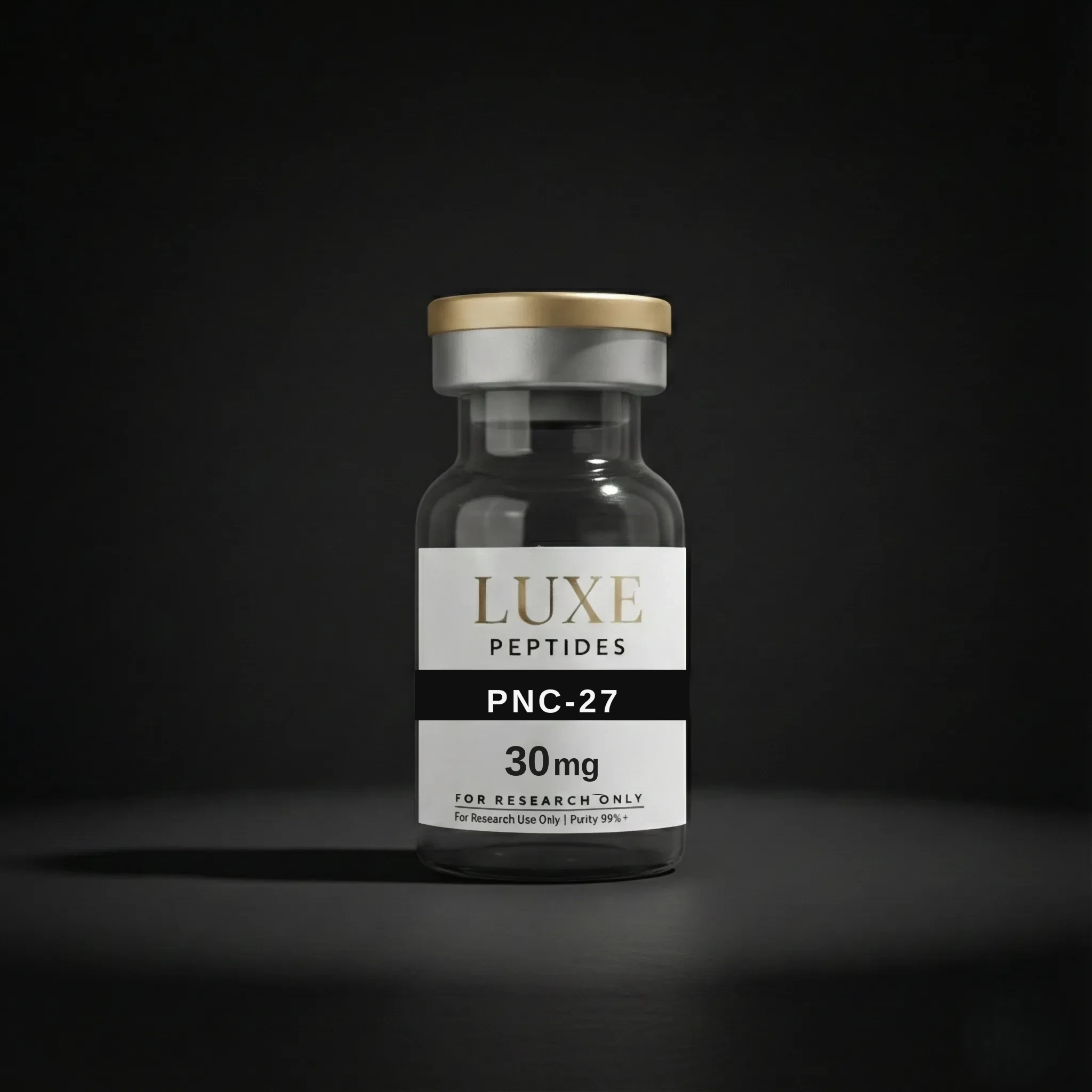
PNC-27
$100.00
- Ships same day on orders placed by 3pm ET. Most US orders arrive in 2–4 days.
- Free shipment protection on every order
- Third-party tested · CoA on file
- Discreet, tracked shipping
- Free shipping over $200
- Members earn 5% back in store credit
What is PNC-27?
PNC-27 is a 32-amino-acid chimeric peptide built by fusing residues 12–26 of the human p53 tumor-suppressor protein — the segment carrying the HDM-2 (MDM2) binding domain — to a C-terminal membrane-residency, cell-penetrating sequence. Its sequence is PPLSQETFSDLWKLLKKWKMRRNQFWVKVQRG, in which the first fifteen residues reproduce the p53 transactivation-domain helix and the remaining seventeen supply the amphipathic, membrane-active leader. That dual-domain architecture is what makes PNC-27 a distinctive laboratory probe: it is studied in preclinical oncology research as a tool for interrogating the p53–HDM-2 protein–protein interaction and membrane-pore formation in transformed cell lines, rather than as a conventional intracellular pathway inhibitor. It should not be confused with the related construct PNC-28, which carries the shorter p53 17–26 segment. This material is supplied for research use only and is not for human consumption.
Mechanism of Action
In published preclinical work, PNC-27 has been characterized as a membrane-active peptide whose two domains contribute distinct functions. NMR studies report that it adopts amphipathic helix-loop-helix conformations in both aqueous and membrane-mimetic solvents, segregating hydrophobic and polar residues onto opposite faces. The p53 12–26 segment has been shown to adopt a conformation superimposable on the same residues bound to HDM-2, and colocalization and antibody-blocking experiments in cultured cells indicate that PNC-27 associates with HDM-2 present in the plasma membrane of cancer-derived cell lines but largely absent from the membranes of untransformed control lines. Immuno-electron microscopy has resolved PNC-27–HDM-2 complexes arranged in ring-like structures at pore sites, supporting a model in which engagement of membrane-bound HDM-2 nucleates transmembrane pore formation and rapid, necrosis-like loss of membrane integrity in susceptible in-vitro models.
Published Research
Solution Structure and Amphipathic Character
Rosal et al. (2004) applied two-dimensional NMR to the 32-residue PNC-27 sequence in both an aqueous, cytosolic-like environment and a membrane-mimetic organic solvent. They reported three alpha-helical domains joined by loop structures in water, lengthening into a U-shaped helix-coil-helix ensemble under membrane-mimetic conditions, with hydrophobic residues coalescing on one face and polar residues on the opposite face — an amphipathic arrangement the authors linked to the peptide’s membrane-disruptive behavior in cultured cell lines [1].
Membrane-Bound HDM-2 as the Binding Partner
Sarafraz-Yazdi et al. (2010) found that the three-dimensional structure of the p53 residues within PNC-27 is directly superimposable on the same residues bound to HDM-2. They detected significant HDM-2 in the membranes of a range of cancer-derived cell lines but not in several untransformed lines, showed colocalization of PNC-27 with membrane-bound HDM-2, and reported that transfecting untransformed MCF-10-2A cells with a membrane-localized full-length HDM-2 construct rendered those previously unaffected cells susceptible to the peptide [2].
Pore Architecture by Immuno-Electron Microscopy
Sarafraz-Yazdi et al. (2022) combined conformational energy calculations with immuno-scanning electron microscopy using differently sized gold-labeled anti-PNC-27 and anti-HDM-2 antibodies. The calculations predicted 1:1 PNC-27–HDM-2 complexes with the leader sequence oriented away from the interface, and the microscopy resolved the two gold labels in approximately 1:1 ratios within layered ring-shaped structures at pore sites near the cell surface. No pores were observed in the PNC-27-treated untransformed fibroblast controls [3].
Product Specifications
| Product | PNC-27 Lyophilized Powder |
|---|---|
| Available Sizes | 30mg |
| Purity | ≥99% (HPLC verified) |
| CAS Number | 1159861-00-3 |
| Sequence | PPLSQETFSDLWKLLKKWKMRRNQFWVKVQRG |
| Molecular Formula | C₁₈₈H₂₉₃N₅₃O₄₄S |
| Molecular Weight | 4031.8 g/mol |
| Appearance | White lyophilized powder in glass vial |
| Storage | Store lyophilized at -20°C. Reconstituted solution at 2-8°C. |
| Testing | Third-party tested — Certificate of Analysis available |
Storage & Stability
Store lyophilized at -20°C. Reconstituted solution at 2-8°C.
Certificate of Analysis
| Purity (HPLC-UV / MS) | ≥99% | Pass |
| Identity | Confirmed by HPLC-UV / MS | Verified |
| Appearance | White lyophilized powder in glass vial | Pass |
Certificates of Analysis — Janoshik
Third-party tested · Independent analytical lab
| Tested | Measured | Purity |
|---|---|---|
| Jan 2026 | 31.36mg | 99.59% |
| Sep 2025 | 28.32mg | 99.74% |
Frequently Asked Questions
PNC-27 is a synthetic 32-amino-acid chimeric peptide that joins residues 12–26 of the human p53 tumor-suppressor protein to a C-terminal membrane-residency (cell-penetrating) sequence. It is supplied strictly as a research compound for in-vitro laboratory study and is not for human consumption.
PNC-27 has the sequence PPLSQETFSDLWKLLKKWKMRRNQFWVKVQRG. The first fifteen residues (PPLSQETFSDLWKLL) correspond to p53 12–26 and contain the HDM-2/MDM2-binding helix, including the contact residues Phe19, Trp23 and Leu26 in full-length p53 numbering. The remaining seventeen residues (KKWKMRRNQFWVKVQRG) form the membrane-residency leader.
PNC-27 has the molecular formula C₁₈₈H₂₉₃N₅₃O₄₄S and an average molecular weight of approximately 4031.8 g/mol. Its CAS number is 1159861-00-3. Some listings quote a lower figure of roughly 3,900 Da; the value given here is the one consistent with the published 32-residue sequence.
In the published preclinical literature PNC-27 has been used to study the p53–HDM-2 protein–protein interaction, membrane biophysics and pore formation, peptide secondary structure in membrane-mimetic environments, and differential membrane behavior between transformed and untransformed cell lines in culture.
Both are p53-derived peptides carrying the same membrane-residency leader sequence, but they use different p53 fragments: PNC-27 incorporates p53 residues 12–26, while PNC-28 uses the shorter 17–26 segment. They are studied as a related pair in mechanistic work, alongside sequence controls such as the leader-free p53 12–26 peptide (PNC-26).
No. PNC-27 is sold strictly as a research chemical for in-vitro laboratory study. It is for research use only and is not for human consumption or for any therapeutic, preventive or diagnostic application. Nothing here should be read as evidence of safety or benefit in humans: the published work described on this page is confined to cultured cells and preclinical laboratory models, and PNC-27 is not an approved drug in any jurisdiction.
References
Rosal R, Pincus MR, Brandt-Rauf PW, et al. NMR solution structure of a peptide from the mdm-2 binding domain of the p53 protein that is selectively cytotoxic to cancer cells. Biochemistry. 2004;43(7):1854-1861. PMID: 14967026
View sourceSarafraz-Yazdi E, Bowne WB, Adler V, et al. Anticancer peptide PNC-27 adopts an HDM-2-binding conformation and kills cancer cells by binding to HDM-2 in their membranes. Proc Natl Acad Sci U S A. 2010;107(5):1918-1923. PMID: 20080680
View sourceSarafraz-Yazdi E, Mumin S, Cheung D, et al. PNC-27, a chimeric p53-penetratin peptide binds to HDM-2 in a p53 peptide-like structure, induces selective membrane-pore formation and leads to cancer cell lysis. Biomedicines. 2022;10(5):945. PMID: 35625682
View source



Customer Reviews
No reviews yet.