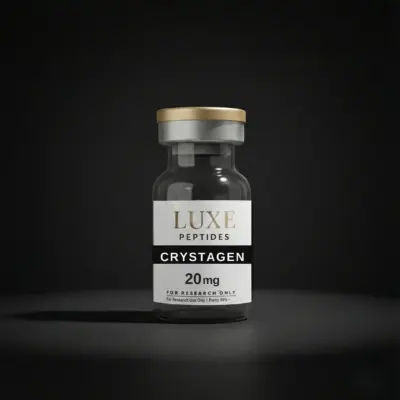
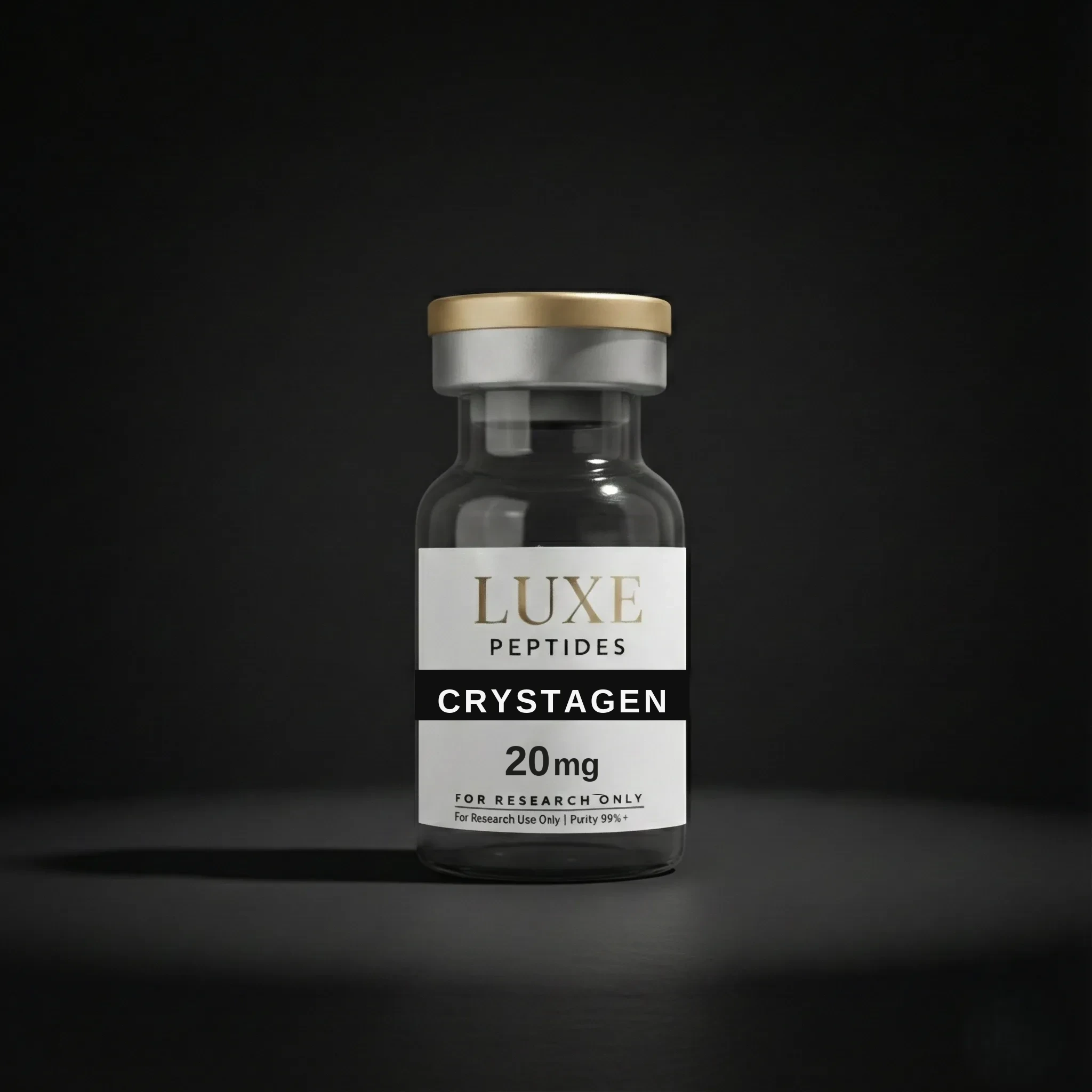
Crystagen
$55.00
- Ships same day on orders placed by 3pm ET. Most US orders arrive in 2–4 days.
- Free shipment protection on every order
- Third-party tested · CoA on file
- Discreet, tracked shipping
- Free shipping over $200
- Members earn 5% back in store credit
What is Crystagen?
Crystagen is a synthetic tripeptide bioregulator with the reported amino-acid sequence Glu-Asp-Pro (EDP), developed within the Khavinson short-peptide bioregulation program at the St. Petersburg Institute of Bioregulation and Gerontology. It belongs to the same family of short organ-directed peptides as Vilon (Lys-Glu), Thymogen (Glu-Trp) and Epitalon (Ala-Glu-Asp-Gly), and is classified in that literature as an immune bioregulator. The molecule is strongly anionic at neutral pH — the glutamic-acid and aspartic-acid residues each carry a carboxylate side chain — while the C-terminal proline imposes backbone rigidity through its pyrrolidine ring. Published work on Crystagen is largely Russian-language and preclinical, using it as a molecular probe in spleen, thymocyte and lymphoid-tissue models of immune aging. This product supplies the defined-sequence synthetic tripeptide; it should not be confused with the related Glu-Asp-X bioregulators (Glu-Asp-Gly, Glu-Asp-Arg, Glu-Asp-Ala) that differ only at the third residue. This material is supplied for research use only and is not for human consumption.
Mechanism of Action
The Khavinson bioregulation hypothesis holds that short peptides of this class penetrate the cytoplasmic and nuclear membranes and interact directly with DNA, so that a single tripeptide can influence the expression of multiple genes. Molecular-docking work on the family placed EDP among peptides that bind a specific short DNA motif, positioning sequence-selective peptide–DNA association as the proposed mechanistic basis for its bioregulatory activity rather than a classical cell-surface receptor. In cellular immunology models, Crystagen has been reported to act on the B-lymphocyte compartment of aging spleen tissue without measurably altering proliferation or apoptosis in that tissue, distinguishing its reported profile from Vilon and Thymogen, which were examined in parallel. Comparative organotypic work on Glu-Asp-X tripeptides indicates that activity is sensitive to the identity of the third residue, which is why structure-activity comparison across the series is a common experimental design. All of these mechanisms remain hypotheses under investigation in laboratory research models.
Published Research
Immunoprotective Profile in Aging Spleen
Chervyakova et al. (2014) compared the short peptides Vilon, Thymogen, Crystagen and R-1 in spleen tissue during aging and reported that each produced a distinct immunoprotective profile. Crystagen was reported to activate the B-cell arm of the immune system, but — unlike Vilon and Thymogen — was not associated with cell-renewal effects in the aging spleen [1].
Peptide-DNA Binding and Gene Regulation
Khavinson, Lin’kova and Tarnovskaya (2016) built spatial models of DNA-peptide complexes for 19 short peptides by docking, proposing that short peptides cross the cytoplasmic and nuclear membranes and bind DNA directly. EDP was reported to bind the same short DNA motif as the dipeptide KE, supporting sequence-selective DNA association as a candidate mechanism for this peptide class [2].
Comparative Tripeptide Structure-Activity Work
Voicekhovskaya et al. (2012) examined a panel of bioregulatory tripeptides — including T-36 (Glu-Asp-Pro) alongside Glu-Asp-Ala, Glu-Asp-Arg, Glu-Asp-Gly and Lys-Glu-Asp — in organotypic cultures of young and old rat skin, tracking proliferation and p53 expression. The differing responses across a series that varies at a single residue illustrate why Glu-Asp-X peptides are studied as a comparative set [3].
Product Specifications
| Product | Crystagen Lyophilized Powder |
|---|---|
| Available Sizes | 20mg |
| Purity | ≥99% (HPLC verified) |
| Sequence | EDP |
| Molecular Formula | C₁₄H₂₁N₃O₈ |
| Molecular Weight | 359.33 g/mol |
| Appearance | White lyophilized powder in glass vial |
| Storage | Store lyophilized at -20°C. Reconstituted solution at 2-8°C. |
| Testing | Third-party tested — Certificate of Analysis available |
Storage & Stability
Store lyophilized at -20°C. Reconstituted solution at 2-8°C.
Certificate of Analysis
| Purity (HPLC-UV / MS) | ≥99% | Pass |
| Identity | Confirmed by HPLC-UV / MS | Verified |
| Appearance | White lyophilized powder in glass vial | Pass |
Certificates of Analysis — Janoshik
Third-party tested · Independent analytical lab
| Tested | Measured | Purity |
|---|---|---|
| Oct 2025 | 20.93mg | 99.89% |
Frequently Asked Questions
Crystagen is a synthetic tripeptide bioregulator with the reported sequence Glu-Asp-Pro (EDP), developed within the Khavinson short-peptide program at the St. Petersburg Institute of Bioregulation and Gerontology. It is supplied here as a research compound for laboratory use only.
Crystagen is a defined-sequence synthetic tripeptide: glutamic acid - aspartic acid - proline (Glu-Asp-Pro, one-letter code EDP). It is one of several Glu-Asp-X bioregulators in the Khavinson series that differ only at the third residue.
The Glu-Asp-Pro tripeptide has the molecular formula C₁₄H₂₁N₃O₈ and a molecular weight of approximately 359.33 g/mol, per the PubChem record for glutamyl-aspartyl-proline. No CAS registry number is listed for this tripeptide, so none is stated here.
In the published preclinical literature Crystagen has been studied in the context of immune bioregulation, B-lymphocyte and spleen biology, immunosenescence and aging models, peptide-DNA interaction and gene-expression regulation, and comparative structure-activity work across the Glu-Asp-X tripeptide series.
It is one member of a family of short organ-directed peptides that includes Vilon (Lys-Glu), Thymogen (Glu-Trp) and Epitalon (Ala-Glu-Asp-Gly). These compounds are frequently examined side by side in the same experimental systems so that tissue-specific and sequence-specific differences can be distinguished; published comparisons report distinct profiles for each.
No. Crystagen is sold strictly as a research chemical for in-vitro laboratory study. It is for research use only and is not for human consumption or any therapeutic or diagnostic application.
References
Chervyakova NA, Linkova NS, Chalisova NI, et al. [Molecular aspects of immunoprotective activity of peptides in spleen during the ageing process]. Adv Gerontol. 2014;27(1):224-228. PMID: 28976144
View sourceKhavinson VK, Lin'kova NS, Tarnovskaya SI. Short Peptides Regulate Gene Expression. Bull Exp Biol Med. 2016;162(2):288-292. PMID: 27909961
View sourceVoicekhovskaya MA, Chalisova NI, Kontsevaya EA, Ryzhak GA. Effect of bioregulatory tripeptides on the culture of skin cells from young and old rats. Bull Exp Biol Med. 2012;152(3):357-359. PMID: 22803085
View source
Customer Reviews
No reviews yet.