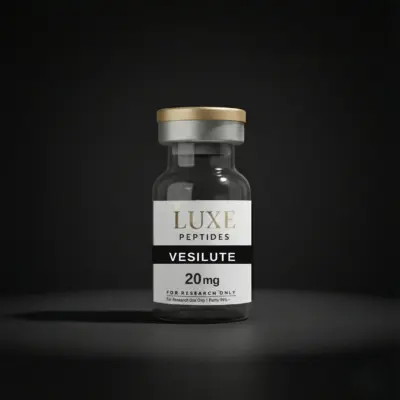
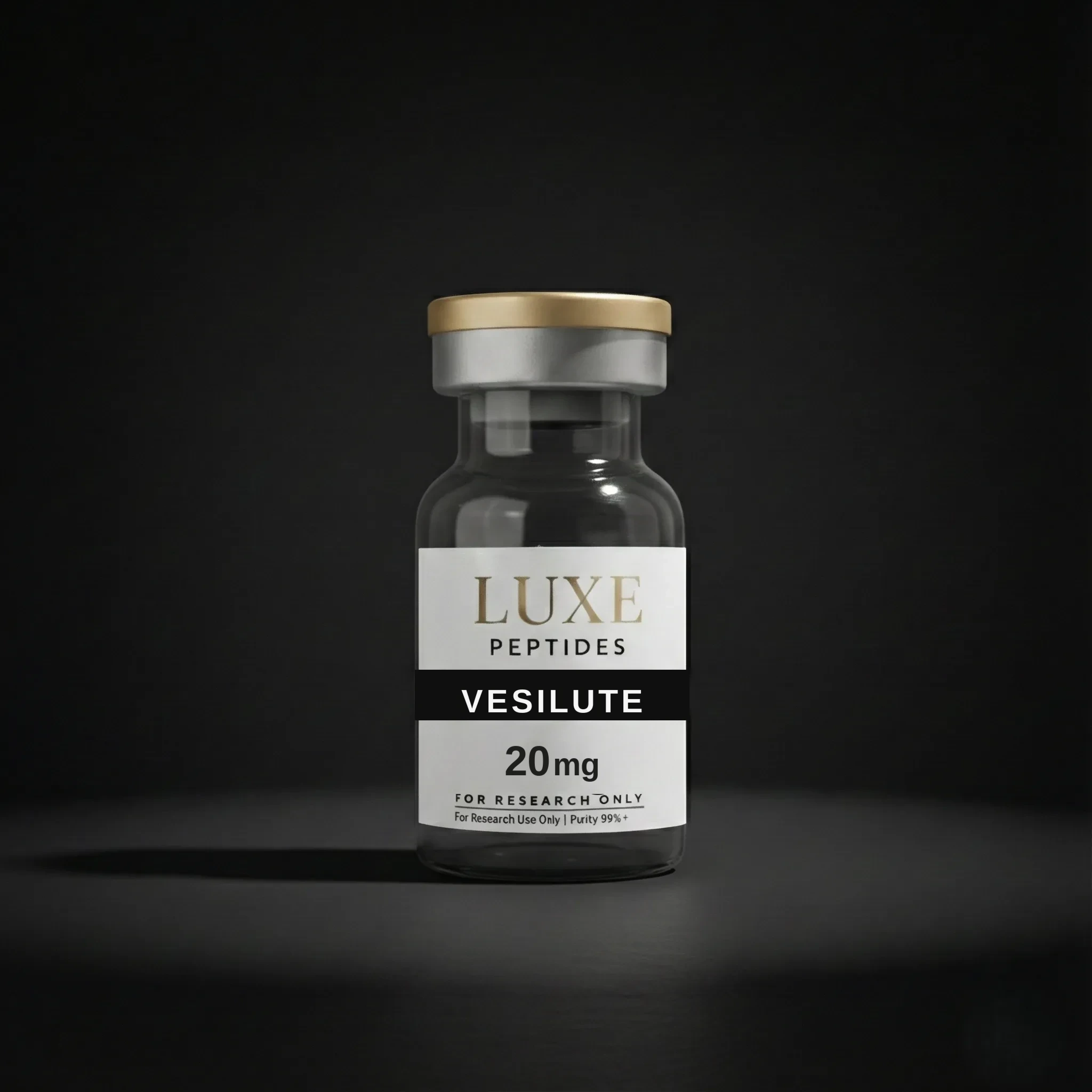
Vesilute
$60.00
- Ships same day on orders placed by 3pm ET. Most US orders arrive in 2–4 days.
- Free shipment protection on every order
- Third-party tested · CoA on file
- Discreet, tracked shipping
- Free shipping over $200
- Members earn 5% back in store credit
What is Vesilute?
Vesilute is a synthetic short peptide supplied as a research compound within the Khavinson class of peptide bioregulators — the family of ultrashort (2–7 residue) peptides developed in the St. Petersburg Institute of Bioregulation and Gerontology program and studied for tissue-directed regulation of gene expression. Within that series it is the member conventionally associated with the urinary bladder and lower urogenital tract, and its name is usually traced to the Latin vesica (bladder). Sources disagree on its exact composition — some describe a Glu-Asp dipeptide, others a Lys-Glu-Asp tripeptide — and no compound record resolves in PubChem under the name Vesilute, so this listing deliberately publishes no sequence, formula, molecular weight, or CAS number; identity should be taken from the lot-specific certificate of analysis. This material is supplied for research use only and is not for human consumption.
Mechanism of Action
No peer-reviewed mechanistic study of Vesilute itself has been identified, so any account of its activity is framed by the wider ultrashort-peptide literature rather than by direct evidence for this compound. That literature proposes that short peptides act as intracellular regulatory signals: reviews of the class describe peptides of 2–7 residues entering cell nuclei and interacting with nucleosomes, histone proteins, and single- and double-stranded DNA, with effects on transcription and DNA methylation status. Transport analyses for the same class suggest that di- and tripeptides can be carried into cells by proton-coupled oligopeptide (POT/PEPT) and L-type amino-acid (LAT) transporters, a route proposed to underlie the tissue selectivity these peptides are reported to show. In bladder-directed work these ideas are tested against urothelial and detrusor endpoints — barrier and tight-junction proteins, contractile gene programs, inflammatory signaling — in in-vitro and preclinical models only.
Published Research
Gene-Expression Framework for Short Peptide Bioregulators
Khavinson and colleagues (2021) published a systematic review of peptide regulation of gene expression, reporting that short peptides of 2–7 amino-acid residues can penetrate cell nuclei and nucleoli, interact with nucleosomes, histones, and single- and double-stranded DNA, and influence DNA methylation status. The review establishes the theoretical framework for the peptide class to which Vesilute is assigned; it reviews the class as a whole and does not present data on Vesilute [1].
Cellular Transport of Ultrashort Peptides
Khavinson et al. (2022) reviewed transport of biologically active ultrashort peptides by POT-family carriers (PEPT1, PEPT2, PHT1, PHT2) and LAT carriers, concluding from molecular-modeling and physicochemical data that di- and tripeptides can be moved into cells of various tissues by these transporters, and proposing this as a basis for the tissue specificity attributed to such peptides. The analysis addresses the ultrashort-peptide class generally rather than Vesilute specifically [2].
Urothelial Signaling and Bladder Wall Biology
Birder and Andersson (2013) reviewed urothelial signaling in Physiological Reviews, describing the urothelium as both a high-resistance barrier and a sensory tissue that releases ATP, nitric oxide, and acetylcholine and expresses P2X3 purinergic, muscarinic, nicotinic, and TRP channels linking it to interstitial cells, afferent nerves, and detrusor muscle. This is a bladder-physiology review with no connection to peptide bioregulators; it is cited here because it defines the urothelial and detrusor endpoints used in bladder-directed peptide research [3].
Product Specifications
| Product | Vesilute Lyophilized Powder |
|---|---|
| Available Sizes | 20mg |
| Purity | ≥99% (HPLC verified) |
| Appearance | White lyophilized powder in glass vial |
| Storage | Store lyophilized at -20°C. Reconstituted solution at 2-8°C. |
| Testing | Third-party tested — Certificate of Analysis available |
Storage & Stability
Store lyophilized at -20°C. Reconstituted solution at 2-8°C.
Certificate of Analysis
| Purity (HPLC-UV / MS) | ≥99% | Pass |
| Identity | Confirmed by HPLC-UV / MS | Verified |
| Appearance | White lyophilized powder in glass vial | Pass |
Frequently Asked Questions
Vesilute is a synthetic short peptide from the Khavinson class of peptide bioregulators — ultrashort peptides studied for tissue-directed regulation of gene expression. Within that series it is the compound conventionally associated with the urinary bladder and lower urogenital tract. It is supplied strictly as a research chemical for laboratory use.
We do not publish one, because the available sources conflict: some describe Vesilute as the dipeptide Glu-Asp (ED) and others as the tripeptide Lys-Glu-Asp (KED), and no compound record resolves in PubChem under the name Vesilute. Rather than print a specification we cannot verify, the sequence, molecular formula, molecular weight, and CAS number are left blank on this page — refer to the lot-specific certificate of analysis for identity and purity data.
It is the term used for the ultrashort peptides of 2–7 amino-acid residues developed in the St. Petersburg Institute of Bioregulation and Gerontology research program. Published reviews of the class report that peptides of this size can enter cell nuclei and interact with DNA, histones, and nucleosomes, and can be carried into cells by POT/PEPT and LAT transporters.
They are sold as separate compounds in the same series: Vesugen is generally described as Lys-Glu-Asp (KED) and directed at vascular endothelial tissue, while Vesilute is the entry associated with bladder and lower urogenital tissue. Note that some suppliers also list Lys-Glu-Asp for Vesilute itself, which is one of the reasons this page does not assert a sequence.
It is used as a research tool in laboratory work on urothelial barrier function, detrusor (bladder wall) smooth-muscle biology, lower-urinary-tract aging, and tissue-specific gene expression. Direct peer-reviewed literature on Vesilute itself is thin — most published work concerns the ultrashort-peptide class in general rather than this individual compound.
No. Vesilute is sold strictly as a research chemical for in-vitro laboratory study. It is for research use only and is not for human consumption or any therapeutic or diagnostic application.
References
Khavinson VK, Popovich IG, Linkova NS, Mironova ES, Ilina AR. Peptide Regulation of Gene Expression: A Systematic Review. Molecules. 2021;26(22):7053. PMID: 34834147
View sourceKhavinson V, Linkova N, Kozhevnikova E, Dyatlova A, Petukhov M. Transport of Biologically Active Ultrashort Peptides Using POT and LAT Carriers. Int J Mol Sci. 2022;23(14):7733. PMID: 35887081
View sourceBirder L, Andersson KE. Urothelial signaling. Physiol Rev. 2013;93(2):653-680. PMID: 23589830
View source
Customer Reviews
No reviews yet.