
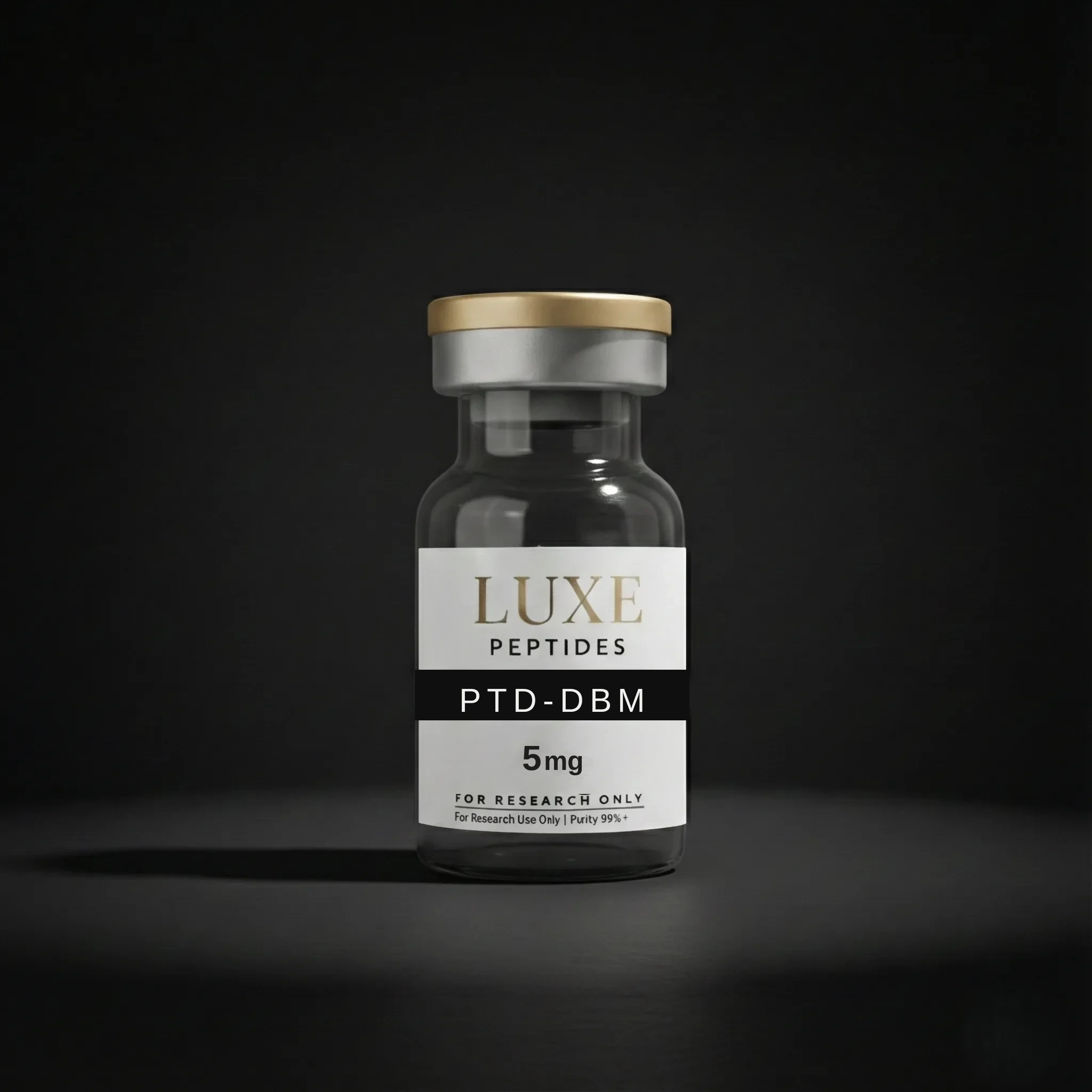
PTD-DBM
$80.00
- Ships same day on orders placed by 3pm ET. Most US orders arrive in 2–4 days.
- Free shipment protection on every order
- Third-party tested · CoA on file
- Discreet, tracked shipping
- Free shipping over $200
- Members earn 5% back in store credit
What is PTD-DBM?
PTD-DBM is a synthetic cell-penetrating peptide investigated for its ability to disrupt the CXXC5–Dishevelled (Dvl) protein interaction within the Wnt/β-catenin signaling pathway. Structurally it fuses three modular elements into a single chain: an octa-arginine (R₈) protein-transduction domain that mediates cellular uptake, a tetraglycine (GGGG) linker, and the Dishevelled-binding motif (RKTGHQICKFRKC) derived from the CXXC5 sequence. The peptide contains two cysteine residues and is supplied as a lyophilized solid. PTD-DBM has been characterized in preclinical rodent models of hair-follicle neogenesis and cutaneous wound healing. This material is offered strictly for research use only and is not for human consumption, diagnostic, or therapeutic use.
Mechanism of Action
CXXC5 is a negative-feedback regulator of Wnt/β-catenin signaling that binds the PDZ domain of Dishevelled (Dvl) and thereby suppresses downstream pathway activity. PTD-DBM has been investigated as a competing peptide that mimics the Dishevelled-binding motif of CXXC5, occupying the Dvl interaction surface and displacing endogenous CXXC5. In preclinical studies, disrupting the CXXC5–Dvl interaction relieved this inhibitory brake, allowing β-catenin to accumulate and Wnt-responsive transcription to proceed. The appended octa-arginine protein-transduction domain has been studied for facilitating intracellular delivery of the peptide across cell membranes, a prerequisite for engaging the cytosolic Dvl scaffold. Reported preclinical effects on hair-follicle regeneration are attributed to this targeted re-activation of the Wnt/β-catenin axis.
Published Research
CXXC5 Targeting and Hair Neogenesis
Lee et al. (2017) identified CXXC5 as a negative regulator of hair growth acting through Dishevelled and reported that a competing peptide disrupting the CXXC5–Dishevelled interaction activated the Wnt/β-catenin pathway and accelerated hair regrowth and wound-induced hair-follicle neogenesis in mouse models [1].
CXXC5 as a Wnt Negative-Feedback Regulator
Kim et al. (2015) characterized CXXC5 as a negative-feedback regulator of Wnt/β-catenin signaling that inhibits osteoblast differentiation via interaction with Dishevelled, and showed that suppressing the Dvl–CXXC5 interaction with a competitor peptide reactivated the pathway in preclinical systems [2].
Structural Basis of the Dvl–CXXC5 Interaction
Lee et al. (2017) determined the crystal structure of the mouse Dishevelled-1 PDZ domain and characterized its interaction with CXXC5, providing structural insight into the binding interface targeted by competing peptides [3].
Product Specifications
| Product | PTD-DBM Lyophilized Powder |
|---|---|
| Available Sizes | 5mg |
| Purity | ≥99% (HPLC verified) |
| CAS Number | 1609454-11-6 |
| Sequence | R₈-GGGG-RKTGHQICKFRKC |
| Molecular Formula | C₁₂₄H₂₂₅N₆₁O₂₈S₂ |
| Molecular Weight | ~3082.6 g/mol |
| Appearance | White lyophilized powder in glass vial |
| Storage | Store lyophilized at -20°C. Reconstituted solution at 2-8°C. |
| Testing | Third-party tested — Certificate of Analysis available |
Storage & Stability
Store lyophilized at -20°C. Reconstituted solution at 2-8°C.
Certificate of Analysis
| Purity (HPLC-UV / MS) | ≥99% | Pass |
| Identity | Confirmed by HPLC-UV / MS | Verified |
| Appearance | White lyophilized powder in glass vial | Pass |
Frequently Asked Questions
PTD-DBM is a synthetic cell-penetrating peptide studied as a competing peptide that disrupts the CXXC5–Dishevelled interaction in the Wnt/β-catenin pathway. It combines an octa-arginine transduction domain, a tetraglycine linker, and a Dishevelled-binding motif. It is intended for laboratory research use only.
PTD refers to the protein-transduction domain (an octa-arginine, R₈, sequence that facilitates cellular uptake), and DBM refers to the Dishevelled-binding motif derived from CXXC5. Together they form a single chain designed to enter cells and engage Dishevelled.
CXXC5 is a negative-feedback regulator of Wnt/β-catenin signaling that binds Dishevelled and suppresses the pathway. PTD-DBM has been investigated as a peptide that competes with CXXC5 for Dishevelled, relieving this inhibition in preclinical models.
Published preclinical research has examined PTD-DBM and related competing peptides in the context of Wnt/β-catenin pathway modulation, hair-follicle neogenesis, wound-induced hair regrowth, and the structural biology of the Dishevelled–CXXC5 interaction.
PTD-DBM has the molecular formula C₁₂₄H₂₂₅N₆₁O₂₈S₂ (reduced free-thiol form) with an average molecular weight of approximately 3082.6 g/mol. Its CAS number is 1609454-11-6.
Store the lyophilized peptide at -20°C protected from moisture. Reconstituted solution should be kept refrigerated at 2-8°C. PTD-DBM contains two cysteine residues and is sensitive to oxidation; minimize freeze-thaw cycles.
No. PTD-DBM is a research chemical supplied for laboratory research use only. It is not a drug or supplement and is not for human consumption, clinical, or therapeutic use.
References
Lee SH, Seo SH, Lee DH, Pi LQ, Lee WS, Choi KY. Targeting of CXXC5 by a Competing Peptide Stimulates Hair Regrowth and Wound-Induced Hair Neogenesis. J Invest Dermatol. 2017;137(11):2260-2269. PMID: 28595998
View sourceKim HY, Yang DH, Shin SW, et al. CXXC5 is a negative-feedback regulator of the Wnt/β-catenin pathway involved in osteoblast differentiation. Cell Death Differ. 2015;22(6):912-920. PMID: 25633194
View sourceLee I, Choi S, Yun JH, et al. Crystal structure of the PDZ domain of mouse Dishevelled 1 and its interaction with CXXC5. Biochem Biophys Res Commun. 2017;485(3):584-590. PMID: 27932247
View source


Customer Reviews
No reviews yet.