

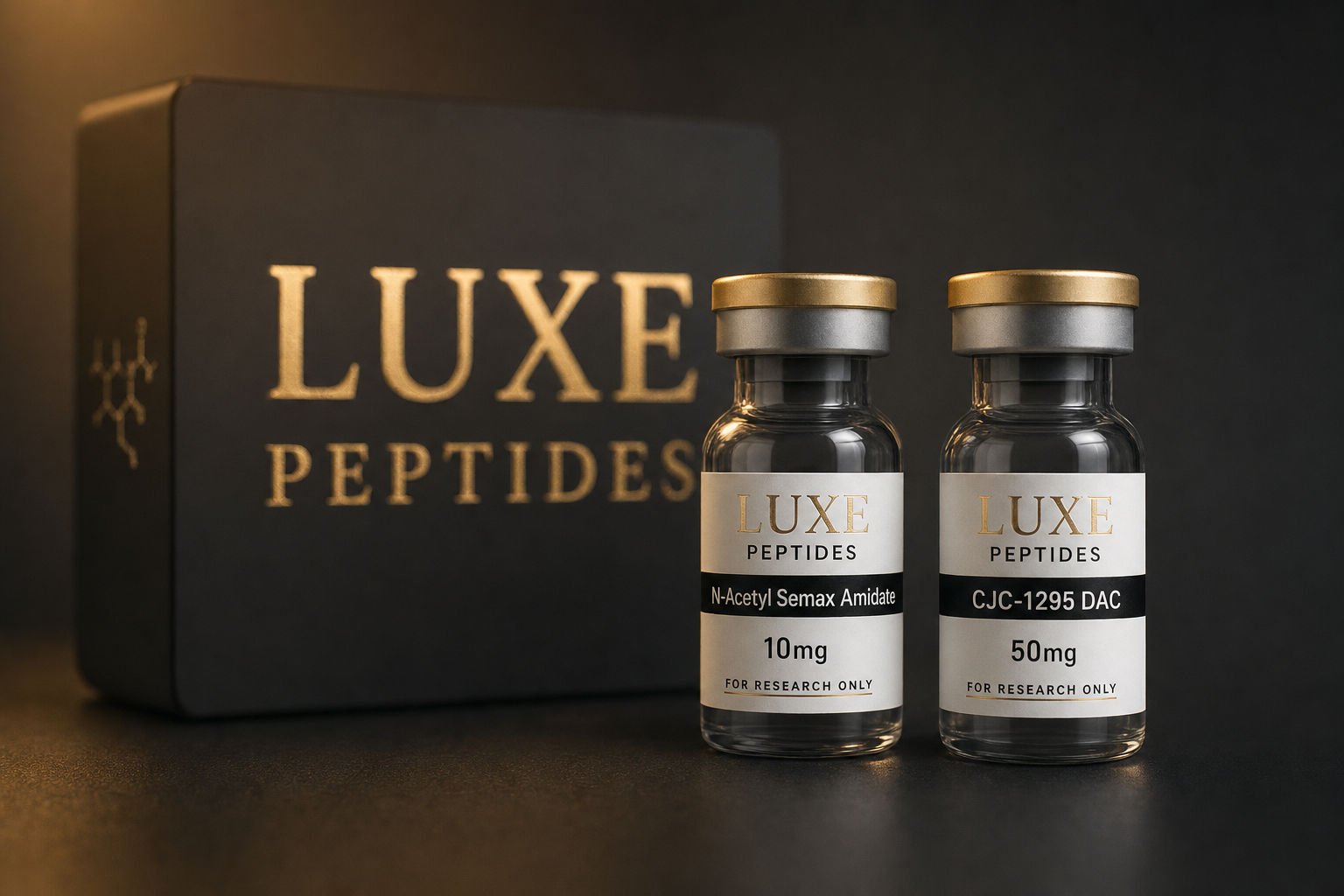
The following is provided strictly for laboratory research purposes. The compounds discussed are research chemicals, are not drugs, foods or cosmetics, and are not intended for human or veterinary use.
Two entries in a catalogue can share almost the same name and still be different chemical entities. “Semax” and “N-Acetyl Semax Amidate” differ by roughly 41 daltons and two blocked reaction sites. “CJC-1295 with DAC” and “CJC-1295 no DAC” share an identical 29-residue backbone and differ by a single appended residue carrying a maleimide group — a difference that has been reported to separate their circulating persistence by orders of magnitude. This article covers what those three modifications actually do at the level of chemistry, and why a modified analogue should be treated in the laboratory as a distinct compound rather than as a variant of its parent.
Reviewed for research accuracy · 1 August 2026
The problem the modifications address: exopeptidases
An unmodified synthetic peptide presents two chemically reactive ends. The N-terminus carries a free α-amino group (–NH3+ at physiological pH); the C-terminus carries a free carboxylate (–COO−). Both are recognition features, not just structural details.
Aminopeptidases are a broad class of enzymes — abundant in serum, on cell surfaces, and in most tissue homogenates — that bind the free protonated N-terminal amine and cleave the first residue. Carboxypeptidases do the mirror-image job at the free C-terminal carboxylate. Because these enzymes require a free, correctly charged terminus to dock, they are described as exopeptidases: they chew inward from the ends rather than cutting internally. Short peptides are disproportionately vulnerable to them, since a peptide only five to ten residues long has very little sequence between its two exposed ends.
Reviews of peptide pharmacokinetics have long identified terminal proteolysis, alongside renal filtration of small molecular-weight species, as a principal reason unmodified peptides show plasma half-lives measured in minutes rather than hours (Werle and Bernkop-Schürch, 2006; Fosgerau and Hoffmann, 2015). Terminal capping and carrier conjugation are the two classical structural responses to that problem, and they attack it in completely different ways.
N-terminal acetylation: capping the amine
N-terminal acetylation transfers an acetyl group (CH3CO–) onto the free α-amino group, converting a primary amine into an amide. The consequences are threefold. The mass increases by approximately 42.01 Da. The permanent positive charge at that terminus is neutralised, which shifts the molecule’s isoelectric point and modestly increases its hydrophobicity. And, most relevant here, the structural feature that aminopeptidases recognise is no longer present, so N-terminal degradation is substantially slowed.
This is not an artificial trick. N-terminal acetylation is one of the most common co-translational protein modifications in eukaryotic cells, carried out by a family of N-terminal acetyltransferases, where it influences protein stability, localisation and interaction partners. Synthetic acetylation borrows an established biological strategy.
C-terminal amidation: neutralising the carboxylate
C-terminal amidation converts the terminal carboxylic acid (–COOH) to a carboxamide (–CONH2). The mass change is small and negative — roughly −0.98 Da, since a hydroxyl is exchanged for an amine — which makes it easy to overlook on a spec sheet and easy to confirm by mass spectrometry if looked for. The functional change is not small. The negative terminal charge disappears, and the carboxypeptidase recognition site goes with it.
Amidation also has a second dimension that acetylation largely lacks: for many endogenous neuropeptides, the amide is required for receptor binding rather than merely protective. A substantial fraction of mammalian neuropeptides are natively α-amidated by peptidylglycine α-amidating monooxygenase, and for several of them the free-acid form is markedly less active at the cognate receptor (Eipper et al., 1992). The practical implication for research work is that amidation cannot be assumed to be a purely pharmacokinetic edit — it can alter target engagement as well.
Why “N-acetyl [X] amidate” is a different compound
When both caps are applied, the resulting molecule has a different molecular formula, a different molecular weight, a different charge distribution, a different CAS registry entry where one exists, and a different proteolytic profile from its parent. Analytical data generated for the parent does not characterise the analogue. Reconstitution arithmetic performed with the parent’s molecular weight will be wrong for the analogue, and a certificate of analysis for one is not a certificate for the other.
Catalogue items in this family include N-Acetyl Semax Amidate and N-Acetyl Selank Amidate — doubly capped versions of two short proline-containing peptides studied in preclinical neuroscience research — and NA-Epitalon, the capped form of the tetrapeptide Ala-Glu-Asp-Gly, which has been examined in cell and animal models for reported effects on telomerase expression. Adamax is described as a further structurally modified analogue within the same short-peptide family. In each case the modified molecule warrants its own identity documentation; compound-specific analytical records are indexed in the COA library, and the correct molecular weight should be used in the reconstitution calculator when preparing laboratory stock concentrations.
DAC: a different mechanism entirely
The drug affinity complex (DAC) is not a terminal cap. It is a bioconjugation handle — a maleimidopropionyl group appended via an added lysine residue at the end of the peptide chain. Maleimides undergo rapid, selective Michael addition with free thiols. In plasma, the dominant free thiol available is cysteine-34 of serum albumin, which is unusual in circulating proteins for carrying an unpaired, reduced cysteine.
The result is that the peptide forms a covalent conjugate with a roughly 67 kDa carrier protein after it enters circulation. Albumin is far too large for glomerular filtration and is actively recycled by the neonatal Fc receptor, which is why it exhibits a circulating half-life measured in weeks rather than minutes. Peptides tethered to it inherit a substantial part of that persistence — the general principle behind albumin-based half-life extension strategies reviewed by Kratz (2008).
This is the whole distinction between CJC-1295 with DAC and CJC-1295 no DAC (also catalogued as modified GRF 1-29). Both are the same 1-29 fragment of growth hormone-releasing hormone carrying four amino acid substitutions, including a D-alanine at position 2 that blocks dipeptidyl peptidase-4 cleavage and a leucine substitution that removes an oxidation-prone methionine. Both are therefore protease-hardened relative to native GHRH 1-29. Only the DAC version carries the maleimide-bearing lysine, and only the DAC version conjugates to albumin. Limited human pharmacokinetic data for the DAC-modified form has been reported to show measurable circulating presence over a period of days (Teichman et al., 2006), whereas the non-DAC form is described in the literature as clearing on a timescale of minutes.
The important framing is that “no DAC” is not a weaker version of the same thing. The two are distinct pharmacokinetic entities: one produces a brief exposure profile, the other a sustained one. Research protocols designed around one are not transferable to the other.
Comparison of the three modifications
| Modification | Chemical change | Approx. mass shift | Degradation route addressed | Reported consequence in research models |
|---|---|---|---|---|
| N-terminal acetylation | Free α-amine → acetamide | +42.01 Da | Aminopeptidases | Slowed N-terminal trimming; loss of terminal positive charge; modestly increased hydrophobicity |
| C-terminal amidation | Carboxylate → carboxamide | −0.98 Da | Carboxypeptidases | Slowed C-terminal trimming; loss of terminal negative charge; may alter receptor affinity, since many native neuropeptides are amidated |
| Both (“N-acetyl … amidate”) | Both termini capped | ~+41 Da net | Both exopeptidase classes | Distinct compound with its own molecular weight, charge profile and analytical identity |
| DAC (maleimide linker) | Added Lys bearing a maleimidopropionyl group | +~200 Da before conjugation; ~67 kDa after | Renal filtration and overall clearance | Covalent conjugation to albumin Cys34; circulating persistence extended from minutes to days in reported data |
Limits of the current evidence
Terminal capping is well characterised as a proteolysis-resistance strategy in general peptide chemistry, but the magnitude of the effect is sequence-specific: a peptide whose dominant clearance route is endopeptidase cleavage or renal filtration will benefit less from terminal caps than one limited by exopeptidase attack. Where receptor pharmacology of a capped analogue has not been measured directly, it should not be inferred from the parent. For DAC-modified constructs, conjugation efficiency in vitro depends on the redox state of the available thiol pool, which is a common source of variability between preparations. Much of the primary literature on the short capped neuropeptides in particular consists of animal and in vitro work, with limited and heterogeneous human data.
References
- Werle M, Bernkop-Schürch A. Strategies to improve plasma half life time of peptide and protein drugs. Amino Acids. 2006;30(4):351–367. PMID: 16622600.
- Fosgerau K, Hoffmann T. Peptide therapeutics: current status and future directions. Drug Discovery Today. 2015;20(1):122–128. PMID: 25450771.
- Eipper BA, Stoffers DA, Mains RE. The biosynthesis of neuropeptides: peptide α-amidation. Annual Review of Neuroscience. 1992;15:57–85. PMID: 1575450.
- Kratz F. Albumin as a drug carrier: design of prodrugs, drug conjugates and nanoparticles. Journal of Controlled Release. 2008;132(3):171–183. PMID: 18582981.
- Teichman SL, Neale A, Lawrence B, Gagnon C, Castaigne J-P, Frohman LA. Journal of Clinical Endocrinology & Metabolism. 2006;91(3):799–805. PMID: 16352683.
- Preclinical characterisation of N-terminal acetyltransferase activity and its role in eukaryotic protein stability has been reviewed extensively in the molecular cell biology literature; primary reviews should be consulted directly.
- Studies of N-acetylated, C-terminally amidated analogues of short proline-containing neuropeptides, and of the tetrapeptide Ala-Glu-Asp-Gly, appear largely in the Russian-language neuropeptide literature and are inconsistently indexed; primary reports should be located and verified individually rather than cited by identifier.
Research use only. All compounds referenced are supplied for in vitro laboratory research and are not for human or veterinary use, diagnostic use, or any therapeutic application.