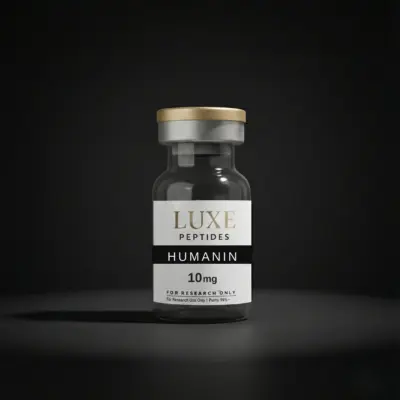
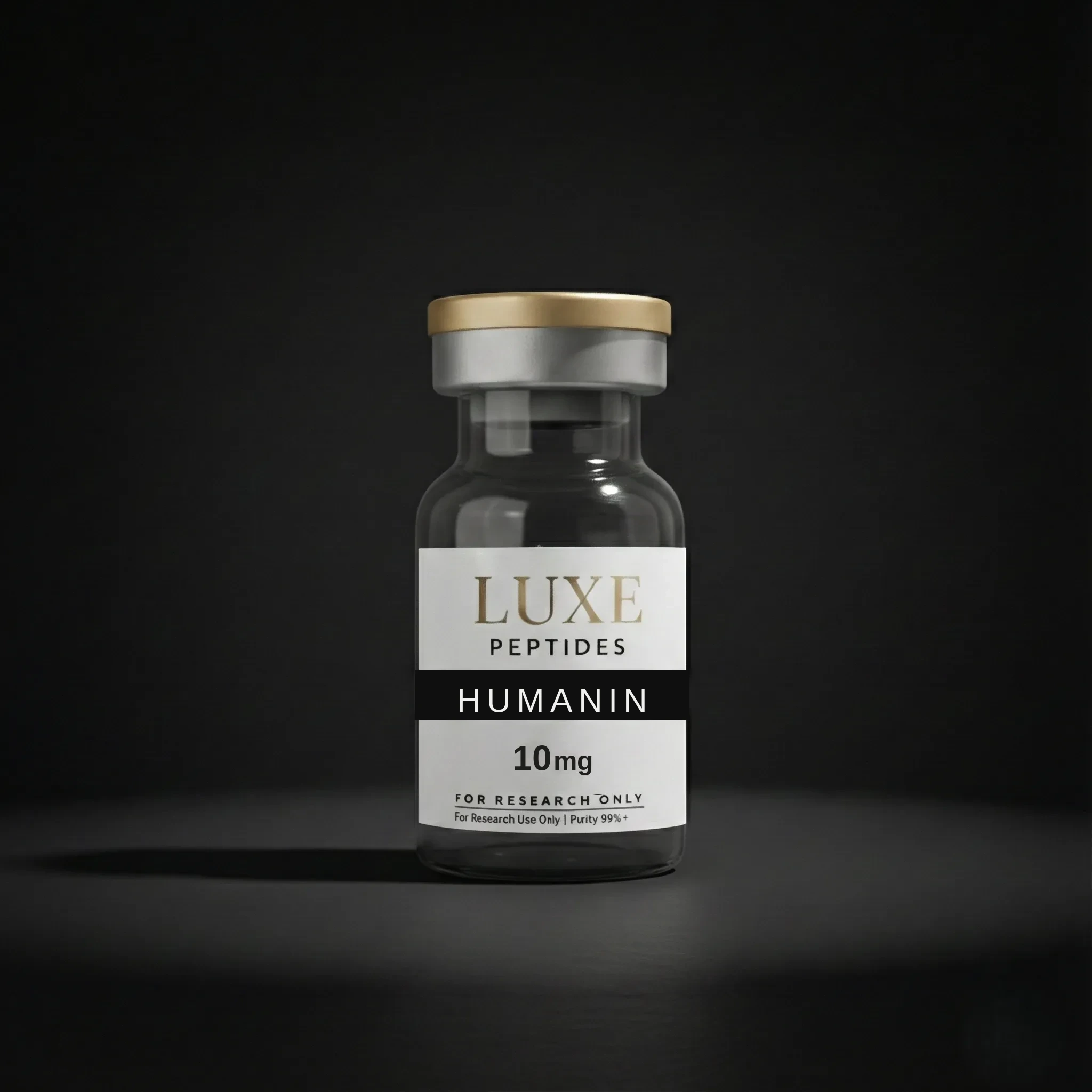
Humanin
$139.00
- Ships same day on orders placed by 3pm ET. Most US orders arrive in 2–4 days.
- Free shipment protection on every order
- Third-party tested · CoA on file
- Discreet, tracked shipping
- Free shipping over $200
- Members earn 5% back in store credit
What is Humanin?
Humanin is a 24-amino-acid mitochondrial-derived peptide (MDP) encoded within an open reading frame in the mitochondrial 16S ribosomal RNA region (MT-RNR2). It was one of the first MDPs to be characterized and has the native human sequence Met-Ala-Pro-Arg-Gly-Phe-Ser-Cys-Leu-Leu-Leu-Leu-Thr-Ser-Glu-Ile-Asp-Leu-Pro-Val-Lys-Arg-Arg-Ala, containing two cysteine residues. This product supplies the native human-sequence peptide; it should not be confused with engineered analogs such as [Gly14]-Humanin (HNG) or the rodent homolog rattin, which carry sequence substitutions. Humanin has been studied in preclinical research as a model peptide for cytoprotective and anti-apoptotic signaling, cellular stress responses, and mitochondrial-to-nuclear communication, alongside related MDPs such as MOTS-c. This material is supplied for research use only and is not for human consumption.
Mechanism of Action
In published preclinical models, Humanin has been investigated for anti-apoptotic and cytoprotective activity. Intracellularly, it has been reported to bind pro-apoptotic Bcl-2 family proteins, including Bax, and to interfere with their translocation to the mitochondrial outer membrane, thereby attenuating mitochondrial outer-membrane permeabilization. Extracellularly, Humanin has been described as signaling through receptor complexes including the formyl peptide receptor-like 1 (FPRL1/FPR2) and a trimeric receptor comprising CNTFR, WSX-1, and gp130, with downstream engagement of STAT3 signaling. These pathways are studied in the context of cellular stress resistance, oxidative-stress responses, and neuronal survival in laboratory research models.
Published Research
Discovery as a Neuronal Rescue Factor
Hashimoto et al. (2001) identified Humanin through functional expression screening and reported that the 24-residue peptide abolished neuronal cell death induced by familial Alzheimer’s disease genes and amyloid-β in cultured cells, establishing it as a cytoprotective factor [1].
Suppression of Apoptosis via Bax
Guo et al. (2003) reported that Humanin interacts with the pro-apoptotic protein Bax and prevents its translocation from the cytosol to mitochondria, suppressing apoptosis induced by stimuli such as staurosporine and serum withdrawal in cell models [2].
Mitochondrial-Derived Peptide Biology
Lee, Yen, and colleagues (2013) reviewed Humanin as a mitochondrial-derived peptide, summarizing its intracellular and extracellular mechanisms and its emerging role in cellular stress resistance [3].
Product Specifications
| Product | Humanin Lyophilized Powder |
|---|---|
| Available Sizes | 10mg |
| Purity | ≥99% (HPLC verified) |
| CAS Number | 330936-69-1 |
| Sequence | MAPRGFSCLLLLTSEIDLPVKRRA |
| Molecular Formula | C₁₁₉H₂₀₄N₃₄O₃₂S₂ |
| Molecular Weight | 2687.2 g/mol |
| Appearance | White lyophilized powder in glass vial |
| Storage | Store lyophilized at -20°C. Reconstituted solution at 2-8°C. |
| Testing | Third-party tested — Certificate of Analysis available |
Storage & Stability
Store lyophilized at -20°C. Reconstituted solution at 2-8°C.
Certificate of Analysis
| Purity (HPLC-UV / MS) | ≥99% | Pass |
| Identity | Confirmed by HPLC-UV / MS | Verified |
| Appearance | White lyophilized powder in glass vial | Pass |
Certificates of Analysis — Janoshik
Third-party tested · Independent analytical lab
| Tested | Measured | Purity |
|---|---|---|
| May 2026 | 11.18mg | 97.59% |
| Jan 2026 | 9.77mg | 99.05% |
Frequently Asked Questions
Humanin is a 24-amino-acid mitochondrial-derived peptide (MDP) encoded within the mitochondrial 16S rRNA region (MT-RNR2). It is supplied here as a research compound for laboratory use only.
This product is the native human Humanin sequence (MAPRGFSCLLLLTSEIDLPVKRRA). It is distinct from engineered variants such as [Gly14]-Humanin (HNG) and from the rodent homolog rattin, which carry amino-acid substitutions.
Humanin has the molecular formula C₁₁₉H₂₀₄N₃₄O₃₂S₂ and an average molecular weight of approximately 2687.2 g/mol. Its CAS number is 330936-69-1.
In published preclinical literature Humanin has been studied in the context of anti-apoptotic and cytoprotective signaling, mitochondrial biology, cellular stress responses, and neuronal and metabolic research models.
Both Humanin and MOTS-c are mitochondrial-derived peptides (MDPs) encoded within the mitochondrial genome. They are studied as part of a broader family of peptides involved in mitochondrial-to-nuclear signaling research.
No. Humanin is sold strictly as a research chemical for in-vitro laboratory study. It is for research use only and is not for human consumption or any therapeutic or diagnostic application.
References
Hashimoto Y, Niikura T, Tajima H, et al. A rescue factor abolishing neuronal cell death by a wide spectrum of familial Alzheimer's disease genes and Abeta. Proc Natl Acad Sci U S A. 2001;98(11):6336-6341. PMID: 11371646
View sourceGuo B, Zhai D, Cabezas E, et al. Humanin peptide suppresses apoptosis by interfering with Bax activation. Nature. 2003;423(6938):456-461. PMID: 12732850
View sourceLee C, Yen K, Cohen P. Humanin: a harbinger of mitochondrial-derived peptides? The emerging role of the mitochondrial-derived peptide humanin in stress resistance. J Mol Endocrinol. 2013;50(1):R11-R19. PMID: 23239898
View source
Customer Reviews
No reviews yet.