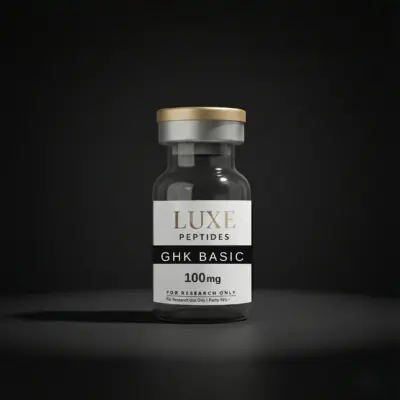
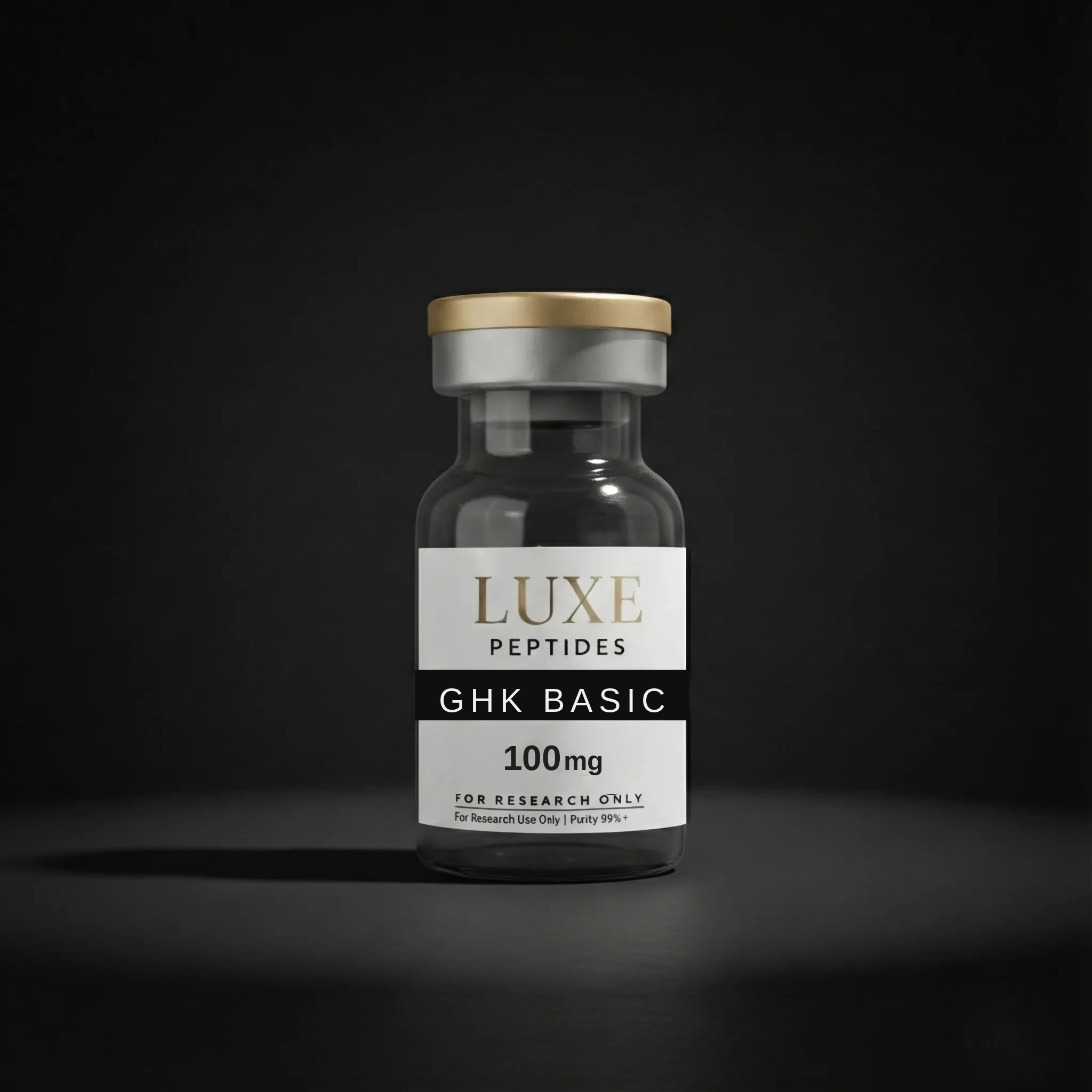
GHK Basic
$79.00
- Ships same day on orders placed by 3pm ET. Most US orders arrive in 2–4 days.
- Free shipment protection on every order
- Third-party tested · CoA on file
- Discreet, tracked shipping
- Free shipping over $200
- Members earn 5% back in store credit
What is GHK Basic?
GHK Basic is the metal-free form of the tripeptide GHK (glycyl-L-histidyl-L-lysine), a naturally occurring sequence of glycine, L-histidine, and L-lysine. In its apo form it carries no bound metal, distinguishing it from the pre-formed blue-green GHK-Cu copper complex (CAS 89030-95-5) in which the same tripeptide is coordinated to a copper(II) ion. GHK occurs endogenously in human plasma, with reported levels declining markedly with age. The histidine imidazole and the N-terminal amine and lysine side chain give GHK a high intrinsic affinity for copper(II), and as the free apo-peptide it has been studied in preclinical and in vitro research as a copper-binding ligand and as a signaling molecule implicated in extracellular-matrix remodeling, collagen and metalloproteinase regulation, and antioxidant and anti-inflammatory gene-expression pathways. GHK Basic is intended for research use only and is not for human consumption.
Mechanism of Action
GHK Basic has been investigated for its copper-coordination chemistry and its role as a modulator of tissue-remodeling gene expression. The free apo-peptide binds copper(II) with high affinity through its N-terminal amine, the histidine imidazole nitrogen, and the deprotonated amide nitrogen, forming the GHK-Cu species that figures in much of the published literature; researchers have studied this exchange as a mechanism by which GHK may shuttle copper between extracellular carriers and cells in vitro. In cultured fibroblast and skin-cell models, GHK and GHK-Cu have been associated with stimulation of collagen and glycosaminoglycan synthesis and with modulation of matrix metalloproteinases and their tissue inhibitors. Gene-expression profiling studies have reported that GHK-Cu alters the transcription of a broad set of genes linked to tissue remodeling, antioxidant defense, and inflammatory signaling. These observations derive from preclinical and in vitro research and characterize the compound’s studied biochemistry rather than any therapeutic effect.
Published Research
Copper Binding and Skin-Regeneration Signaling
Pickart, Vasquez-Soltero, and Margolina (2015) reviewed GHK and GHK-Cu as modulators of multiple cellular pathways, summarizing in vitro and preclinical data on the peptide’s copper-binding behavior and its associations with collagen synthesis, antioxidant activity, and anti-inflammatory signaling in skin-cell models [1].
Gene-Expression Modulation
Pickart and Margolina (2018) reviewed gene-expression data indicating that GHK-Cu influences the transcription of a large set of genes involved in tissue remodeling, DNA repair, and antioxidant and inflammatory pathways, framing the apo-peptide’s copper-coordination chemistry as central to these reported effects [2].
Collagen Synthesis in Fibroblast Culture
Maquart et al. (1988) reported that the GHK-copper complex stimulated collagen synthesis in cultured fibroblasts, providing an early in vitro basis for subsequent extracellular-matrix research on the tripeptide [3].
Product Specifications
| Product | GHK Basic Lyophilized Powder |
|---|---|
| Available Sizes | 100mg |
| Purity | ≥99% (HPLC verified) |
| CAS Number | 49557-75-7 |
| Sequence | Gly-His-Lys |
| Molecular Formula | C₁₄H₂₄N₆O₄ |
| Molecular Weight | 340.38 g/mol |
| Appearance | White lyophilized powder in glass vial |
| Storage | Store lyophilized at -20°C. Reconstituted solution at 2-8°C. |
| Testing | Third-party tested — Certificate of Analysis available |
Storage & Stability
Store lyophilized at -20°C. Reconstituted solution at 2-8°C.
Certificate of Analysis
| Purity (HPLC-UV / MS) | ≥99% | Pass |
| Identity | Confirmed by HPLC-UV / MS | Verified |
| Appearance | White lyophilized powder in glass vial | Pass |
Frequently Asked Questions
GHK Basic is the metal-free (apo) form of the tripeptide GHK, glycyl-L-histidyl-L-lysine, supplied without bound copper. It is a research chemical intended for laboratory use only.
GHK Basic is the free tripeptide and carries no metal, while GHK-Cu is the same peptide pre-coordinated to a copper(II) ion and appears blue-green. The two have different CAS numbers (49557-75-7 for metal-free GHK versus 89030-95-5 for GHK-Cu).
GHK consists of glycine, L-histidine, and L-lysine in sequence (Gly-His-Lys).
In preclinical and in vitro studies, GHK and GHK-Cu have been investigated in the context of copper-coordination chemistry, extracellular-matrix remodeling, collagen and metalloproteinase regulation, and antioxidant, anti-inflammatory, and gene-expression signaling.
The N-terminal amine, the histidine imidazole nitrogen, and an amide nitrogen of GHK together create a high-affinity coordination site for copper(II), which is why the apo-peptide readily forms the GHK-Cu complex.
No. GHK Basic is sold strictly for research use only. It is not a drug or dietary supplement and is not for human consumption.
References
Pickart L, Vasquez-Soltero JM, Margolina A. GHK Peptide as a Natural Modulator of Multiple Cellular Pathways in Skin Regeneration. Biomed Res Int. 2015;2015:648108. PMID: 26236730
View sourcePickart L, Margolina A. Regenerative and Protective Actions of the GHK-Cu Peptide in the Light of the New Gene Data. Int J Mol Sci. 2018;19(7):1987. PMID: 29986520
View sourceMaquart FX, Pickart L, Laurent M, Gillery P, Monboisse JC, Borel JP. Stimulation of collagen synthesis in fibroblast cultures by the tripeptide-copper complex glycyl-L-histidyl-L-lysine-Cu2+. FEBS Lett. 1988;238(2):343-346. PMID: 3169264
View source
Customer Reviews
No reviews yet.