

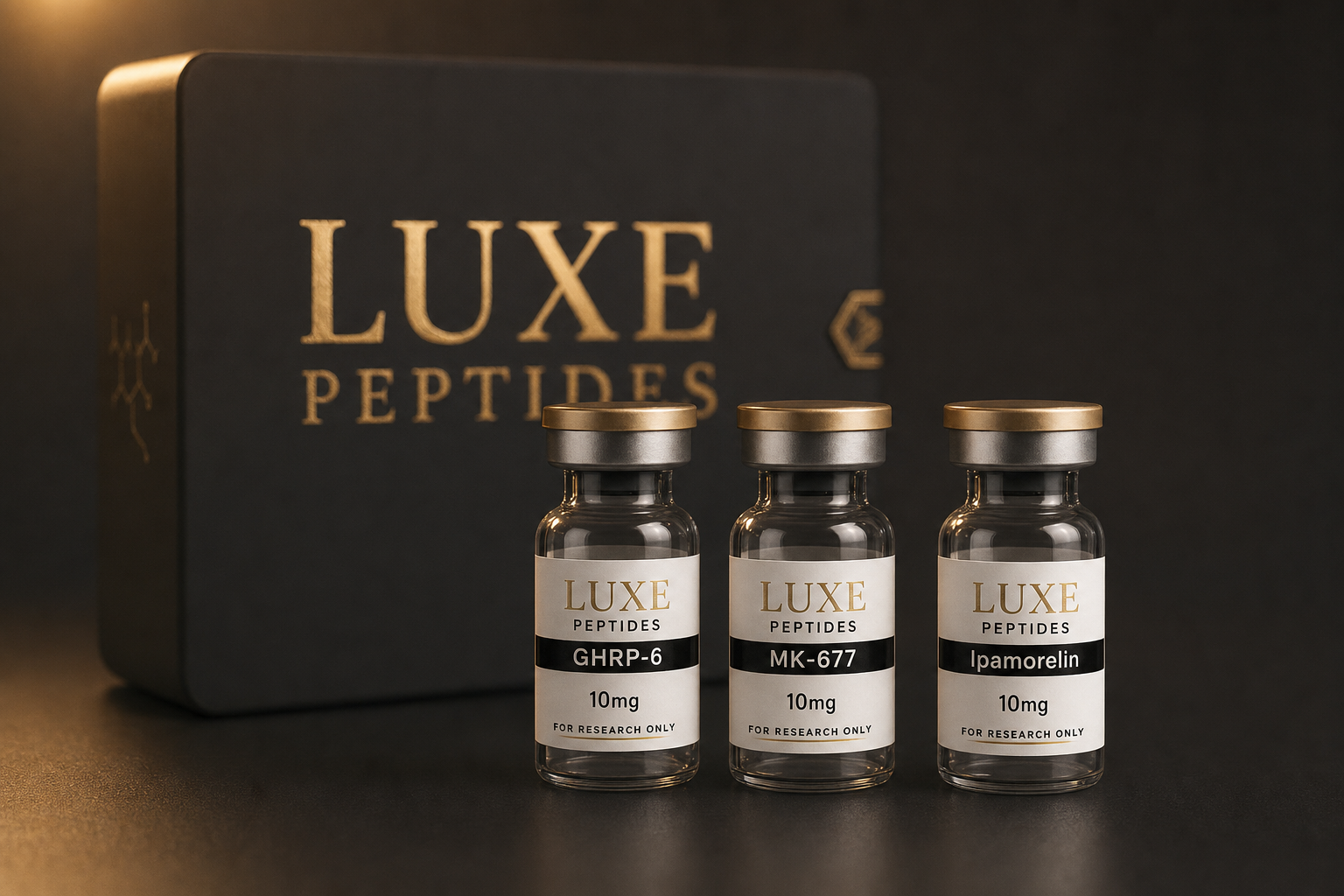
The following is provided for laboratory research use only; the compounds discussed are not approved for human or veterinary use and are not intended to diagnose, treat, cure, or prevent any condition.
Growth hormone (GH) secretagogues are a class of molecules studied for their ability to stimulate GH release through the growth hormone secretagogue receptor (GHS-R1a), the same receptor targeted by the endogenous peptide ghrelin. Three compounds recur throughout the preclinical literature: GHRP-6, MK-677 (ibutamoren), and Ipamorelin. Although researchers group them together by receptor target, they differ substantially in chemical class, selectivity, and the secondary hormonal responses observed in research models. This article compares the three on mechanism and research profile only.
Shared mechanism: the GHS-R1a pathway
All three compounds are studied as agonists of GHS-R1a, a G-protein-coupled receptor expressed in the hypothalamus and pituitary. In research models, activation of this receptor is associated with pulsatile GH release from somatotroph cells and, indirectly, with modulation of somatostatin tone. Because the receptor is the ghrelin receptor, investigators frequently examine these secretagogues alongside ghrelin biology. The mechanistic distinction between the three lies less in which receptor they engage and more in their selectivity for GH release versus the co-secretion of other pituitary and adrenal hormones, and in their pharmacokinetic behavior.
GHRP-6: the first-generation peptide
GHRP-6 is a synthetic hexapeptide and one of the earliest growth hormone-releasing peptides characterized in the literature. In preclinical and early human investigational studies, GHRP-6 has been observed to stimulate GH release; it is also noted in the research record for its associated effects on other axes. Studies indicate that GHRP-6 administration is associated with increases in cortisol and prolactin, and it has been widely used in research as a probe of ghrelin-mediated signaling, including its broader ghrelin-receptor signaling profile in animal models. This broader secondary profile is a defining feature that later secretagogues were designed to reduce. Researchers sourcing this peptide can review the GHRP-6 product page for specifications.
Ipamorelin: a selective pentapeptide
Ipamorelin is a synthetic pentapeptide developed specifically to improve GH selectivity relative to earlier GHRPs. In the foundational preclinical characterization, Ipamorelin was reported to stimulate GH release with a potency comparable to GHRP-6 but without the marked elevations in ACTH and cortisol observed with the earlier peptide, and with minimal effect on prolactin (Raun et al., 1998). This selectivity is the principal reason Ipamorelin appears frequently in research designs where investigators wish to isolate GH-axis effects from confounding adrenal or prolactin responses. As a peptide, it shares the injectable-research-format and relatively short duration of action characteristic of the GHRP family. Specifications are available on the Ipamorelin product page.
MK-677 (ibutamoren): the orally active non-peptide
MK-677, also called ibutamoren, differs from the other two in a fundamental way: it is not a peptide but a small-molecule, spiropiperidine-based GHS-R1a agonist. Its defining research characteristics are oral bioavailability and a substantially longer duration of action. In clinical research settings, MK-677 has been reported to produce sustained increases in GH and IGF-1 concentrations, with studies examining sustained daily exposure in investigational contexts. Because its half-life supports prolonged receptor engagement, MK-677 is studied where a longer, more continuous elevation of the GH/IGF-1 axis is the variable of interest, in contrast to the pulsatile stimulation associated with the injectable peptides.
Comparison table
| Attribute | GHRP-6 | MK-677 (Ibutamoren) | Ipamorelin |
|---|---|---|---|
| Chemical class | Hexapeptide | Non-peptide small molecule | Pentapeptide |
| Receptor target (research) | GHS-R1a | GHS-R1a | GHS-R1a |
| GH selectivity (preclinical) | Lower; associated co-secretion | Moderate; sustained axis stimulation | High; GH-selective in models |
| Cortisol / ACTH association | Observed elevation in studies | Reported minimal at studied levels | Reported minimal |
| Prolactin association | Observed elevation | Reported minimal | Reported minimal |
| Duration of action (research) | Short | Long (supports sustained-exposure study designs) | Short |
| Oral bioavailability | No (research injectable format) | Yes | No (research injectable format) |
| Generation | First-generation GHRP | Non-peptide secretagogue | Later-generation, selectivity-optimized |
How researchers frame the distinctions
The three compounds are best understood as points along two axes rather than as substitutes for one another. The first axis is selectivity: GHRP-6 sits at the less-selective end, with a research record of co-secretion of cortisol and prolactin, while Ipamorelin was engineered toward the selective end for GH-axis isolation. The second axis is pharmacokinetics and route: the two peptides act briefly and are handled in injectable research formats, whereas MK-677 is orally active with a long duration, making it distinct in study designs concerned with sustained IGF-1 elevation. A researcher designing an experiment on pulsatile GH signaling, an experiment isolating GH from adrenal confounders, and an experiment on prolonged axis stimulation would plausibly select GHRP-6, Ipamorelin, and MK-677 respectively.
For laboratory handling, reconstitution of the peptide compounds is straightforward arithmetic based on the desired concentration and the diluent volume; the reconstitution calculator assists with that math, and batch-specific analytical data is published in the COA library.
Reviewed for research accuracy
Reviewed for research accuracy on 2026-07-11. Statements describe findings reported in preclinical and investigational literature and are not claims about outcomes in humans.
References
- Raun K, Hansen BS, Johansen NL, et al. Ipamorelin, the first selective growth hormone secretagogue. European Journal of Endocrinology. 1998;139(5):552–561. PMID: 9849822.
- Bowers CY. Growth hormone-releasing peptide (GHRP). Foundational pharmacology of the GHRP family, including GHRP-6, described across the endocrinology literature.
- Clinical and preclinical investigations of MK-677 (ibutamoren) have examined its oral bioavailability and sustained effects on the GH/IGF-1 axis; see the peer-reviewed endocrinology literature on non-peptide growth hormone secretagogues.
Research use only. The compounds discussed are intended solely for laboratory research and are not for human or veterinary use, consumption, or administration of any kind.