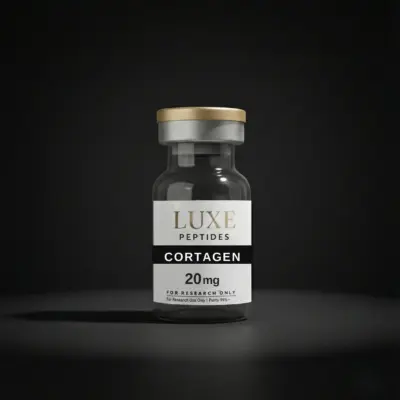
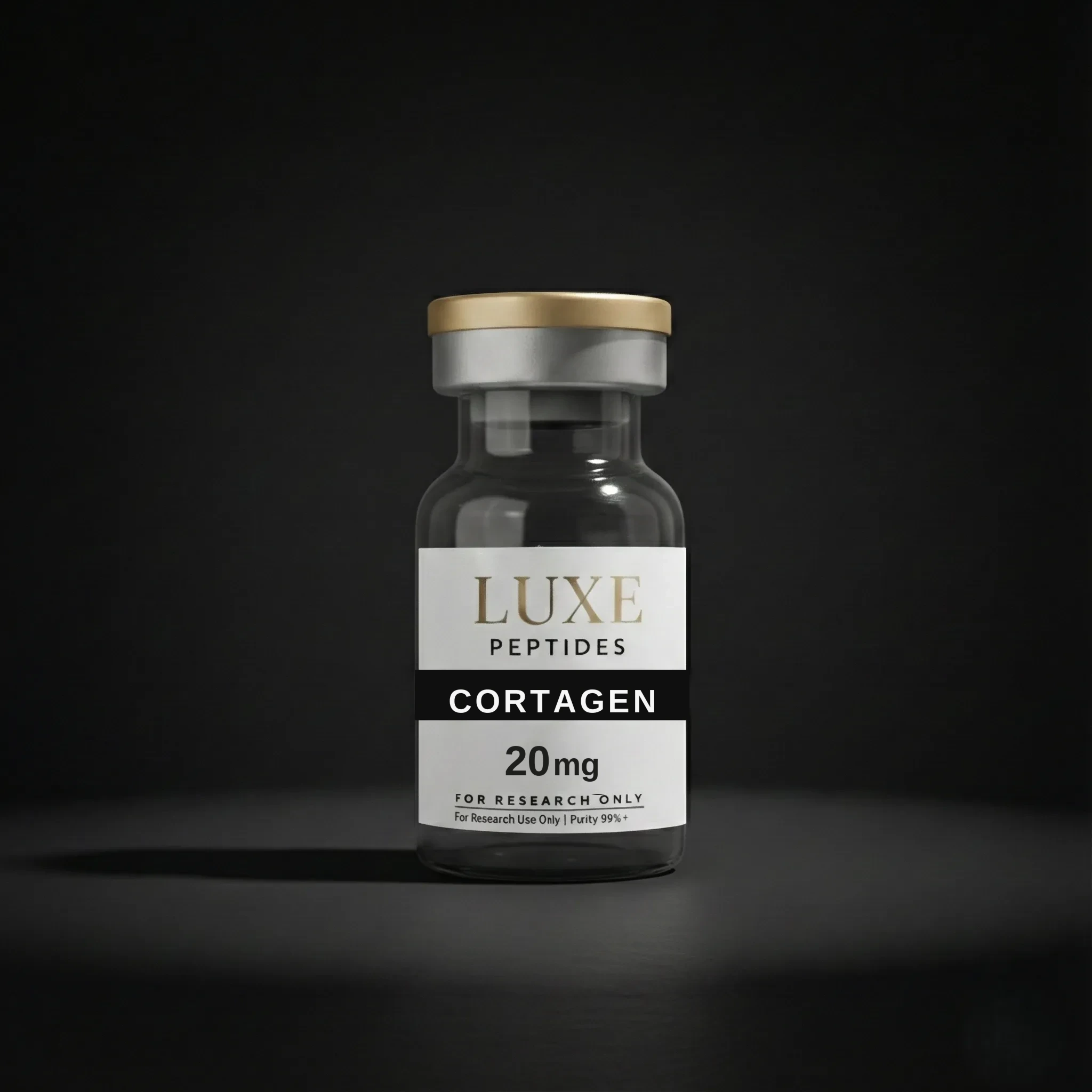
Cortagen
$45.00
- Ships same day on orders placed by 3pm ET. Most US orders arrive in 2–4 days.
- Free shipment protection on every order
- Third-party tested · CoA on file
- Discreet, tracked shipping
- Free shipping over $200
- Members earn 5% back in store credit
What is Cortagen?
Cortagen is a synthetic tetrapeptide bioregulator with the sequence Ala-Glu-Asp-Pro (AEDP), obtained by directed synthesis based on the amino-acid composition of the brain-cortex peptide preparation Cortexin. It belongs to the Khavinson class of short peptide bioregulators developed at the St. Petersburg Institute of Bioregulation and Gerontology, a family of tri- and tetrapeptides studied for tissue-associated activity in laboratory models. Cortagen is the cerebral-cortex-associated member of that family and is studied in preclinical research on peptide bioregulation, transcriptional profiling, and nervous-tissue models, alongside related short peptides such as Epitalon and Vilon. Most of the published Cortagen literature comes from Russian-language journals including Bulletin of Experimental Biology and Medicine and Advances in Gerontology. This material is supplied for research use only and is not for human consumption.
Mechanism of Action
Cortagen has no established receptor target; in published preclinical work it is investigated as a gene-regulatory signal rather than as a ligand for a defined receptor. The prevailing hypothesis in the Khavinson bioregulator literature is that short, charged peptides of this class interact with nucleic acids and chromatin to modulate transcription in a tissue-associated manner, and microarray work in mice has reported altered expression of a defined set of transcripts following Cortagen administration. Structurally, the two acidic residues (Glu, Asp) give the peptide a strongly anionic centre, while the C-terminal proline constrains backbone rotation; both features are examined in structure-activity studies of this peptide class. Downstream endpoints reported in animal research models include markers of lipid peroxidation and antioxidant capacity in brain tissue and functional measures of peripheral nerve regeneration. These mechanisms remain hypotheses under investigation in laboratory research models.
Published Research
Gene Expression Profiling in a Mouse Model
Anisimov, Khavinson, and Anisimov (2004) administered Cortagen (Ala-Glu-Asp-Pro) to female CBA mice for five consecutive days and profiled 15,247 cardiac transcripts by cDNA microarray. They reported 234 clones (1.53% of the total) with significant expression changes, matching 110 known genes, and compared the resulting profile against those of the related peptides Vilon and Epitalon, identifying both shared and Cortagen-specific effects [1].
Chronic Cerebral Ischemia Research Models
Zarubina and Shabanov (2011) compared cortagen with the polypeptide preparation cortexin in rats subjected to chronic brain ischemia. In this animal research model both preparations were reported to accelerate recovery of disturbed individual behaviour and to limit excessive activation of lipid peroxidation alongside a fall in antioxidant activity in brain tissue [2].
Peripheral Nerve Regeneration Studies
Turchaninova and colleagues (2000) examined tetrapeptide cortagen in a rat sciatic-nerve transection-and-suture model, administering 10 µg/kg intramuscularly for ten days. They reported increases of 27% in growth rate and 40% in conduction velocity in the regenerating nerve fibres relative to control [3].
Product Specifications
| Product | Cortagen Lyophilized Powder |
|---|---|
| Available Sizes | 20mg |
| Purity | ≥99% (HPLC verified) |
| CAS Number | 335591-03-2 |
| Sequence | Ala-Glu-Asp-Pro (AEDP) |
| Molecular Formula | C₁₇H₂₆N₄O₉ |
| Molecular Weight | 430.4 g/mol |
| Appearance | White lyophilized powder in glass vial |
| Storage | Store lyophilized at -20°C. Reconstituted solution at 2-8°C. |
| Testing | Third-party tested — Certificate of Analysis available |
Storage & Stability
Store lyophilized at -20°C. Reconstituted solution at 2-8°C.
Certificate of Analysis
| Purity (HPLC-UV / MS) | ≥99% | Pass |
| Identity | Confirmed by HPLC-UV / MS | Verified |
| Appearance | White lyophilized powder in glass vial | Pass |
Certificates of Analysis — Janoshik
Third-party tested · Independent analytical lab
| Tested | Measured | Purity |
|---|---|---|
| Nov 2025 | 23.88mg | 99.49% |
Frequently Asked Questions
Cortagen is a synthetic tetrapeptide bioregulator with the sequence Ala-Glu-Asp-Pro (AEDP), derived by directed synthesis from the amino-acid composition of the brain-cortex preparation Cortexin. It is supplied here as a research compound for laboratory use only.
Cortagen has the molecular formula C₁₇H₂₆N₄O₉ and an average molecular weight of approximately 430.4 g/mol. The CAS number listed for the compound is 335591-03-2.
It refers to the Khavinson research hypothesis that short organ-derived peptides act as endogenous signals influencing tissue-associated gene expression. Cortagen is studied within that framework as the cerebral-cortex-associated member of the family. The hypothesis remains under investigation in laboratory models and is not an established mechanism.
Cortexin is the natural brain-cortex peptide preparation whose amino-acid analysis guided the directed synthesis of Cortagen. Epitalon and Vilon are other short Khavinson-class peptides, and published microarray work has compared their transcriptional profiles with that of Cortagen in the same animal research model.
In published preclinical literature Cortagen has been studied in the context of peptide bioregulation, transcriptional and gene-expression profiling, cerebral ischemia research models, oxidative-stress and antioxidant endpoints, peripheral nerve regeneration models, and gerontology research.
No. Cortagen is sold strictly as a research chemical for in-vitro laboratory study. It is for research use only and is not for human consumption or any therapeutic or diagnostic application.
References
Anisimov SV, Khavinson VKh, Anisimov VN. Elucidation of the effect of brain cortex tetrapeptide Cortagen on gene expression in mouse heart by microarray. Neuro Endocrinol Lett. 2004;25(1-2):87-93. PMID: 15159690
View sourceZarubina IV, Shabanov PD. Cortexin and cortagen as correcting agents in functional and metabolic disorders in the brain in chronic ischemia. Eksp Klin Farmakol. 2011;74(2):8-15. PMID: 21476278
View sourceTurchaninova LN, Kolosova LI, Malinin VV, et al. Effect of tetrapeptide cortagen on regeneration of sciatic nerve. Bull Exp Biol Med. 2000;130(12):1172-1174. PMID: 11276314
View source
Customer Reviews
No reviews yet.