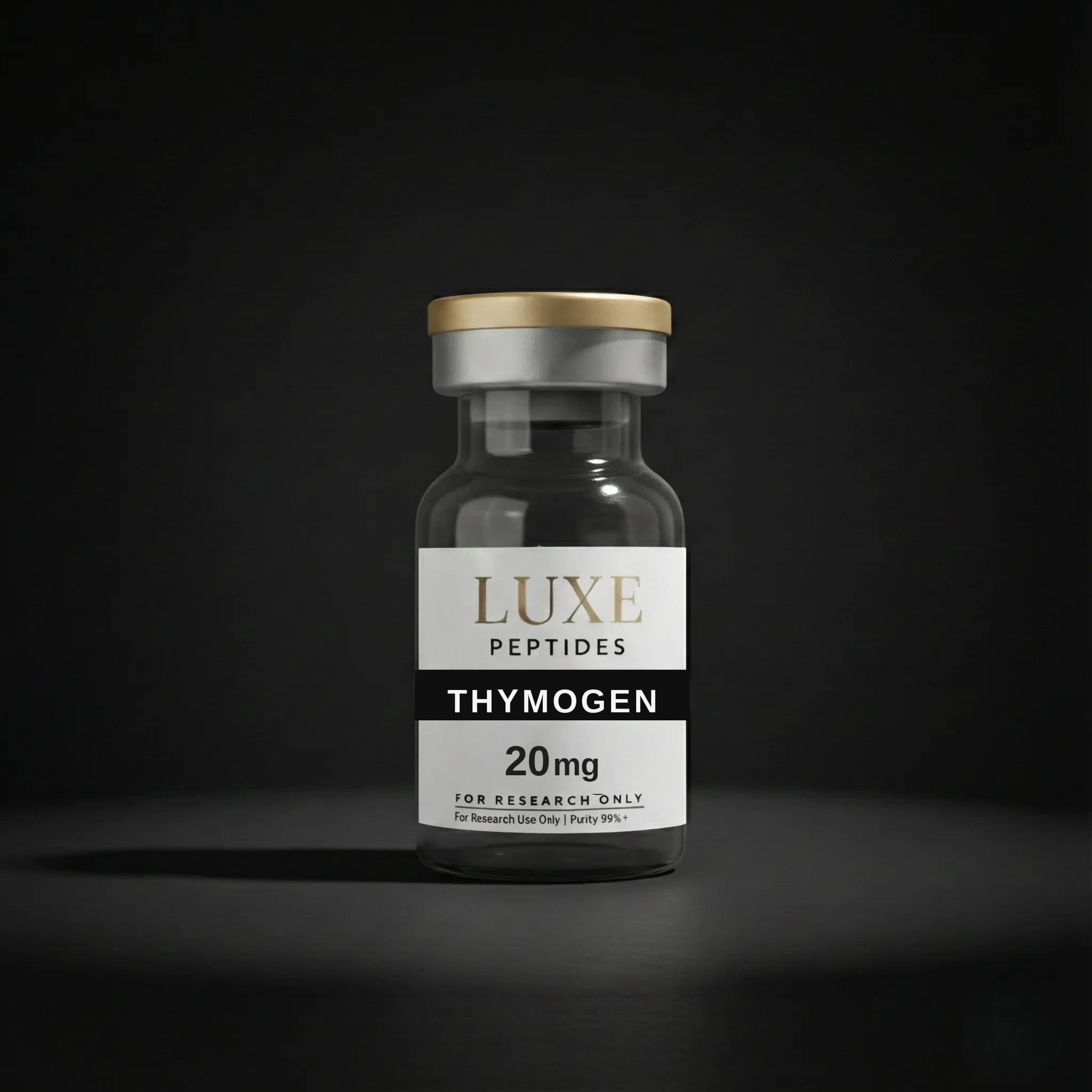
Thymogen
$60.00
- Ships same day on orders placed by 3pm ET. Most US orders arrive in 2–4 days.
- Free shipment protection on every order
- Third-party tested · CoA on file
- Discreet, tracked shipping
- Free shipping over $200
- Members earn 5% back in store credit
What is Thymogen?
Thymogen is a synthetic dipeptide with the sequence L-glutamyl-L-tryptophan (Glu-Trp, EW). The molecule was originally isolated by reverse-phase HPLC from Thymalin, a calf thymic peptide complex, and the synthetic dipeptide prepared on that basis was subsequently given the name Thymogen; the same compound carries the International Nonproprietary Name oglufanide and was investigated under the code IM-862. At 333.34 g/mol it is among the smallest peptides used as an immunological research tool, pairing the negatively charged side chain of glutamate with the aromatic indole ring of tryptophan. Because both enantiomeric forms of this dipeptide exist, note that this product is the L-L compound (L-Glu-L-Trp) and not the D-D isomer known as Thymodepressin, which is reported in the literature to act in the opposite direction. Thymogen has been studied in preclinical research on thymic and immune bioregulation, T-lymphocyte differentiation, natural killer cell function, and immunosenescence. This material is supplied for research use only and is not for human consumption.
Mechanism of Action
In published preclinical models, Thymogen has been described as an immunostimulatory bioregulator rather than a directly cytotoxic compound. Reported effects include activation of T-cell differentiation and of T-cell recognition of peptide-MHC complexes, shifts in the intracellular balance of cyclic nucleotides, and stimulation of neutrophil chemotaxis and phagocytosis. In murine tumor models the dipeptide showed no direct toxicity against a panel of human tumor cell lines, and its in-vivo activity instead required intact cytolytic effector function: activity was lost in perforin-deficient animals and in animals carrying the Lyst mutation that disrupts cytoplasmic granule trafficking, was retained in IFN-gamma knockout animals, and was substantially diminished in IL-12 knockout animals, indicating an NK/NKT-cell-mediated and partly IL-12-dependent route. Chirality appears central to the direction of action, with the L-L form studied as an immunostimulant and the D-D enantiomer studied as an immunosuppressor, a reciprocal pairing that is itself an active subject of laboratory investigation.
Published Research
Thymic Origin, Immunomodulatory Profile, and Aging Models
Anisimov, Khavinson, and Morozov (2000) reported that L-Glu-L-Trp was isolated from the natural calf thymic peptide complex Thymalin by reverse-phase HPLC, and that the synthetic dipeptide activated T-cell differentiation, T-cell recognition of peptide-MHC complexes, and neutrophil chemotaxis and phagocytosis. In a long-term study in female rats, treatment lowered the Gompertz aging-rate coefficient and reduced total, malignant, and hematopoietic tumor incidence relative to saline-treated controls [1].
NK-Cell Dependence of Antitumor Activity
Smith et al. (2003) reported that L-glutamyl-L-tryptophan inhibited tumor growth in mice without direct cytotoxicity against a panel of human tumor cell lines, and that this in-vivo activity required natural killer cell function. Activity was abolished in perforin-deficient animals and in animals carrying the Lyst granule-trafficking mutation, preserved in IFN-gamma knockouts, and significantly diminished in IL-12 knockouts [2].
Enantiomeric Pairing and Peptide Chirality
Deigin et al. (2024) reviewed Thymogen (L-Glu-L-Trp) alongside its D-enantiomer Thymodepressin as an example of reciprocal, up-and-down regulation of homeostasis by a chiral peptide pair, discussing peptide susceptibility to proteolysis and the enantiomeric selectivity of biological systems as a design axis for peptide research [3].
Product Specifications
| Product | Thymogen Lyophilized Powder |
|---|---|
| Available Sizes | 20mg |
| Purity | ≥99% (HPLC verified) |
| CAS Number | 38101-59-6 |
| Sequence | Glu-Trp (EW) |
| Molecular Formula | C₁₆H₁₉N₃O₅ |
| Molecular Weight | 333.34 g/mol |
| Appearance | White lyophilized powder in glass vial |
| Storage | Store lyophilized at -20°C. Reconstituted solution at 2-8°C. |
| Testing | Third-party tested — Certificate of Analysis available |
Storage & Stability
Store lyophilized at -20°C. Reconstituted solution at 2-8°C.
Certificate of Analysis
| Purity (HPLC-UV / MS) | ≥99% | Pass |
| Identity | Confirmed by HPLC-UV / MS | Verified |
| Appearance | White lyophilized powder in glass vial | Pass |
Certificates of Analysis — Janoshik
Third-party tested · Independent analytical lab
| Tested | Measured | Purity |
|---|---|---|
| Jan 2026 | 25.32mg | 98.51% |
| Dec 2025 | 26.14mg | 99.01% |
Frequently Asked Questions
Thymogen is a synthetic dipeptide, L-glutamyl-L-tryptophan (Glu-Trp), originally isolated from the calf thymic peptide complex Thymalin. It is studied as a thymic and immune bioregulator in preclinical models and is supplied here as a research compound for laboratory use only.
Thymogen is the dipeptide Glu-Trp (EW), specifically L-alpha-glutamyl-L-tryptophan. Its molecular formula is C₁₆H₁₉N₃O₅, its molecular weight is 333.34 g/mol, and its CAS number is 38101-59-6.
Yes. Thymogen, Timogen, oglufanide (the International Nonproprietary Name), and the IM-862 dipeptide are all names for the same molecule, L-glutamyl-L-tryptophan, catalogued in PubChem as CID 100094.
They are enantiomers. Thymogen is the L-L dipeptide (L-Glu-L-Trp) and has been studied as an immunostimulant, while Thymodepressin is the corresponding D-form and has been studied as an immunosuppressor. The two are frequently discussed together in the literature as a chiral pair with reciprocal activity, so the stereochemistry of the research material matters.
In published preclinical literature Thymogen has been studied in the context of thymic peptide bioregulation, T-lymphocyte differentiation, natural killer cell function and perforin-dependent cytolysis, neutrophil chemotaxis and phagocytosis, immunosenescence and aging-rate models, and peptide stereochemistry.
No. Thymogen is sold strictly as a research chemical for in-vitro laboratory study. It is for research use only and is not for human consumption or any therapeutic or diagnostic application.
References
Anisimov VN, Khavinson VK, Morozov VG. Immunomodulatory synthetic dipeptide L-Glu-L-Trp slows down aging and inhibits spontaneous carcinogenesis in rats. Biogerontology. 2000;1(1):55-59. PMID: 11707921
View sourceSmith DL, Cai J, Zhu S, et al. Natural killer cell cytolytic activity is necessary for in vivo antitumor activity of the dipeptide L-glutamyl-L-tryptophan. Int J Cancer. 2003;106(4):528-533. PMID: 12845648
View sourceDeigin V, Linkova N, Vinogradova J, et al. The First Reciprocal Activities of Chiral Peptide Pharmaceuticals: Thymogen and Thymodepressin, as Examples. Int J Mol Sci. 2024;25(9):5042. PMID: 38732260
View source
Customer Reviews
No reviews yet.