
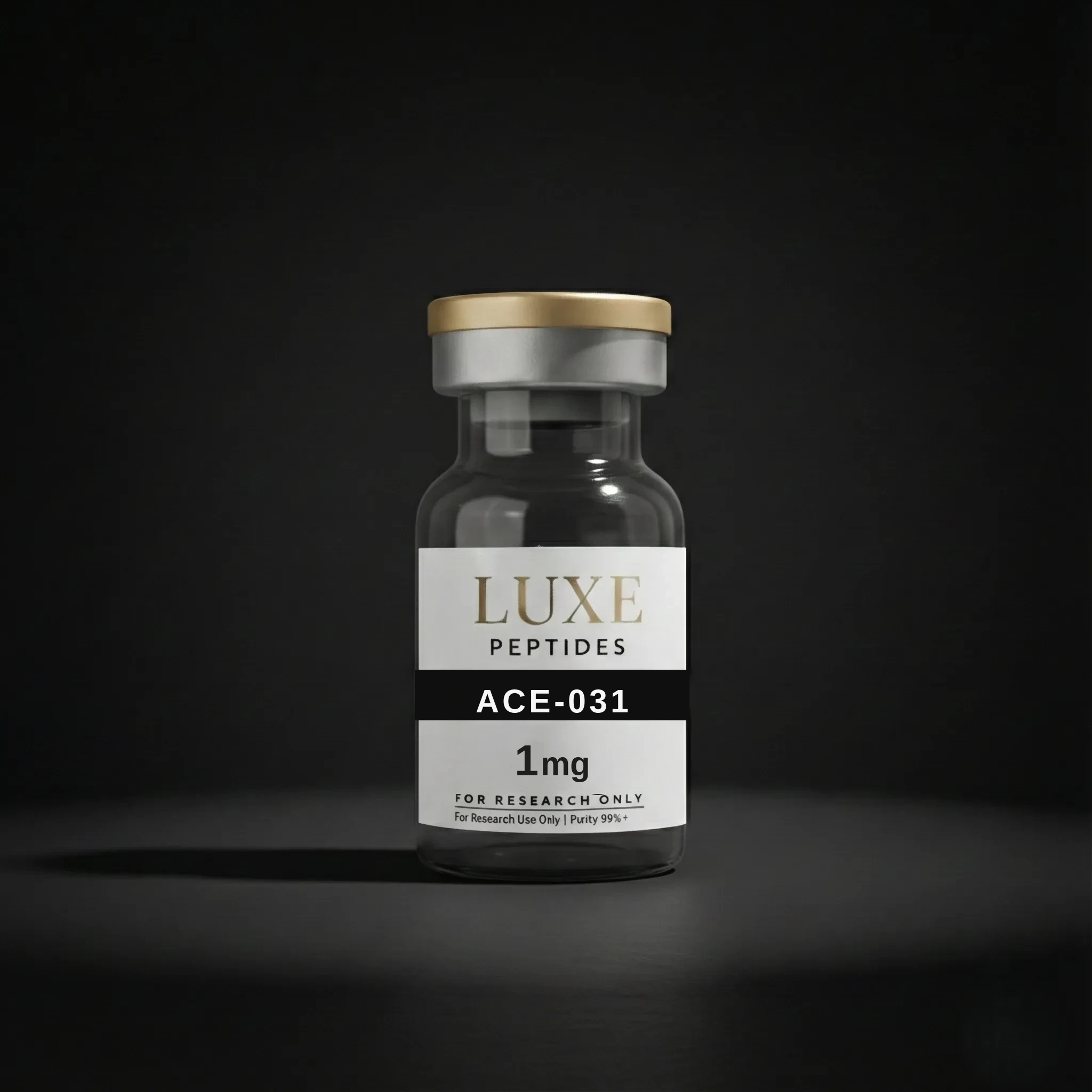
ACE-031
$139.00
- Ships same day on orders placed by 3pm ET. Most US orders arrive in 2–4 days.
- Free shipment protection on every order
- Third-party tested · CoA on file
- Discreet, tracked shipping
- Free shipping over $200
- Members earn 5% back in store credit
What is ACE-031?
ACE-031 is a recombinant fusion protein in which the extracellular ligand-binding domain of the human activin receptor type IIB (ActRIIB / ACVR2B) is joined to the Fc region of human immunoglobulin G1, forming a disulfide-linked homodimer. It is not a synthetic peptide: it is a glycosylated biologic produced by recombinant expression, assigned the international nonproprietary name ramatercept. Molecules of this class act as soluble decoy receptors, or “ligand traps,” that bind ActRIIB ligands in the extracellular space instead of at the cell surface. In published preclinical work, soluble ActRIIB-Fc proteins have been used as laboratory tools for studying myostatin (GDF-8) and activin signaling, skeletal muscle mass regulation, and bone formation in rodent models. This material is supplied for research use only and is not for human consumption.
Mechanism of Action
In published preclinical models, soluble ActRIIB-Fc proteins act by sequestering ligands of the activin type II receptors before those ligands can engage membrane-bound receptor, thereby limiting downstream SMAD2/3 signaling that normally restrains muscle growth. Lee and colleagues reported that a soluble form of ACVR2B produced large increases in muscle mass in wild-type mice, and that the response was attenuated but not abolished in myostatin-null (Mstn-/-) animals, indicating that at least one ligand other than myostatin also limits muscle growth through these receptors. Consistent with that breadth, work in bone described ActRIIB-Fc as a myostatin and activin decoy receptor whose skeletal effects were not reproduced by a myostatin-neutralizing antibody. ACE-031 is therefore studied as a broad activin type II receptor ligand trap rather than a myostatin-selective inhibitor.
Published Research
Soluble ActRIIB and Multiple Muscle-Regulating Ligands
Lee et al. (2005) described a soluble form of the activin type IIB receptor (ACVR2B) as a potent myostatin inhibitor that caused increases in muscle mass of up to 60% within two weeks when injected into wild-type mice. The effect was attenuated but not eliminated in myostatin-deficient mice, and genetic evidence indicated that the relevant ligands signal through both ACVR2 and ACVR2B [1].
Muscle Growth Independent of Fiber Type
Cadena et al. (2010) treated 8-week-old C57BL/6 mice with ACE-031 or vehicle for 28 days and reported increased wet weights of the soleus, plantaris, gastrocnemius and extensor digitorum longus muscles, with increased mean fiber cross-sectional area in both type I and type II soleus fibers and no change in soleus fiber-type distribution. The authors reported this as the first evidence that soluble ActRIIB increases muscle mass independent of fiber-type expression, distinguishing it from selective myostatin inhibition [2].
Ligand Trapping and Bone Mass in Mice
Bialek et al. (2014) compared a myostatin-neutralizing antibody with a soluble ActRIIB-Fc decoy receptor in young adult mice. Both increased muscle mass, but only ActRIIB-Fc increased bone volume fraction by microCT in the distal femur and lumbar vertebrae, an effect also seen in myostatin-deficient mice. The authors concluded that a ligand other than myostatin contributes to the skeletal response, and showed it was not explained by BMP3 neutralization [3].
Product Specifications
| Product | ACE-031 Lyophilized Powder |
|---|---|
| Available Sizes | 1mg |
| Purity | ≥99% (HPLC verified) |
| CAS Number | 1169766-01-1 |
| Appearance | White lyophilized powder in glass vial |
| Storage | Store lyophilized at -20°C. Reconstituted solution at 2-8°C. |
| Testing | Third-party tested — Certificate of Analysis available |
Storage & Stability
Store lyophilized at -20°C. Reconstituted solution at 2-8°C.
Certificate of Analysis
| Purity (HPLC-UV / MS) | ≥99% | Pass |
| Identity | Confirmed by HPLC-UV / MS | Verified |
| Appearance | White lyophilized powder in glass vial | Pass |
Frequently Asked Questions
ACE-031 is a recombinant fusion protein built from the extracellular ligand-binding domain of the human activin receptor type IIB (ActRIIB / ACVR2B) joined to a human IgG1 Fc region, assembled as a dimer. Its international nonproprietary name is ramatercept. It is supplied here as a research compound for laboratory use only.
It is a protein, not a synthetic peptide. ACE-031 is a glycosylated Fc-fusion protein produced by recombinant expression, which is why it is described as a biologic rather than as a peptide of defined amino-acid length. For this reason no single peptide sequence, empirical molecular formula, or exact molecular weight is listed for this product.
ACE-031 (ramatercept) is registered under CAS number 1169766-01-1, and carries the FDA UNII code 42HQC6QLEK. Because it is a recombinant glycoprotein rather than a small molecule, no meaningful molecular formula or single molecular weight is published for it.
Published preclinical work describes soluble ActRIIB-Fc proteins as decoy receptors or ligand traps: they bind ligands of the activin type II receptors, including myostatin (GDF-8) and activins, in the extracellular space and limit their engagement of membrane-bound receptor and downstream SMAD2/3 signaling. Because more than one ligand is captured, researchers interpret results as broad activin type II receptor pathway inhibition rather than myostatin-selective inhibition.
In published preclinical literature, soluble ActRIIB-Fc proteins have been used to study skeletal muscle mass regulation and muscle fiber cross-sectional area, myostatin and activin signaling, TGF-beta superfamily receptor biology, and bone volume and bone formation in rodent models. All of the cited work is laboratory research in animals or cells.
No. ACE-031 is sold strictly as a research chemical for in-vitro laboratory study. It is for research use only and is not for human consumption or any therapeutic or diagnostic application.
References
Lee SJ, Reed LA, Davies MV, et al. Regulation of muscle growth by multiple ligands signaling through activin type II receptors. Proc Natl Acad Sci U S A. 2005;102(50):18117-18122. PMID: 16330774
View sourceCadena SM, Tomkinson KN, Monnell TE, et al. Administration of a soluble activin type IIB receptor promotes skeletal muscle growth independent of fiber type. J Appl Physiol (1985). 2010;109(3):635-642. PMID: 20466801
View sourceBialek P, Parkington J, Li X, et al. A myostatin and activin decoy receptor enhances bone formation in mice. Bone. 2014;60:162-171. PMID: 24333131
View source


Customer Reviews
No reviews yet.