VIP
Price range: $55.00 through $99.00
What is VIP?
VIP (Vasoactive Intestinal Peptide) is a 28-amino acid neuropeptide first isolated from porcine intestine by Said and Mutt in 1970. Despite its name, VIP is widely distributed throughout the central and peripheral nervous systems, functioning as a neurotransmitter, neuromodulator, and immune regulator far beyond the intestinal tract. VIP signals through two G-protein coupled receptors: VPAC1 (expressed widely) and VPAC2 (expressed in CNS, pancreas, and immune cells). It is a member of the secretin/glucagon peptide superfamily. VIP has been extensively investigated for its roles in pulmonary physiology (bronchodilation, surfactant regulation), circadian rhythm control (master clock regulation in the SCN), immune modulation (anti-inflammatory, Th2 polarization), and neuroprotection. An inhaled formulation (aviptadil) has been investigated in clinical trials for pulmonary conditions. VIP deficiency has been implicated in several inflammatory and autoimmune research models.
Mechanism of Action
VIP has been investigated for its activation of VPAC1 and VPAC2, both Gs-coupled GPCRs that increase intracellular cAMP. In airway smooth muscle, VPAC-mediated cAMP elevation activates PKA, which phosphorylates myosin light chain kinase, reducing smooth muscle contraction and promoting bronchodilation. Researchers observed that VIP also stimulates surfactant secretion from type II alveolar cells and mucus secretion from airway glands through cAMP-dependent mechanisms. In the immune system, VIP has been investigated for its anti-inflammatory effects: it inhibits NF-κB-dependent production of pro-inflammatory cytokines (TNF-α, IL-6, IL-12) in macrophages while promoting IL-10 and TGF-β production, polarizing immune responses toward a regulatory/anti-inflammatory profile. In the SCN (suprachiasmatic nucleus), VIP is essential for synchronizing circadian oscillator neurons through VPAC2-dependent intercellular coupling. Additionally, VIP has neuroprotective properties, promoting neuronal survival through BDNF upregulation and anti-apoptotic signaling in multiple CNS models.
Published Research
Discovery and Physiology
Said and Mutt (1970) isolated and characterized VIP from porcine intestinal extracts, establishing its vasodilatory and secretory properties that led to its naming [1].
Immune Modulation
Delgado et al. (2004) reviewed VIP’s immunomodulatory functions, describing its anti-inflammatory effects through NF-κB inhibition, Th2 polarization, and regulatory T-cell induction across multiple immune models [2].
Pulmonary Research
Said SI (2012) reviewed VIP’s role in pulmonary physiology and pathology, describing its bronchodilatory, surfactant-stimulating, and anti-inflammatory effects in the respiratory system [3].
Product Specifications
| Product | VIP Lyophilized Powder |
|---|---|
| Available Sizes | 5mg, 10mg |
| Purity | ≥99% (HPLC verified) |
| CAS Number | 37221-79-7 |
| Sequence | HSDAVFTDNYTRLRKQMAVKKYLNSILN-NH₂ |
| Molecular Formula | C₁₄₇H₂₃₈N₄₄O₄₃S |
| Molecular Weight | 3,326.82 g/mol |
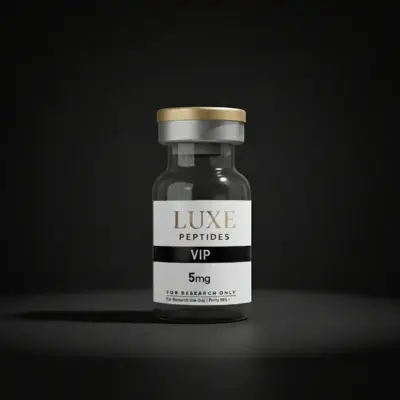
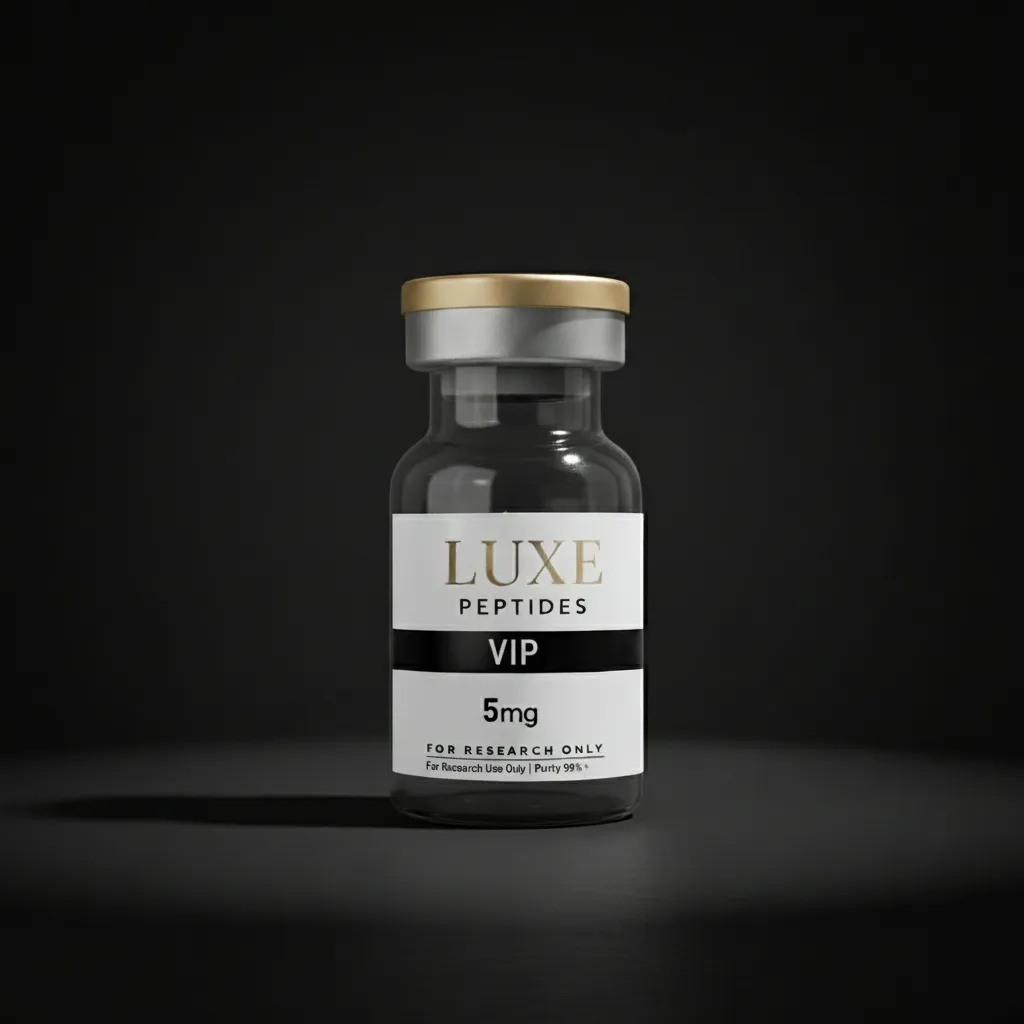
| Appearance | White lyophilized powder in glass vial |
| Storage | Store lyophilized at -20°C. Reconstituted solution at 2-8°C, use within 14 days. |
| Testing | Third-party tested — Certificate of Analysis available |
Frequently Asked Questions
VIP (Vasoactive Intestinal Peptide) is a 28-amino acid neuropeptide with broad functions in pulmonary physiology, immune modulation, circadian rhythms, and neuroprotection.
The CAS registry number for VIP is 37221-79-7.
No, despite its name, VIP is widely distributed throughout the central and peripheral nervous systems, immune cells, and multiple organ systems.
Store lyophilized VIP at -20°C. Once reconstituted, store at 2-8°C and use within 14 days.
VIP activates VPAC1 and VPAC2, both Gs-coupled GPCRs that increase intracellular cAMP. VPAC1 is widely expressed; VPAC2 is enriched in the CNS and immune cells.
VIP is studied in pulmonary physiology, immunomodulation, circadian biology, neuroprotection, and gastrointestinal signaling.
References
- Said SI, Mutt V. Polypeptide with broad biological activity: isolation from small intestine. Science. 1970;169(3951):1217-1218. PMID: 5450698
- Delgado M, et al. Vasoactive intestinal peptide: a neuropeptide with pleiotropic immune functions. Amino Acids. 2004;25(1-2):49-58. PMID: 14685551
- Said SI. VIP as a modulatory factor of lung inflammation/injury. Ann N Y Acad Sci. 2012;1070:306-308.

Customer Reviews
Very pleased with this purchase. Will be a repeat customer.
Third order from Luxe — always reliable, always pure.
Really happy with this. Clean, pure, well-packaged.
Product arrived fast and in perfect condition.
Reordering because the first batch was flawless.
Great product. Arrived quickly and exactly as described.
Reordering because the first batch was flawless.
Very pleased with this purchase. Will be a repeat customer.
Professional packaging, fast delivery, great product.
Great product. Arrived quickly and exactly as described.
Professional packaging, fast delivery, great product.
Happy with the product. Packaging could be improved slightly.
Third order from Luxe — always reliable, always pure.
Excellent purity. Lab results confirmed. Will order again.
Reordering because the first batch was flawless.
Third order from Luxe — always reliable, always pure.
Product arrived fast and in perfect condition.
Best quality I have found. Quick turnaround on shipping.