
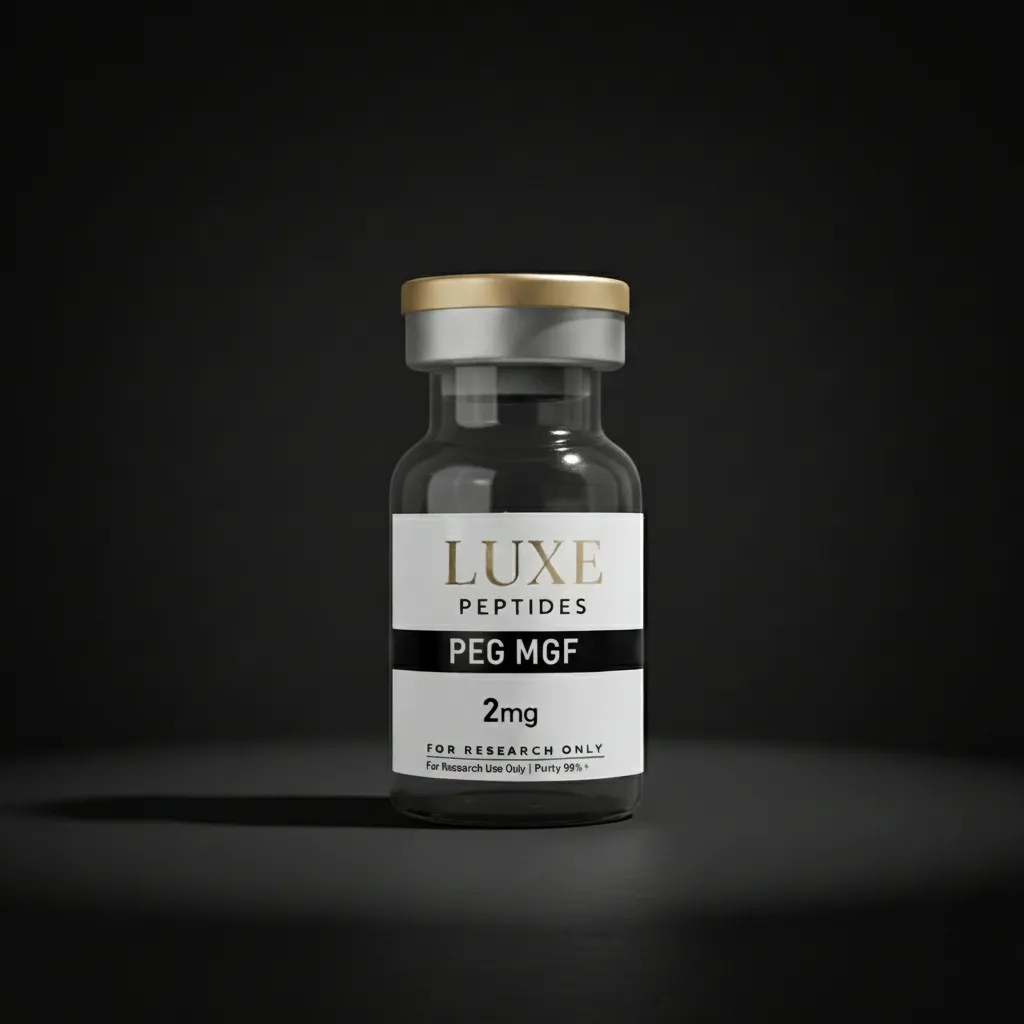
PEG MGF
$40.00
What is PEG MGF?
PEG-MGF (PEGylated Mechano Growth Factor) is a PEGylated form of the C-terminal peptide unique to the MGF (mechano growth factor) splice variant of IGF-1. MGF corresponds to the IGF-1Ec splice variant, which is expressed in skeletal muscle in response to mechanical load (exercise) and differs from other IGF-1 isoforms in its E-peptide domain. The unique 24-amino acid C-terminal E-peptide of MGF has been isolated as a synthetic peptide and studied independently from the mature IGF-1 protein. PEGylation (attachment of polyethylene glycol) extends the peptide’s half-life by reducing renal clearance and proteolytic degradation. Native unmodified MGF has a very short half-life in vivo (minutes), making PEGylation essential for extending its research utility. PEG-MGF has been investigated in preclinical models examining satellite cell activation, muscle progenitor cell biology, and tissue repair signaling.
Mechanism of Action
PEG-MGF has been investigated for its effects on muscle satellite cell activation and proliferation. The MGF E-peptide is distinct from the mature IGF-1 domain and appears to signal through a mechanism independent of the IGF-1 receptor. Researchers observed that MGF promotes satellite cell activation — the transition of quiescent muscle stem cells into the proliferative state — without prematurely inducing differentiation. This distinguishes MGF from mature IGF-1, which promotes both proliferation and differentiation. Studies suggest that MGF’s unique E-peptide interacts with cell membrane receptors distinct from IGF-1R, though the specific receptor has not been conclusively identified. In muscle injury models, researchers observed that MGF expression peaks within hours of mechanical damage, preceding the expression of IGF-1Ea (the systemic IGF-1 isoform), suggesting a temporal division of labor between IGF-1 splice variants. PEGylation extends the half-life from minutes to hours, allowing sustained signaling at muscle progenitor cells.
Published Research
MGF and Satellite Cells
Hill and Goldspink (2003) characterized MGF as a splice variant of IGF-1 upregulated by mechanical loading in skeletal muscle. Researchers observed that the MGF E-peptide specifically activated satellite cells and promoted their proliferation in muscle tissue [1].
MGF E-Peptide Signaling
Yang and BhSport (2006) demonstrated that the MGF E-peptide activates satellite cells through a mechanism independent of the IGF-1 receptor, establishing the unique signaling profile of this peptide domain [2].
PEGylation for Stability
Harris and Chess (2003) reviewed PEGylation technology for peptide stabilization, describing how PEG attachment reduces proteolytic degradation and renal clearance to extend biological half-life [3].
Product Specifications
| Product | PEG MGF Lyophilized Powder |
|---|---|
| Available Sizes | 2mg |
| Purity | ≥99% (HPLC verified) |
| Sequence | YQPPSTNKNTKSQRRKGSTFEEHK-PEG |
| Molecular Weight | ~5,000 g/mol (peptide + PEG) |
| Appearance | White lyophilized powder in glass vial |
| Storage | Store lyophilized at -20°C. Reconstituted solution at 2-8°C, use within 14 days. |
| Testing | Third-party tested — Certificate of Analysis available |
Frequently Asked Questions
PEG-MGF is the PEGylated form of Mechano Growth Factor, the unique E-peptide domain of the IGF-1Ec splice variant. PEGylation extends its very short native half-life.
MGF is a splice variant of IGF-1 with a unique C-terminal E-peptide. This E-peptide activates satellite cells through a mechanism independent of the IGF-1 receptor.
Unmodified MGF has a half-life of only minutes in vivo. PEG attachment reduces proteolytic degradation and renal clearance, extending the functional half-life to hours.
Store lyophilized PEG-MGF at -20°C. Once reconstituted, store at 2-8°C and use within 14 days.
Satellite cells are muscle stem cells located beneath the basal lamina of muscle fibers. They are quiescent until activated by mechanical stress or damage, then proliferate and contribute to muscle repair.
References
- Hill M, Goldspink G. Expression and splicing of the insulin-like growth factor gene in rodent muscle is associated with muscle satellite (stem) cell activation following local tissue damage. J Physiol. 2003;549(Pt 2):409-418. PMID: 12692175
- Yang SY, Goldspink G. Different roles of the IGF-I Ec peptide (MGF) and mature IGF-I in myoblast proliferation and differentiation. FEBS Lett. 2002;522(1-3):156-160. PMID: 12095637
- Harris JM, Chess RB. Effect of pegylation on pharmaceuticals. Nat Rev Drug Discov. 2003;2(3):214-221. PMID: 12612647




Customer Reviews
Five stars earned. Quality speaks for itself.
Verified purity matches the COA. Excellent.
Exactly what I needed for my research. Clean product.
Consistent quality across multiple orders. Very satisfied.
Verified purity matches the COA. Excellent.
Consistent quality across multiple orders. Very satisfied.
Consistent quality across multiple orders. Very satisfied.
Solid product quality. COA checks out perfectly.
Exactly what I needed for my research. Clean product.
Really happy with this. Clean, pure, well-packaged.
Quality is solid. Wish there were more size options.
Five stars earned. Quality speaks for itself.
Exactly what I needed for my research. Clean product.
Very pleased with this purchase. Will be a repeat customer.
Outstanding quality. This is my go-to source now.
Quality is solid. Wish there were more size options.
Product is great. Only minor delay in shipping.
Solid product quality. COA checks out perfectly.
Fast shipping, well-packaged. Product quality is top-notch.
Reliable product. Took a bit longer to arrive than expected.
Very pleased with this purchase. Will be a repeat customer.
Fast shipping, well-packaged. Product quality is top-notch.
Consistent quality across multiple orders. Very satisfied.
Exactly what I needed for my research. Clean product.
Great product. Arrived quickly and exactly as described.
Best quality I have found. Quick turnaround on shipping.
Fast shipping, well-packaged. Product quality is top-notch.
Third order from Luxe — always reliable, always pure.