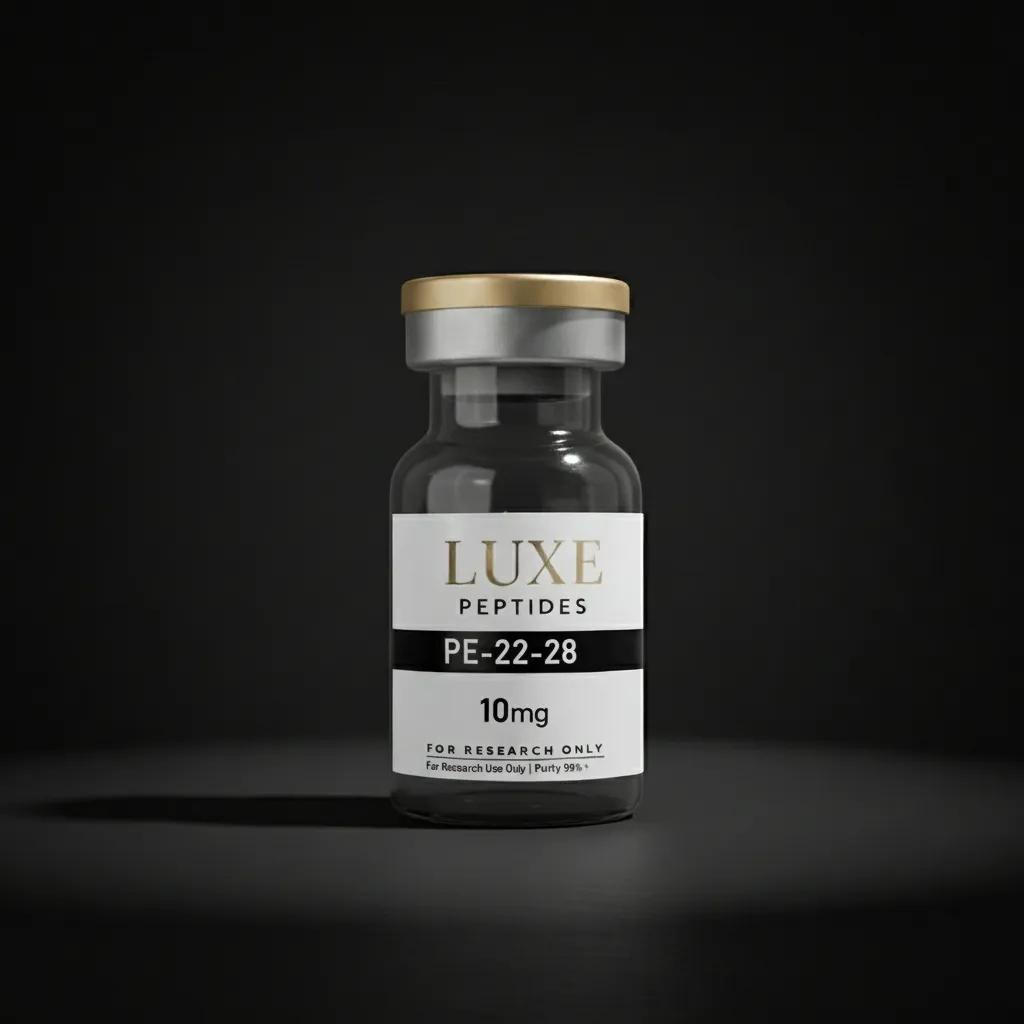
PE-22-28
$40.00
What is PE-22-28?
PE-22-28 is a synthetic heptapeptide derived from the propeptide of sortilin (also called neurotensin receptor-3/NTSR3). It was developed as an optimized analog of spadin, a natural peptide that blocks TREK-1 potassium channels. TREK-1 (TWIK-Related K+ channel-1, also known as KCNK2/K2P2.1) is a two-pore domain potassium channel expressed in the brain that has been identified as a target for antidepressant research. TREK-1 knockout mice display an antidepressant-like phenotype, and TREK-1 blockade has been investigated as a mechanism for modulating mood-related signaling. PE-22-28 represents a shorter, optimized fragment of the 28-amino acid spadin peptide that retains TREK-1 blocking activity. The peptide has been investigated in preclinical behavioral models where TREK-1 modulation produces effects overlapping with those of conventional antidepressant mechanisms.
Mechanism of Action
PE-22-28 has been investigated for its blockade of TREK-1 potassium channels in neuronal tissue. TREK-1 channels are background leak potassium channels that contribute to resting membrane potential and neuronal excitability. Researchers observed that PE-22-28 interacts with TREK-1 through binding to the sortilin/NTSR3 receptor-associated complex, blocking potassium conductance and increasing neuronal excitability in serotonergic and other mood-relevant neuronal populations. Studies suggest that TREK-1 blockade increases serotonin release in the dorsal raphe nucleus and hippocampus, mimicking the downstream effects of SSRI antidepressants but through an ion channel mechanism rather than reuptake inhibition. In preclinical behavioral models (forced swim test, tail suspension test), researchers observed that PE-22-28 produced effects in as few as 4 days, faster than the typical 2-3 week onset of SSRIs. The peptide also increased hippocampal neurogenesis markers in treated animals, consistent with the neuroplasticity effects associated with TREK-1 deletion.
Published Research
TREK-1 and Antidepressant Signaling
Mazella et al. (2010) identified spadin (the parent compound) as a natural TREK-1 blocker and demonstrated antidepressant-like effects in behavioral models. This work established the TREK-1 channel as a novel target for mood research [1].
PE-22-28 Optimization
Djillani et al. (2017) characterized PE-22-28 as an optimized spadin analog with improved stability and potency at TREK-1. The researchers demonstrated rapid behavioral effects in preclinical models [2].
TREK-1 Knockout Phenotype
Heurteaux et al. (2006) characterized TREK-1 knockout mice and observed resistance to behavioral despair paradigms, elevated serotonin levels, and increased hippocampal neurogenesis, establishing the rationale for TREK-1 blockade [3].
Product Specifications
| Product | PE-22-28 Lyophilized Powder |
|---|---|
| Available Sizes | 10mg |
| Purity | ≥99% (HPLC verified) |
| Sequence | WLKGQVL-NH₂ (Trp-Leu-Lys-Gly-Gln-Val-Leu-NH₂) |
| Molecular Formula | C₄₃H₆₅N₉O₁₀ |
| Molecular Weight | 872.04 g/mol |
| Appearance | White lyophilized powder in glass vial |
| Storage | Store lyophilized at -20°C. Reconstituted solution at 2-8°C, use within 14 days. |
| Testing | Third-party tested — Certificate of Analysis available |
Frequently Asked Questions
PE-22-28 is a synthetic heptapeptide that blocks TREK-1 potassium channels. It is an optimized analog of spadin, derived from the sortilin propeptide.
TREK-1 is a two-pore domain potassium channel in the brain. TREK-1 knockout mice display antidepressant-like phenotypes, making it a target for mood research.
Store lyophilized PE-22-28 at -20°C. Once reconstituted, store at 2-8°C and use within 14 days.
PE-22-28 blocks TREK-1 potassium channels (increasing neuronal excitability), while SSRIs inhibit serotonin reuptake. Both influence serotonergic signaling but through different primary mechanisms.
PE-22-28 is studied in the context of TREK-1 channel modulation, serotonergic signaling, neurogenesis, and behavioral pharmacology in preclinical models.
References
- Mazella J, et al. Spadin, a sortilin-derived peptide, targeting rodent TREK-1 channels: a new concept in the antidepressant drug design. PLoS Biol. 2010;8(4):e1000355. PMID: 20405001
- Djillani A, et al. Shortened spadin analogs display better TREK-1 inhibition, in vivo stability and antidepressant activity. Front Pharmacol. 2017;8:643. PMID: 28966592
- Heurteaux C, et al. Deletion of the background potassium channel TREK-1 results in a depression-resistant phenotype. Nat Neurosci. 2006;9(9):1134-1141. PMID: 16906152


Customer Reviews
Fast shipping, well-packaged. Product quality is top-notch.
Exactly what I needed for my research. Clean product.
Third order from Luxe — always reliable, always pure.
Outstanding quality. This is my go-to source now.
Really happy with this. Clean, pure, well-packaged.
Third order from Luxe — always reliable, always pure.
Verified purity matches the COA. Excellent.
This vendor sets the standard. Highly recommend.
Good product overall. Shipping took a couple extra days.