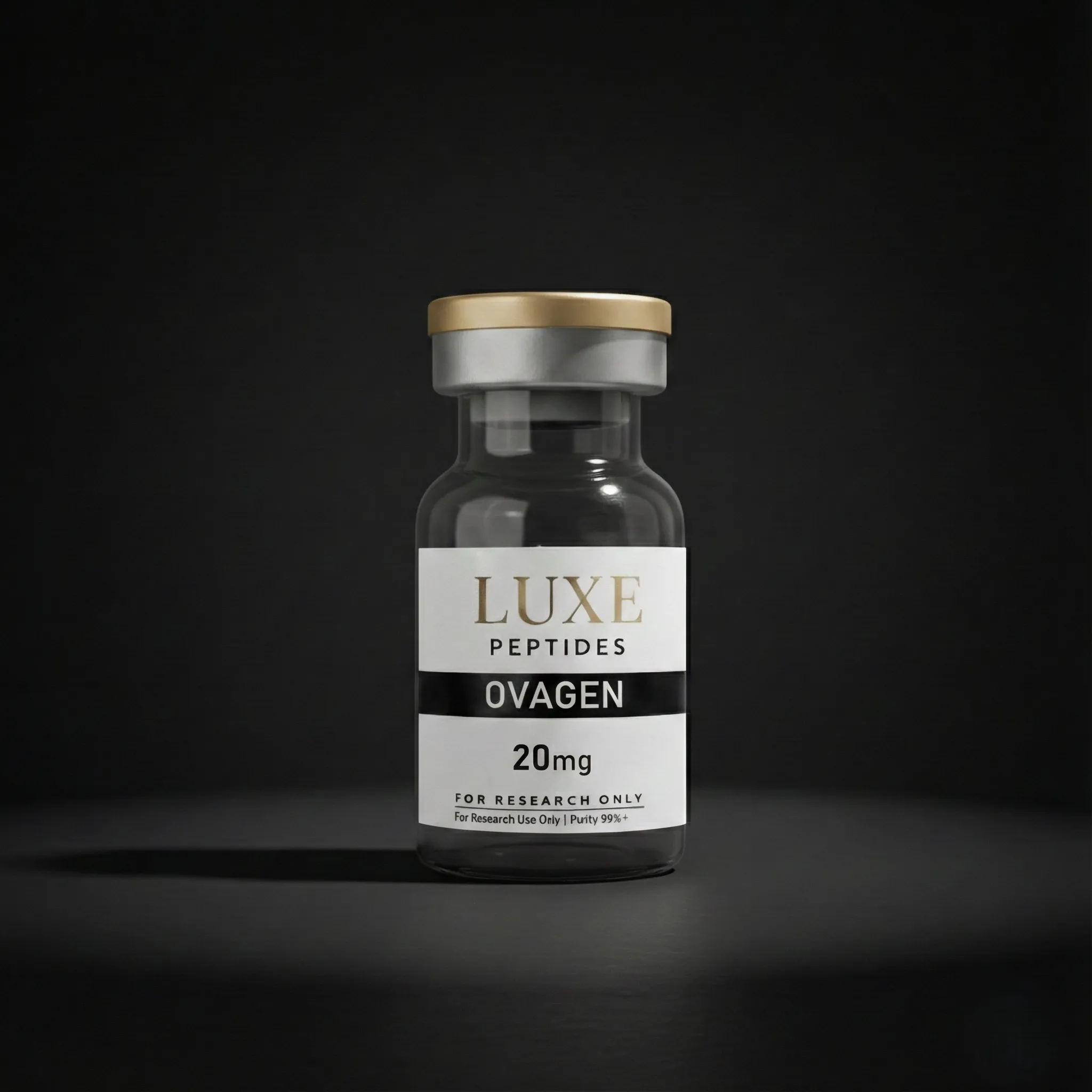
Ovagen
$60.00
What is Ovagen?
Ovagen is a synthetic tripeptide (Glu-Asp-Leu) belonging to the Khavinson class of bioregulatory peptides from the Saint Petersburg Institute of Bioregulation and Gerontology. It is designed to target hepatic (liver) and gastrointestinal tissue through proposed peptide-DNA interactions. Ovagen complements Livagen (another liver-targeted bioregulator) with a different amino acid sequence and potentially distinct gene regulatory specificity. The Khavinson model proposes that even minimal peptide sequences like tripeptides carry tissue-targeting information through their charge distribution, hydrogen bonding patterns, and spatial conformation. Ovagen has been investigated in Russian biogerontology research examining age-related changes in hepatic function, liver tissue gene expression, and gastrointestinal epithelial homeostasis. It is one of several organ-specific short peptides in the Khavinson bioregulator family.
Mechanism of Action
Ovagen has been investigated for its proposed interactions with gene regulatory regions in hepatocytes and GI tract epithelial cells. In the Khavinson bioregulatory model, the Glu-Asp-Leu sequence is proposed to penetrate cell membranes and interact with specific DNA sequences in promoter regions of tissue-expressed genes. Researchers have observed that Ovagen treatment in liver cell culture models was associated with changes in expression of hepatic function genes, including those involved in detoxification, protein synthesis, and bile acid metabolism. Studies from the Saint Petersburg group suggest that bioregulatory peptides targeting the liver may help maintain hepatocyte differentiation markers and metabolic enzyme expression. The proposed mechanism involves direct peptide-DNA interactions that influence chromatin accessibility at specific gene loci, rather than conventional cell-surface receptor signaling. Ovagen is studied alongside Livagen as part of the hepatic bioregulator class within the Khavinson system.
Published Research
Hepatic Gene Expression
Khavinson et al. (2005) investigated short peptides in hepatocyte culture models, observing changes in gene expression profiles related to hepatic function and metabolism following treatment with liver-targeted bioregulatory peptides [1].
Bioregulatory Peptide Framework
Khavinson VK (2002) presented the comprehensive model for tissue-specific bioregulatory peptides, including those targeting hepatic and GI tissues [2].
Peptide-DNA Interactions
Fedoreyeva et al. (2011) demonstrated that short peptides can bind DNA sequences in vitro using fluorescence spectroscopy, supporting the proposed mechanism for bioregulatory peptide activity [3].
Product Specifications
| Product | Ovagen Lyophilized Powder |
|---|---|
| Available Sizes | 20mg |
| Purity | ≥99% (HPLC verified) |
| Sequence | Glu-Asp-Leu |
| Molecular Formula | C₁₃H₂₁N₃O₇ |
| Molecular Weight | 347.32 g/mol |
| Appearance | White lyophilized powder in glass vial |
| Storage | Store at -20°C or 2-8°C desiccated. Protect from moisture. |
| Testing | Third-party tested — Certificate of Analysis available |
Frequently Asked Questions
Ovagen is a synthetic tripeptide (Glu-Asp-Leu) from the Khavinson bioregulatory peptide family, designed to target hepatic and gastrointestinal tissue.
Both target liver tissue but have different amino acid sequences: Ovagen (Glu-Asp-Leu) is a tripeptide, while Livagen (Lys-Glu-Asp-Ala) is a tetrapeptide. They may have distinct gene regulatory specificity.
Store Ovagen at -20°C or 2-8°C in a desiccated environment, protected from moisture.
Ovagen targets hepatic (liver) and gastrointestinal tissue in the Khavinson bioregulatory model.
Yes, Ovagen belongs to the Khavinson class of bioregulatory peptides from the Saint Petersburg Institute of Bioregulation and Gerontology.
References
- Khavinson V, et al. Short peptides stimulate gene expression in hepatocyte cultures. Bull Exp Biol Med. 2005;139(3):389-391.
- Khavinson VK. Peptides and Ageing. Neuroendocrinol Lett. 2002;23 Suppl 3:11-144. PMID: 12374906
- Fedoreyeva LI, et al. Penetration of short fluorescence-labeled peptides into the nucleus in HeLa cells. Biochemistry (Moscow). 2011;76(11):1210-1219. PMID: 22117547


Customer Reviews
Purity exceeded expectations. Prompt delivery too.
Quality is solid. Wish there were more size options.
Solid product quality. COA checks out perfectly.
Purity exceeded expectations. Prompt delivery too.
Good purity, fair pricing. Would order again.
Best quality I have found. Quick turnaround on shipping.
Verified purity matches the COA. Excellent.
This vendor sets the standard. Highly recommend.
Excellent purity. Lab results confirmed. Will order again.
Nice quality. Website could use more research documentation.
Fast shipping, well-packaged. Product quality is top-notch.
Third order from Luxe — always reliable, always pure.
Third order from Luxe — always reliable, always pure.
Exactly what I needed for my research. Clean product.
This vendor sets the standard. Highly recommend.
Impressed with the quality. Packaging was professional.
This vendor sets the standard. Highly recommend.
Great product. Arrived quickly and exactly as described.
Verified purity matches the COA. Excellent.