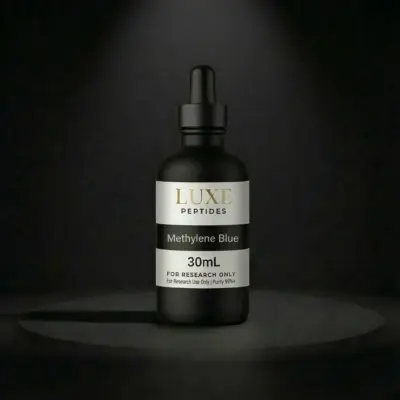
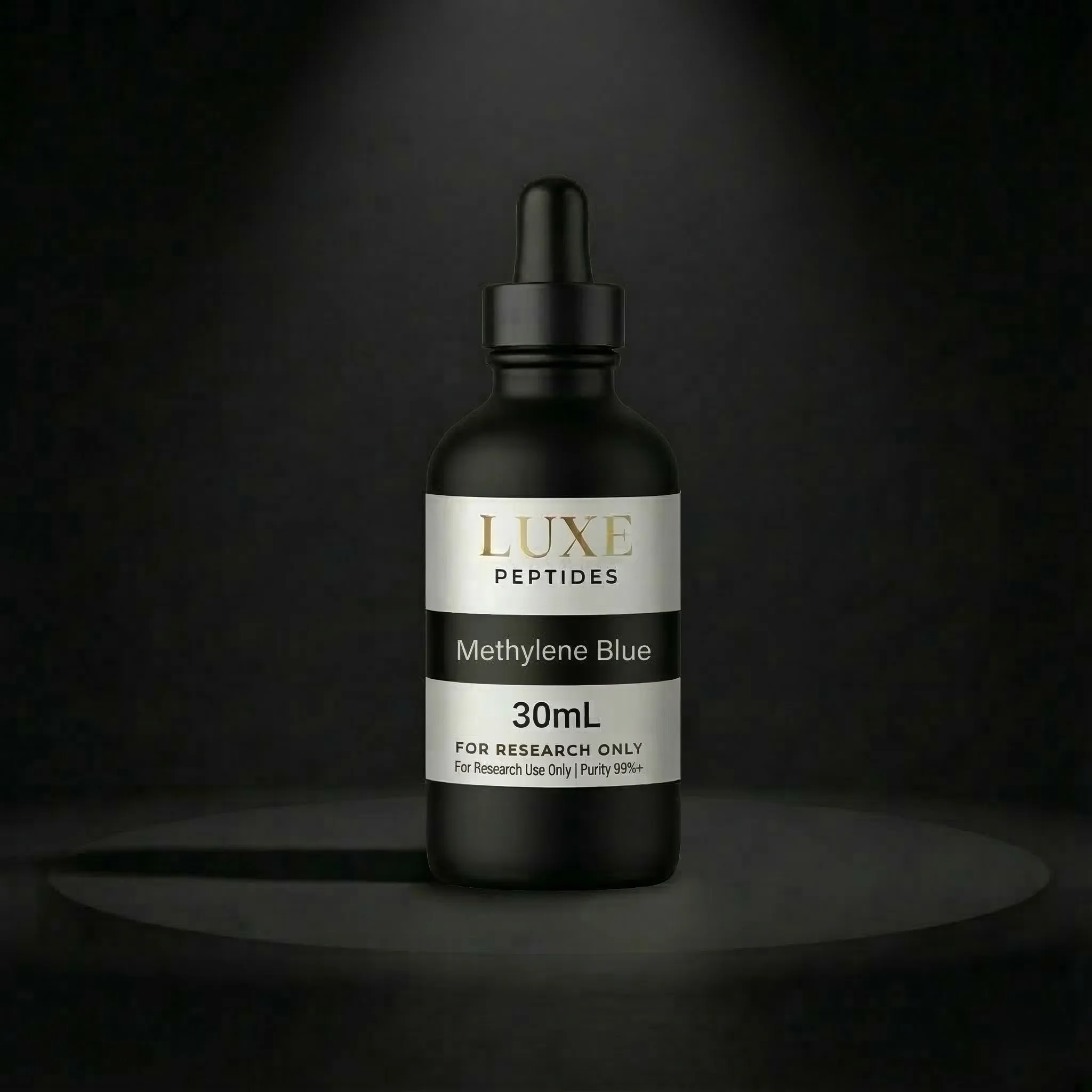
Methylene Blue
Price range: $24.99 through $30.99
What is Methylene Blue?
Methylene Blue (methylthioninium chloride) is a synthetic phenothiazine dye first synthesized by Heinrich Caro in 1876. It holds the distinction of being the first fully synthetic drug used in medicine, introduced by Paul Ehrlich for malaria treatment in 1891. Methylene Blue is a redox-active compound that can accept and donate electrons, cycling between its oxidized (blue) and reduced (leucomethylene blue, colorless) forms. This redox cycling capability allows it to function as an alternative electron carrier in the mitochondrial electron transport chain, shuttling electrons from NADH to cytochrome c and bypassing Complex I and Complex III. Methylene Blue has been investigated in diverse research contexts including mitochondrial dysfunction, neuroprotection, photodynamic applications, and methemoglobinemia (for which it is FDA-approved). It is on the WHO List of Essential Medicines.
Mechanism of Action
Methylene Blue has been investigated for its unique redox cycling properties in the mitochondrial electron transport chain. At low concentrations (nanomolar to low micromolar), researchers observed that Methylene Blue accepts electrons from NADH via Complex I and donates them to cytochrome c, effectively acting as an alternative electron carrier that bypasses dysfunctional segments of the ETC. This bypass maintains mitochondrial membrane potential and ATP production even when Complex I or III is impaired. Studies suggest that this electron shuttling also reduces electron leak to oxygen, decreasing superoxide production and oxidative stress. In methemoglobinemia, Methylene Blue is reduced by NADPH-methemoglobin reductase to leucomethylene blue, which then reduces methemoglobin (Fe³⁺) back to functional hemoglobin (Fe²⁺). In neuroprotection research, Methylene Blue has been investigated for its effects on tau aggregation, mitochondrial function in neuronal models, and NO/cGMP pathway modulation. At higher concentrations, Methylene Blue acts as a pro-oxidant and photosensitizer.
Published Research
Mitochondrial Electron Carrier
Rojas et al. (2012) characterized Methylene Blue as an alternative mitochondrial electron carrier, demonstrating that it bypasses Complex I-III blockade and maintains ATP production in neuronal models with impaired electron transport [1].
Neuroprotection Research
Oz et al. (2009) reviewed Methylene Blue’s neuroprotective properties across multiple preclinical models, including its effects on mitochondrial function, oxidative stress, and protein aggregation pathways [2].
Historical and Clinical Significance
Schirmer et al. (2011) reviewed Methylene Blue’s history from its synthesis in 1876 to modern applications, describing its FDA-approved use for methemoglobinemia and ongoing research applications [3].
Product Specifications
| Product | Methylene Blue Lyophilized Powder |
|---|---|
| Available Sizes | 10mg/ML 50ml, 12mg x 60 Capsules |
| Purity | ≥99% (HPLC verified) |
| CAS Number | 61-73-4 |
| Molecular Formula | C₁₆H₁₈ClN₃S |
| Molecular Weight | 319.85 g/mol |
| Appearance | White lyophilized powder in glass vial |
| Storage | Store at room temperature protected from light. Keep tightly sealed. |
| Testing | Third-party tested — Certificate of Analysis available |
Frequently Asked Questions
Methylene Blue is a synthetic phenothiazine compound with redox-cycling properties. It was the first synthetic drug used in medicine (1891) and is FDA-approved for methemoglobinemia.
The CAS registry number for Methylene Blue is 61-73-4.
No, Methylene Blue is a small-molecule phenothiazine dye. It is a redox-active compound, not a peptide.
Store Methylene Blue at room temperature, protected from light and tightly sealed to prevent moisture absorption.
Methylene Blue acts as an alternative electron carrier in the mitochondrial ETC, accepting electrons from NADH and donating them to cytochrome c, bypassing Complex I and III.
At low concentrations, Methylene Blue acts as an antioxidant electron carrier. At higher concentrations, it becomes a pro-oxidant and photosensitizer. This hormetic dose-response is critical in research.
References
- Rojas JC, et al. Neurometabolic mechanisms for memory enhancement and neuroprotection of methylene blue. Prog Neurobiol. 2012;96(1):32-45. PMID: 21871538
- Oz M, et al. Cellular and molecular actions of methylene blue in the nervous system. Med Res Rev. 2009;31(1):93-117. PMID: 19760660
- Schirmer RH, et al. Lest we forget you—methylene blue. Neurobiol Aging. 2011;32(12):2325.e7-2325.e16. PMID: 21316815
Customer Reviews
Great product. Arrived quickly and exactly as described.
Verified purity matches the COA. Excellent.
Fast shipping, well-packaged. Product quality is top-notch.
Really happy with this. Clean, pure, well-packaged.
Product arrived fast and in perfect condition.
Product is great. Only minor delay in shipping.
Purity exceeded expectations. Prompt delivery too.
Professional packaging, fast delivery, great product.
Product arrived fast and in perfect condition.
Solid quality for the price point. Good experience.
Five stars earned. Quality speaks for itself.
Outstanding quality. This is my go-to source now.
Best quality I have found. Quick turnaround on shipping.
Excellent purity. Lab results confirmed. Will order again.
Exactly what I needed for my research. Clean product.
Fast shipping, well-packaged. Product quality is top-notch.
Quick delivery and the quality is consistently high.
Happy with the product. Packaging could be improved slightly.