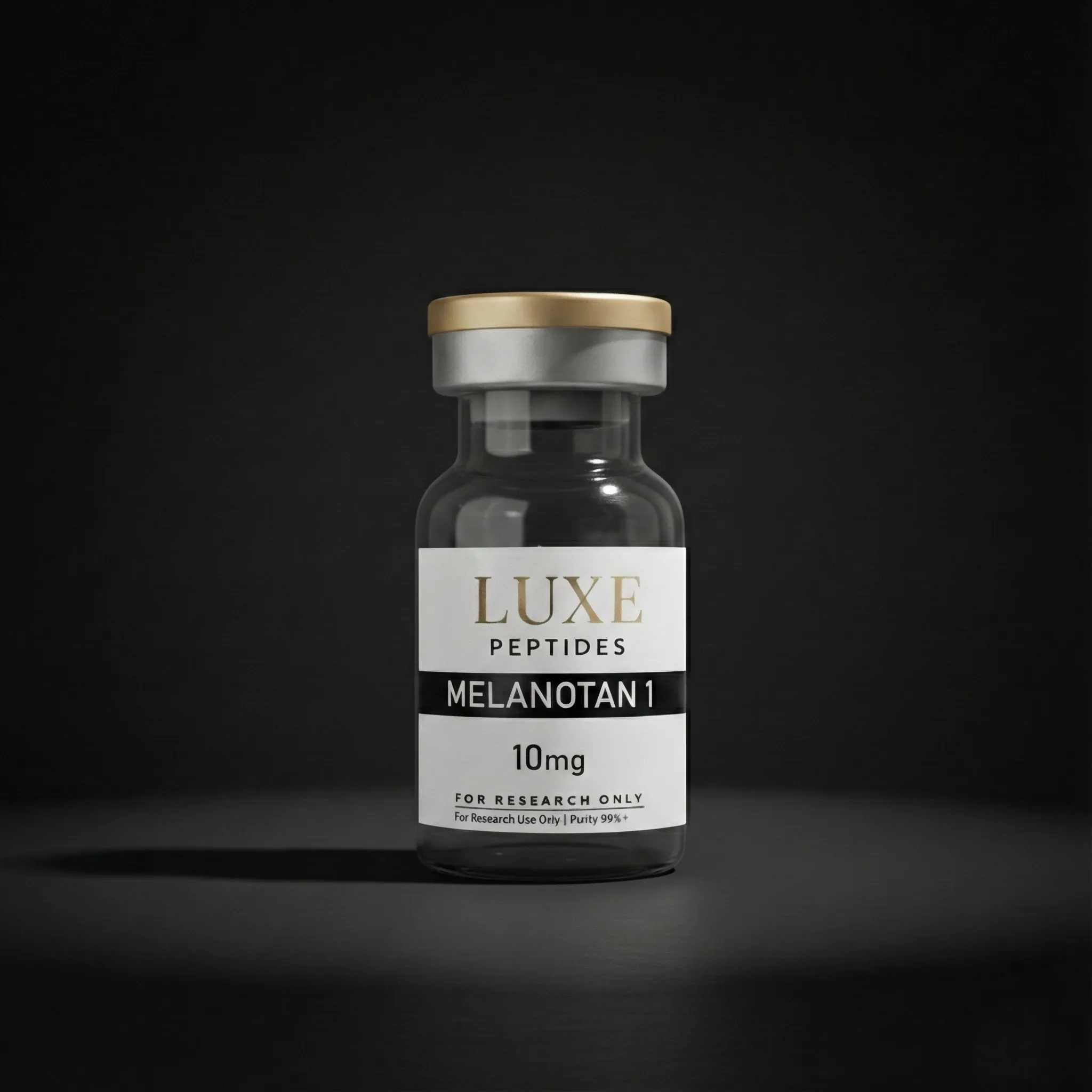
Melanotan 1
$40.00
What is Melanotan 1?
Melanotan 1 (MT-1), also known as afamelanotide, is a synthetic tridecapeptide analog of alpha-melanocyte-stimulating hormone (α-MSH). It was developed at the University of Arizona by Hruby and Hadley and contains two key modifications from native α-MSH: a norleucine substitution at position 4 (replacing methionine) and a D-phenylalanine substitution at position 7 (replacing L-phenylalanine). These changes create NDP-α-MSH (Nle4, D-Phe7-α-MSH), which is approximately 100-1000 times more potent than native α-MSH at the MC1R receptor and is resistant to enzymatic degradation. Afamelanotide was approved by the European Medicines Agency in 2014 under the brand name Scenesse for the prevention of phototoxicity in patients with erythropoietic protoporphyria. MT-1 is a relatively selective MC1R agonist compared to Melanotan 2, which has broader melanocortin receptor activity.
Mechanism of Action
Melanotan 1 has been investigated for its potent and selective agonism of the melanocortin 1 receptor (MC1R), a Gs-coupled GPCR expressed on melanocytes and other cell types. Researchers observed that MC1R activation by MT-1 stimulates adenylyl cyclase, increasing intracellular cAMP, which activates CREB (cAMP response element binding protein) and induces MITF (microphthalmia-associated transcription factor) expression. MITF drives transcription of melanogenic enzymes including tyrosinase, TRP-1, and TRP-2, promoting eumelanin (brown/black pigment) synthesis. Studies suggest that eumelanin production provides photoprotection through UV absorption and reactive oxygen species scavenging. MT-1’s selectivity for MC1R over MC3R, MC4R, and MC5R distinguishes it from Melanotan 2, which has broader receptor activity. In clinical studies, researchers observed that MT-1 administration was associated with increased melanin density without UV exposure, and enhanced the melanogenic response to subsequent UV exposure.
Published Research
MC1R Pharmacology
Hruby et al. (1995) described the design and characterization of NDP-α-MSH (Melanotan 1), demonstrating its enhanced potency, stability, and MC1R selectivity compared to native α-MSH [1].
Clinical Photoprotection
Langendonk et al. (2015) reported results from a Phase 3 clinical trial of afamelanotide in erythropoietic protoporphyria, demonstrating increased time to phototoxicity symptoms and supporting regulatory approval [2].
Melanogenesis
Barnetson et al. (2006) investigated afamelanotide in a clinical study and observed increased melanin density and skin darkening, with enhanced photoprotection against UV-induced erythema [3].
Product Specifications
| Product | Melanotan 1 Lyophilized Powder |
|---|---|
| Available Sizes | 10mg |
| Purity | ≥99% (HPLC verified) |
| CAS Number | 75921-69-6 |
| Sequence | Ac-Ser-Tyr-Ser-Nle-Glu-His-D-Phe-Arg-Trp-Gly-Lys-Pro-Val-NH₂ |
| Molecular Formula | C₇₈H₁₁₁N₂₁O₁₉ |
| Molecular Weight | 1,646.85 g/mol |
| Appearance | White lyophilized powder in glass vial |
| Storage | Store lyophilized at -20°C protected from light. Reconstituted solution at 2-8°C, use within 14 days. |
| Testing | Third-party tested — Certificate of Analysis available |
Frequently Asked Questions
Melanotan 1 (afamelanotide/NDP-u03b1-MSH) is a synthetic u03b1-MSH analog that selectively activates MC1R, promoting melanogenesis. It is 100-1000x more potent than native u03b1-MSH.
The CAS registry number for Melanotan 1 is 75921-69-6.
MT-1 is relatively selective for MC1R (melanogenesis), while MT-2 has broader melanocortin receptor activity affecting MC1R, MC3R, MC4R, and MC5R.
Afamelanotide (MT-1) was approved by the EMA in 2014 and FDA in 2019 under the brand name Scenesse for erythropoietic protoporphyria.
Store lyophilized MT-1 at -20°C protected from light. Once reconstituted, store at 2-8°C and use within 14 days.
MC1R (melanocortin 1 receptor) is a GPCR on melanocytes that controls melanin production. MC1R activation promotes eumelanin synthesis, which provides photoprotection.
References
- Hruby VJ, et al. Design of NDP-MSH analog peptides with MC1R selectivity. J Med Chem. 1995;38(18):3454-3461.
- Langendonk JG, et al. Afamelanotide for erythropoietic protoporphyria. N Engl J Med. 2015;373(1):48-59. PMID: 26132941
- Barnetson RS, et al. [Nle4-D-Phe7]-alpha-melanocyte-stimulating hormone significantly increased pigmentation and decreased UV damage in fair-skinned Caucasian volunteers. J Invest Dermatol. 2006;126(8):1869-1878. PMID: 16763546
Customer Reviews
Five stars earned. Quality speaks for itself.
Five stars earned. Quality speaks for itself.
Five stars earned. Quality speaks for itself.
Professional packaging, fast delivery, great product.
Happy with the product. Packaging could be improved slightly.
Five stars earned. Quality speaks for itself.
Purity exceeded expectations. Prompt delivery too.
Five stars earned. Quality speaks for itself.
Consistent quality across multiple orders. Very satisfied.
Professional packaging, fast delivery, great product.