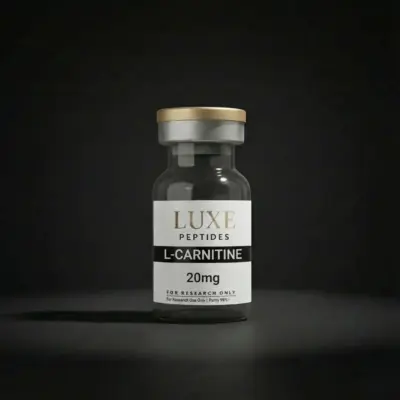
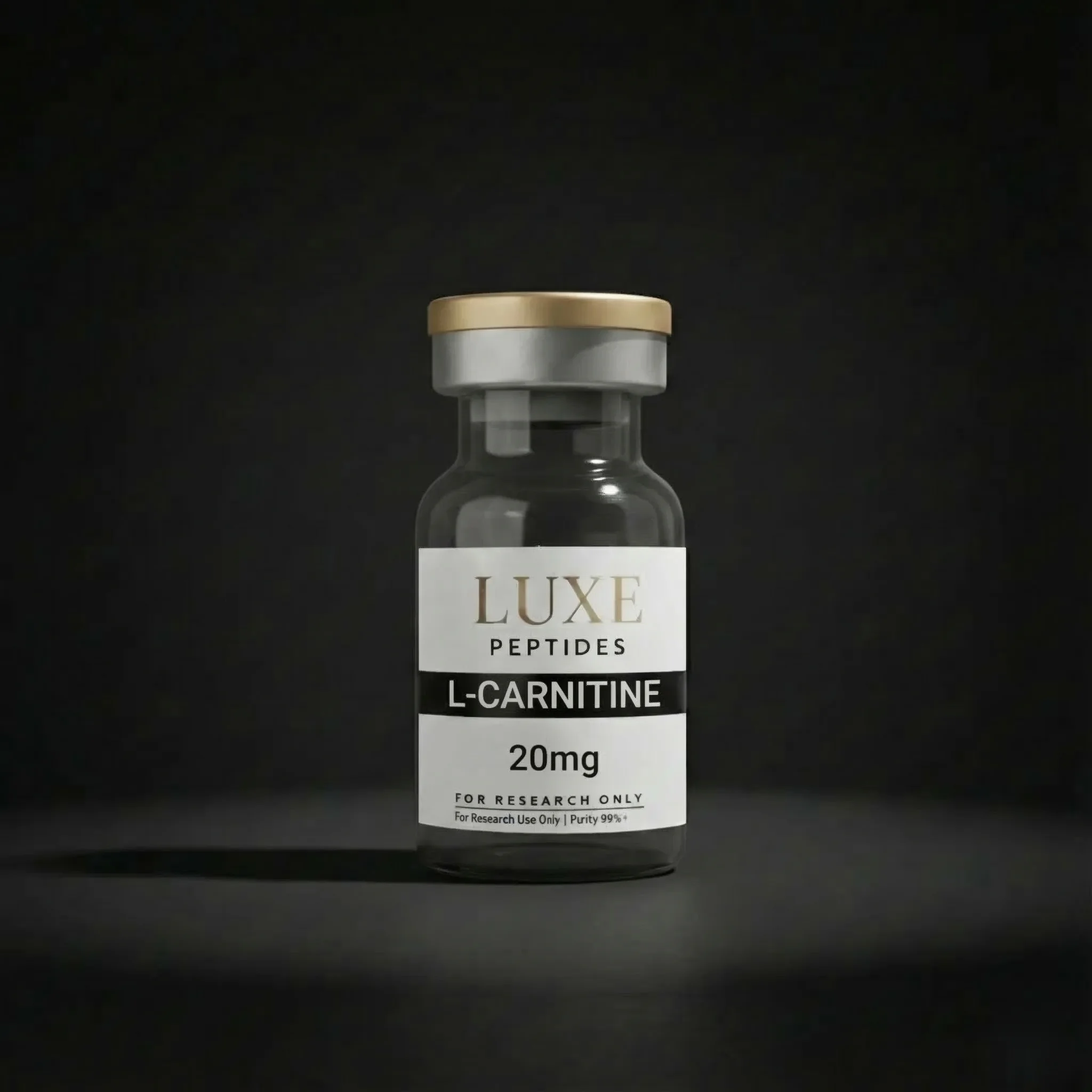
L-Carnitine
Price range: $35.00 through $200.00
What is L-Carnitine?
L-Carnitine is a naturally occurring quaternary ammonium compound biosynthesized from the amino acids lysine and methionine. It is essential for the transport of long-chain fatty acids across the inner mitochondrial membrane for beta-oxidation, a process known as the carnitine shuttle. L-Carnitine is synthesized endogenously in the liver and kidneys, and is also obtained through dietary intake, particularly from red meat and dairy products. The body maintains a total carnitine pool of approximately 20-25 grams, with over 95% stored in skeletal and cardiac muscle. L-Carnitine exists in two stereoisomers — only the L-form is biologically active. It has been studied extensively in the context of energy metabolism, exercise physiology, and cardiac biology. L-Carnitine is an FDA-approved prescription medication (as levocarnitine) for primary carnitine deficiency and has been investigated in numerous clinical trials across metabolic and cardiovascular research areas.
Mechanism of Action
L-Carnitine has been investigated for its essential role in the mitochondrial carnitine shuttle system. Long-chain fatty acyl-CoA esters cannot cross the inner mitochondrial membrane directly. Carnitine palmitoyltransferase I (CPT-I) on the outer mitochondrial membrane converts fatty acyl-CoA to fatty acyl-carnitine, which is then transported across the inner membrane by carnitine-acylcarnitine translocase (CACT). CPT-II on the inner membrane regenerates fatty acyl-CoA for beta-oxidation, releasing free carnitine to recycle through the shuttle. Researchers observed that L-carnitine also functions as a buffer for the acyl-CoA/CoA ratio, accepting excess acyl groups to maintain free CoA availability for other metabolic pathways. In clinical studies, L-carnitine supplementation has been investigated for its effects on fatty acid oxidation rates, exercise capacity, and recovery markers. The compound also participates in peroxisomal fatty acid oxidation and branched-chain amino acid metabolism.
Published Research
Carnitine Shuttle Biochemistry
Bremer J (1983) characterized the carnitine palmitoyltransferase system and the role of carnitine in mitochondrial fatty acid transport, establishing the biochemical framework for L-carnitine’s metabolic function [1].
Exercise Physiology
Wall et al. (2011) investigated L-carnitine supplementation in human subjects and observed increased muscle carnitine content and changes in fuel utilization during exercise, demonstrating that chronic supplementation can alter the muscle carnitine pool [2].
Clinical Applications
Flanagan et al. (2010) reviewed L-carnitine’s role in primary and secondary carnitine deficiency, establishing the clinical rationale for supplementation in conditions where endogenous synthesis or dietary intake is insufficient [3].
Product Specifications
| Product | L-Carnitine Lyophilized Powder |
|---|---|
| Available Sizes | 400mg/ml, 600mg/ml, 5 Pack - 600mg |
| Purity | ≥99% (HPLC verified) |
| CAS Number | 541-15-1 |
| Molecular Formula | C₇H₁₅NO₃ |
| Molecular Weight | 161.20 g/mol |
| Appearance | White lyophilized powder in glass vial |
| Storage | Store at room temperature or 2-8°C. Protect from moisture and light. |
| Testing | Third-party tested — Certificate of Analysis available |
Frequently Asked Questions
L-Carnitine is a naturally occurring amino acid derivative essential for transporting long-chain fatty acids into mitochondria for beta-oxidation (the carnitine shuttle).
The CAS registry number for L-Carnitine is 541-15-1.
No, L-Carnitine is a quaternary ammonium compound derived from the amino acids lysine and methionine. It is not a peptide.
Store L-Carnitine at room temperature or 2-8°C, protected from moisture and light.
The carnitine shuttle is the process by which L-carnitine facilitates transport of long-chain fatty acids across the inner mitochondrial membrane for beta-oxidation.
No, acetyl-L-carnitine (ALCAR) is the acetylated form. L-Carnitine is the free form. Both participate in carnitine metabolism but have different pharmacokinetic profiles.
References
- Bremer J. Carnitine—metabolism and functions. Physiol Rev. 1983;63(4):1420-1480. PMID: 6361812
- Wall BT, et al. Chronic oral ingestion of L-carnitine and carbohydrate increases muscle carnitine content and alters muscle fuel metabolism during exercise in humans. J Physiol. 2011;589(4):963-973. PMID: 21224234
- Flanagan JL, et al. Role of carnitine in disease. Nutr Metab (Lond). 2010;7:30. PMID: 20398344
Customer Reviews
Outstanding quality. This is my go-to source now.
Outstanding quality. This is my go-to source now.
Verified purity matches the COA. Excellent.
Quick delivery and the quality is consistently high.
Reordering because the first batch was flawless.
Product arrived fast and in perfect condition.
Really happy with this. Clean, pure, well-packaged.
Great product. Arrived quickly and exactly as described.
Verified purity matches the COA. Excellent.
Product is great. Only minor delay in shipping.
Very pleased with this purchase. Will be a repeat customer.
This vendor sets the standard. Highly recommend.