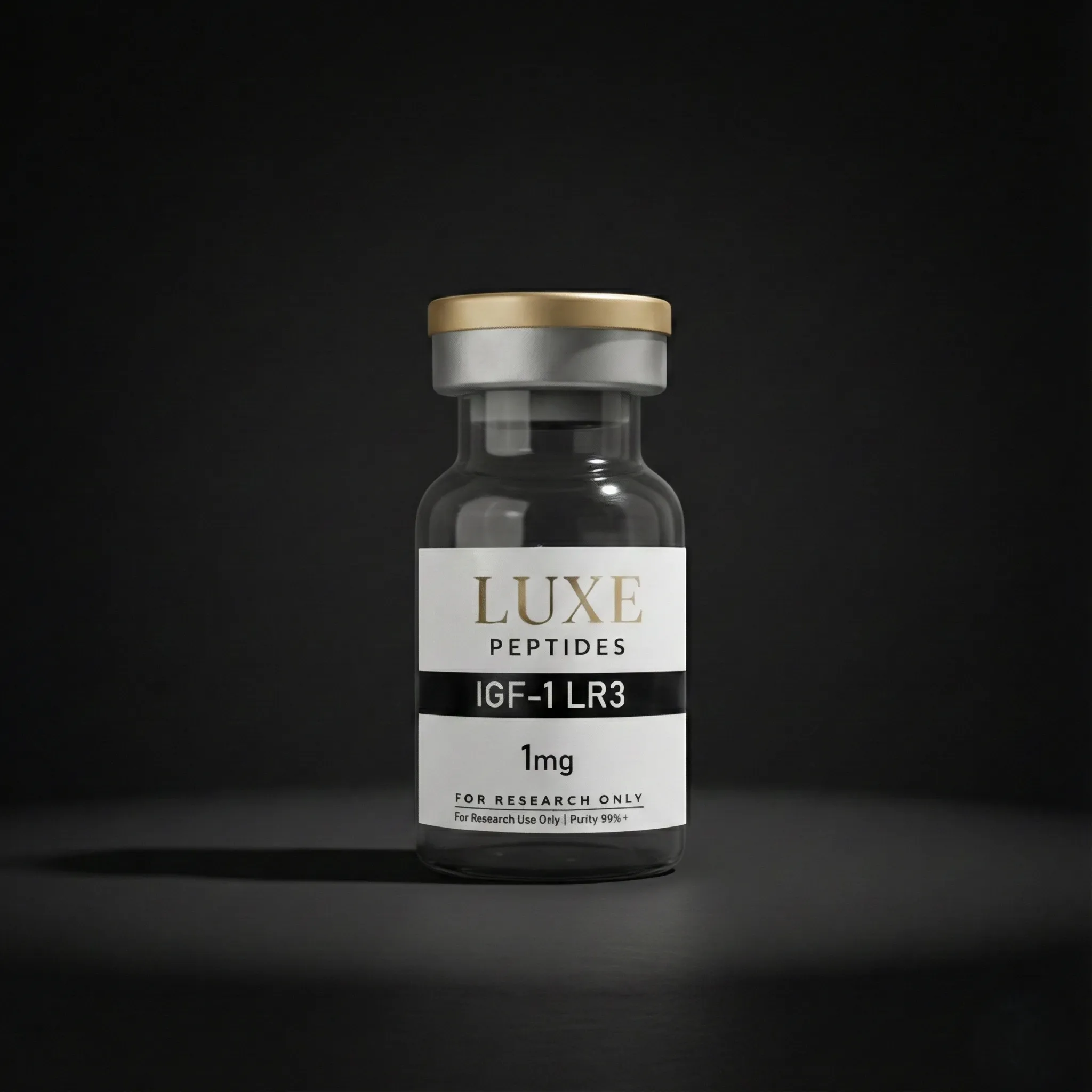
IGF-1- LR3
$65.00
What is IGF-1- LR3?
IGF-1 LR3 (Long R3 Insulin-like Growth Factor-1) is a synthetic 83-amino acid analog of human IGF-1 with two key modifications: an arginine substitution at position 3 (replacing glutamic acid) and a 13-amino acid extension peptide at the N-terminus. These modifications were specifically engineered to reduce binding to IGF binding proteins (IGFBPs), which normally sequester and regulate IGF-1 bioavailability in circulation. As a result, IGF-1 LR3 has a significantly longer functional half-life and greater bioavailability than native IGF-1 (70 amino acids). The analog retains full agonist activity at the IGF-1 receptor (IGF-1R) and has become the standard form of IGF-1 used in cell culture and preclinical research. IGF-1 LR3 activates the same downstream signaling cascades as native IGF-1, including PI3K/Akt and MAPK/ERK pathways, which are central to cell growth, proliferation, and survival.
Mechanism of Action
IGF-1 LR3 has been investigated for its agonist activity at the type 1 IGF receptor (IGF-1R), a receptor tyrosine kinase. Researchers observed that upon binding, IGF-1 LR3 induces IGF-1R autophosphorylation, recruiting IRS-1 (insulin receptor substrate-1) and activating two major downstream cascades: the PI3K/Akt pathway (promoting cell survival, protein synthesis via mTOR, and glucose uptake) and the Ras/MAPK/ERK pathway (promoting cell proliferation and differentiation). The critical advantage of IGF-1 LR3 over native IGF-1 is its dramatically reduced affinity for IGFBPs (particularly IGFBP-3 and IGFBP-5), which normally bind >95% of circulating IGF-1. Studies suggest that this IGFBP evasion results in a ~3-fold increase in potency in cell-based assays. In myoblast culture models, researchers observed that IGF-1 LR3 is associated with increased myotube formation, protein synthesis rates, and satellite cell activation markers.
Published Research
Engineering and Characterization
Francis et al. (1992) described the design and characterization of Long R3 IGF-1, demonstrating reduced IGFBP binding while maintaining full IGF-1R agonist activity. This work established the rationale for the dual modification approach [1].
IGFBP Interactions
Tomas et al. (1993) investigated IGF-1 LR3 in animal models and demonstrated that its reduced IGFBP binding resulted in enhanced bioactivity compared to native IGF-1 at equivalent doses [2].
Cell Culture Applications
Ballard et al. (1996) characterized IGF-1 LR3 as a cell culture supplement, demonstrating superior potency to native IGF-1 in supporting proliferation of multiple cell types due to freedom from IGFBP sequestration [3].
Product Specifications
| Product | IGF-1- LR3 Lyophilized Powder |
|---|---|
| Available Sizes | 1mg |
| Purity | ≥99% (HPLC verified) |
| CAS Number | 946870-92-4 |
| Sequence | Modified 83-amino acid analog of IGF-1 (Glu3→Arg substitution + 13-aa N-terminal extension) |
| Molecular Formula | C₄₀₀H₆₂₅N₁₁₁O₁₁₅S₉ |
| Molecular Weight | 9,111.4 g/mol |
| Appearance | White lyophilized powder in glass vial |
| Storage | Store lyophilized at -20°C. Reconstituted solution at 2-8°C, use within 14 days. |
| Testing | Third-party tested — Certificate of Analysis available |
Frequently Asked Questions
IGF-1 LR3 is a modified 83-amino acid analog of IGF-1 with reduced binding to IGF binding proteins, resulting in greater bioavailability and a longer functional half-life than native IGF-1.
The CAS registry number for IGF-1 LR3 is 946870-92-4.
IGF-1 LR3 has two modifications: an Arg substitution at position 3 and a 13-amino acid N-terminal extension. These reduce IGFBP binding, increasing bioavailability ~3-fold.
Store lyophilized IGF-1 LR3 at -20°C. Once reconstituted, store at 2-8°C and use within 14 days.
IGF binding proteins (IGFBPs) are a family of six proteins that bind and sequester IGF-1 in circulation. Over 95% of native IGF-1 is bound to IGFBPs at any time.
IGF-1 LR3 activates the IGF-1 receptor, triggering PI3K/Akt (cell survival, mTOR, protein synthesis) and Ras/MAPK/ERK (proliferation, differentiation) cascades.
References
- Francis GL, et al. Novel recombinant fusion protein analogues of insulin-like growth factor (IGF)-I indicate the relative importance of IGF-binding protein and receptor binding for enhanced biological potency. J Mol Endocrinol. 1992;8(3):213-223. PMID: 1381174
- Tomas FM, et al. Superior potency of infused IGF-I analogues which bind poorly to IGF-binding proteins. Am J Physiol. 1993;264(3):E368-E374.
- Ballard FJ, et al. Does IGF-I ever act through the insulin receptor? Prog Growth Factor Res. 1996;6(2-4):463-468.
Customer Reviews
Professional packaging, fast delivery, great product.
Reliable product. Took a bit longer to arrive than expected.
Great product. Arrived quickly and exactly as described.
Professional packaging, fast delivery, great product.
Solid product quality. COA checks out perfectly.
Consistent quality across multiple orders. Very satisfied.