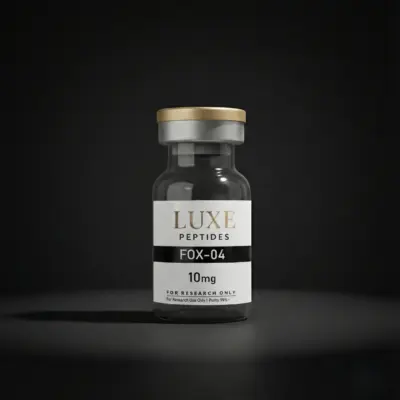
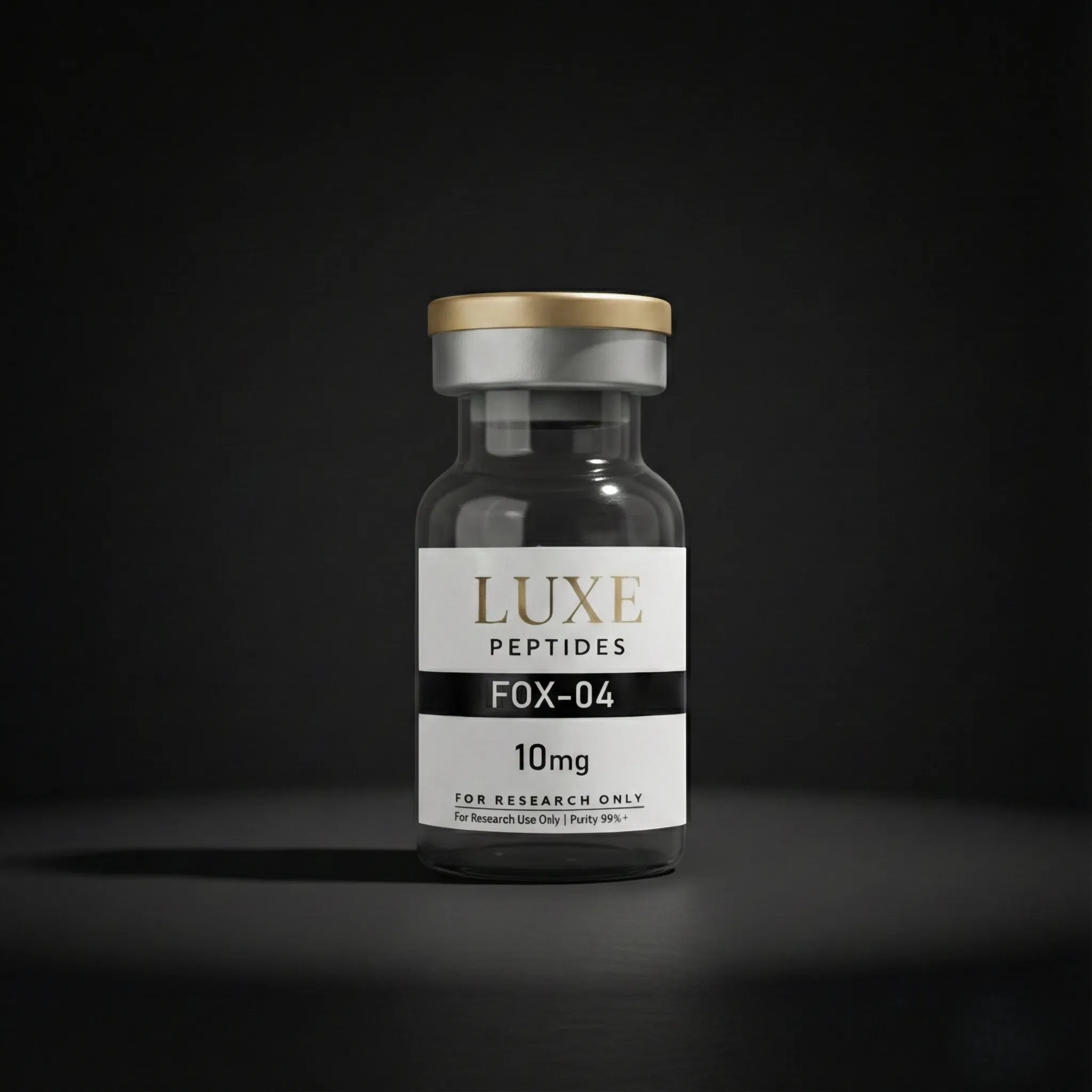
Fox04-DRI
$149.00
What is Fox04-DRI?
FOXO4-DRI is a D-retro-inverso (DRI) peptide designed to disrupt the interaction between FOXO4 and p53 in senescent cells. Developed by Baar et al. at Erasmus University Medical Center in the Netherlands, the peptide is based on the FOXO4 domain that binds p53, but synthesized with D-amino acids in reverse order to create a protease-resistant mirror image that retains binding activity. In senescent cells, FOXO4 sequesters p53 in PML nuclear bodies, preventing p53-mediated apoptosis and allowing senescent cells to remain viable despite growth arrest. FOXO4-DRI was designed to compete with endogenous FOXO4 for p53 binding, releasing p53 to activate apoptotic pathways selectively in senescent cells. This approach has been described as a “senolytic” strategy — selectively eliminating senescent cells while sparing non-senescent cells that do not depend on the FOXO4-p53 interaction for survival.
Mechanism of Action
FOXO4-DRI has been investigated for its selective disruption of the FOXO4-p53 protein-protein interaction in senescent cells. In the senescent state, FOXO4 accumulates in PML (promyelocytic leukemia) nuclear bodies where it binds and sequesters p53, preventing p53 from activating the mitochondrial apoptotic pathway. Researchers observed that FOXO4-DRI, as a D-retro-inverso peptide, competes with endogenous FOXO4 for p53 binding while resisting proteolytic degradation. Studies suggest that by displacing FOXO4, the peptide releases p53 to translocate to the cytoplasm and mitochondria, where it activates Bax/Bak pore formation and caspase-mediated apoptosis. Critically, this mechanism is selective for senescent cells because non-senescent cells do not accumulate FOXO4 in PML bodies and do not depend on FOXO4-p53 sequestration for survival. In aged mouse models, researchers observed that FOXO4-DRI administration was associated with changes in senescence biomarker levels and functional parameters.
Published Research
Discovery and In Vivo Studies
Baar et al. (2017) designed and characterized FOXO4-DRI and demonstrated its selective activity against senescent cells in culture and in naturally aged mice. Researchers observed that treatment was associated with reduced p16-positive cell populations and changes in physical function parameters in aged animals [1].
Senescence and p53
Demaria et al. (2014) characterized the role of senescent cells in tissue biology, demonstrating that senescent cell accumulation is associated with functional changes in aging tissues and providing the rationale for senolytic approaches [2].
D-Retro-Inverso Peptide Design
Baar et al. (2017) described the D-retro-inverso modification strategy that confers protease resistance while maintaining the binding surface topology needed for p53 interaction, establishing the pharmaceutical chemistry basis for FOXO4-DRI [1].
Product Specifications
| Product | Fox04-DRI Lyophilized Powder |
|---|---|
| Available Sizes | 10mg |
| Purity | ≥99% (HPLC verified) |
| Sequence | D-retro-inverso form of FOXO4 p53-interaction domain |
| Molecular Formula | C₂₃₈H₃₇₁N₇₅O₆₈S₂ |
| Molecular Weight | 5,611.14 g/mol |
| Appearance | White lyophilized powder in glass vial |
| Storage | Store lyophilized at -20°C. Reconstituted solution at 2-8°C, use within 14 days. |
| Testing | Third-party tested — Certificate of Analysis available |
Frequently Asked Questions
FOXO4-DRI is a D-retro-inverso peptide designed to disrupt the FOXO4-p53 interaction in senescent cells. It was developed at Erasmus University Medical Center as a senolytic research tool.
D-retro-inverso refers to a peptide made with D-amino acids in reverse sequence order. This creates a protease-resistant mirror image that retains the binding surface of the original L-peptide.
A senolytic is a compound that selectively targets and eliminates senescent (growth-arrested) cells while sparing normal, proliferating cells. FOXO4-DRI is studied in this context.
Store lyophilized FOXO4-DRI at -20°C. Once reconstituted, store at 2-8°C and use within 14 days.
Senescent cells uniquely depend on FOXO4 sequestering p53 in PML nuclear bodies to avoid apoptosis. Non-senescent cells do not rely on this interaction, so they are not affected.
FOXO4-DRI is studied in the context of cellular senescence, p53 signaling, senolytic research, and biogerontology in preclinical models.
References
- Baar MP, et al. Targeted apoptosis of senescent cells restores tissue homeostasis in response to chemotoxicity and aging. Cell. 2017;169(1):132-147.e16. PMID: 28340339
- Demaria M, et al. An essential role for senescent cells in optimal wound healing through secretion of PDGF-AA. Dev Cell. 2014;31(6):722-733. PMID: 25499914
Customer Reviews
Third order from Luxe — always reliable, always pure.
Quick delivery and the quality is consistently high.
Impressed with the quality. Packaging was professional.
Great product. Arrived quickly and exactly as described.
Good purity, fair pricing. Would order again.
Best quality I have found. Quick turnaround on shipping.
Quick delivery and the quality is consistently high.
Consistent quality across multiple orders. Very satisfied.
This vendor sets the standard. Highly recommend.
Consistent quality across multiple orders. Very satisfied.
Consistent quality across multiple orders. Very satisfied.
Verified purity matches the COA. Excellent.
Five stars earned. Quality speaks for itself.
Professional packaging, fast delivery, great product.
Purity exceeded expectations. Prompt delivery too.
Exactly what I needed for my research. Clean product.
Outstanding quality. This is my go-to source now.
Impressed with the quality. Packaging was professional.
Exactly what I needed for my research. Clean product.