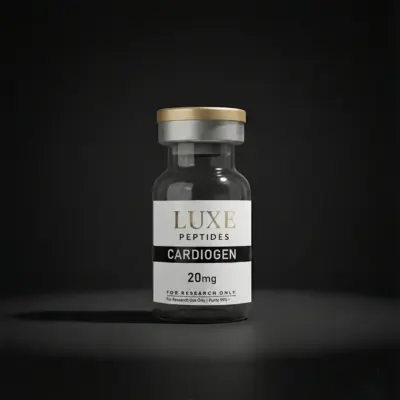
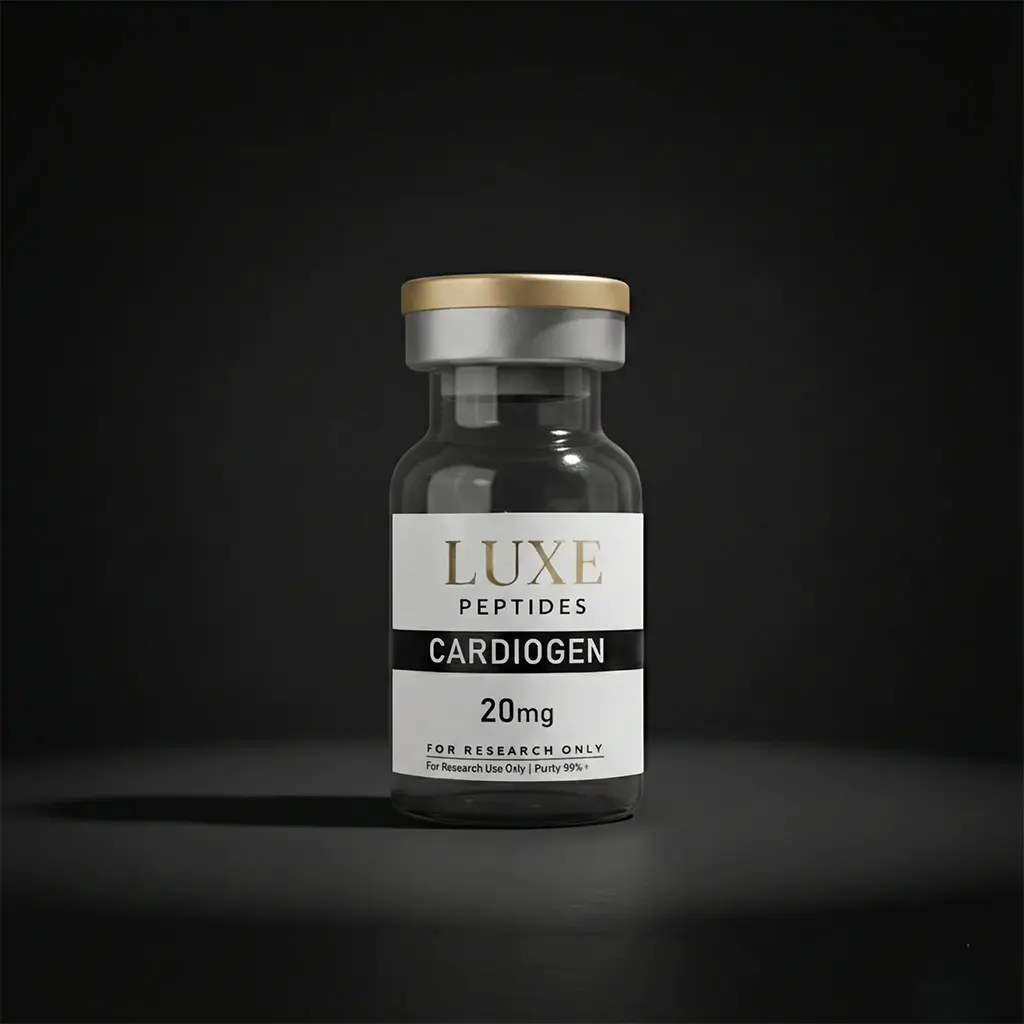
Cardiogen
$50.00
What is Cardiogen?
Cardiogen is a synthetic tetrapeptide (Ala-Glu-Asp-Arg) from the Khavinson class of bioregulatory peptides developed at the Saint Petersburg Institute of Bioregulation and Gerontology. It is designed to target cardiac (myocardial) tissue through proposed peptide-DNA interactions that modulate gene expression in cardiomyocytes. The Khavinson bioregulatory model proposes that short peptide sequences (2-4 amino acids) can interact with specific regions of DNA in a tissue-selective manner, influencing transcription of genes involved in tissue maintenance and cellular homeostasis. Cardiogen has been investigated in Russian biogerontology research for its potential effects on cardiac tissue biology, including studies examining cardiomyocyte differentiation markers, extracellular matrix composition, and age-related changes in cardiac gene expression. It is one of several organ-specific tetrapeptides in the Khavinson bioregulator family.
Mechanism of Action
Cardiogen has been investigated for its proposed interactions with gene regulatory regions in cardiac cells, consistent with the Khavinson bioregulatory peptide model. Researchers in this field propose that the Ala-Glu-Asp-Arg sequence penetrates cell membranes and interacts with specific DNA sequences in promoter regions of cardiac-expressed genes. In preclinical cell culture models, researchers observed that Cardiogen treatment was associated with changes in expression of cardiac differentiation markers and structural proteins including cardiac troponins and connexin-43. Studies from the Saint Petersburg group suggest that Cardiogen may influence cardiomyocyte proliferation and survival markers in culture systems. The peptide has also been investigated for its effects on cardiac tissue in aging models, where researchers observed changes in collagen-to-elastin ratios and matrix metalloproteinase expression. These effects are attributed to the peptide’s proposed epigenetic regulatory activity rather than conventional receptor signaling.
Published Research
Cardiac Gene Expression
Khavinson et al. (2003) investigated Cardiogen in cardiac tissue culture models and observed changes in expression of differentiation markers in cardiomyocytes. The study proposed that the tetrapeptide interacts with promoter regions of cardiac-specific genes [1].
Bioregulatory Peptides and Aging
Khavinson VK (2002) described the broader framework of bioregulatory peptides including Cardiogen, presenting data from preclinical studies on tissue-specific peptides across multiple organ systems including the heart [2].
Short Peptide-DNA Interactions
Fedoreyeva et al. (2011) investigated the binding of short peptides to DNA using fluorescence spectroscopy. Researchers demonstrated that tetrapeptides including those with similar charge distributions to Cardiogen could interact with specific DNA sequences in vitro [3].
Product Specifications
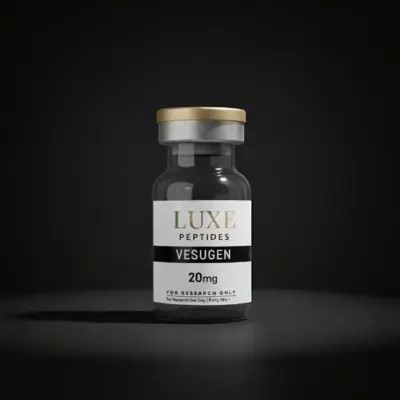
| Product | Cardiogen Lyophilized Powder |
|---|---|
| Available Sizes | 20mg |
| Purity | ≥99% (HPLC verified) |
| Sequence | Ala-Glu-Asp-Arg |
| Molecular Formula | C₁₆H₂₈N₆O₈ |
| Molecular Weight | 448.43 g/mol |
| Appearance | White lyophilized powder in glass vial |
| Storage | Store at -20°C or 2-8°C desiccated. Protect from moisture. |
| Testing | Third-party tested — Certificate of Analysis available |
Frequently Asked Questions
Cardiogen is a synthetic tetrapeptide (Ala-Glu-Asp-Arg) from the Khavinson bioregulatory peptide family, designed to target cardiac tissue through proposed gene regulatory mechanisms.
Cardiogen is designed to target cardiac (myocardial) tissue, consistent with the Khavinson model of tissue-selective bioregulatory peptides.
Store Cardiogen at -20°C or 2-8°C in a desiccated environment, protected from moisture.
Khavinson bioregulatory peptides are short (2-4 amino acid) synthetic peptides developed at the Saint Petersburg Institute of Bioregulation and Gerontology, theorized to modulate gene expression in specific target tissues.
Unlike receptor-binding cardiac peptides (such as BNP or ANP), Cardiogen is proposed to act through direct peptide-DNA interactions in gene regulatory regions rather than cell-surface receptor signaling.
References
- Khavinson VK, et al. Effects of short peptides on cardiomyocyte differentiation. Bull Exp Biol Med. 2003;136(6):559-561.
- Khavinson VK. Peptides and Ageing. Neuroendocrinol Lett. 2002;23 Suppl 3:11-144. PMID: 12374906
- Fedoreyeva LI, et al. Penetration of short fluorescence-labeled peptides into the nucleus in HeLa cells. Biochemistry (Moscow). 2011;76(11):1210-1219. PMID: 22117547

Customer Reviews
Product arrived fast and in perfect condition.
Verified purity matches the COA. Excellent.
Fast shipping, well-packaged. Product quality is top-notch.
Good product overall. Shipping took a couple extra days.
Verified purity matches the COA. Excellent.
Quality is solid. Wish there were more size options.
Purity exceeded expectations. Prompt delivery too.
Really happy with this. Clean, pure, well-packaged.
Reordering because the first batch was flawless.
Consistent quality across multiple orders. Very satisfied.
Verified purity matches the COA. Excellent.
Verified purity matches the COA. Excellent.
Best quality I have found. Quick turnaround on shipping.
Great product. Arrived quickly and exactly as described.
Purity exceeded expectations. Prompt delivery too.
Verified purity matches the COA. Excellent.
Outstanding quality. This is my go-to source now.
Verified purity matches the COA. Excellent.
Solid quality for the price point. Good experience.