
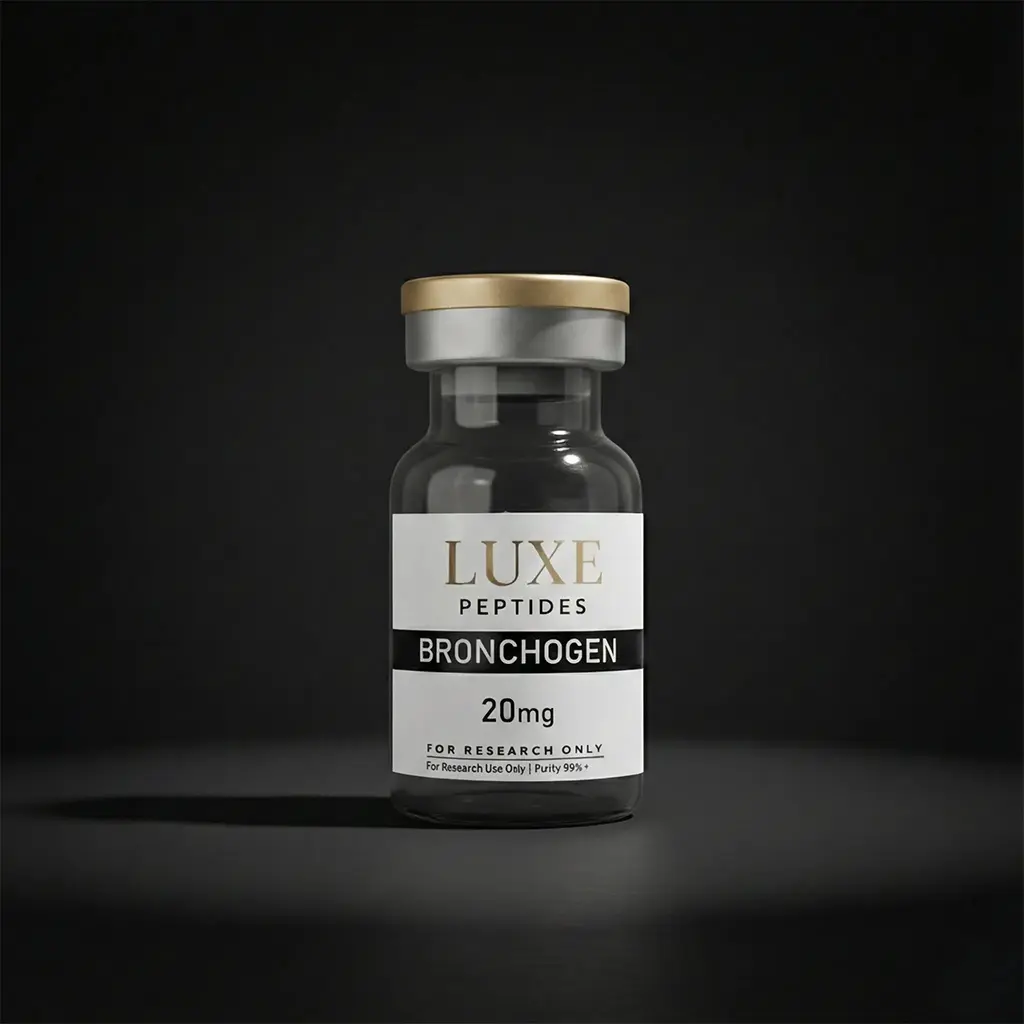
Bronchogen (Bioregulator)
$55.00
What is Bronchogen (Bioregulator)?
Bronchogen is a synthetic tetrapeptide (Ala-Asp-Glu-Leu) belonging to the Khavinson class of bioregulatory peptides developed at the Saint Petersburg Institute of Bioregulation and Gerontology in Russia. Bioregulatory peptides are short peptide sequences (typically 2-4 amino acids) theorized to interact with specific gene promoter regions in target tissues, modulating transcription in a tissue-selective manner. Bronchogen was designed to target bronchial and respiratory epithelial tissue. The Khavinson bioregulation theory proposes that these short peptides act as epigenetic modulators, influencing gene expression patterns associated with tissue maintenance and cellular homeostasis. Bronchogen has been studied primarily in Russian biogerontology research, where it has been investigated in preclinical models of respiratory tissue biology and aging-related changes in bronchial epithelium.
Mechanism of Action
Bronchogen has been investigated for its potential interaction with gene regulatory regions in bronchial epithelial cells, consistent with the Khavinson bioregulatory peptide model. Researchers in this field propose that short peptides can penetrate cell membranes and interact with specific DNA sequences in gene promoter regions, modulating transcription of tissue-specific genes. Studies suggest that Bronchogen may influence expression of genes involved in mucociliary function, surfactant production, and epithelial barrier integrity in respiratory tissue models. In preclinical studies conducted at the Saint Petersburg Institute, researchers observed that Bronchogen administration was associated with changes in bronchial epithelial cell proliferation markers and mucin gene expression. The bioregulatory peptide model proposes that these effects are mediated through direct peptide-DNA interactions rather than conventional receptor-mediated signaling, though this mechanism remains an area of active investigation in the bioregulation research community.
Published Research
Bioregulatory Peptide Theory
Khavinson VK (2002) described the theoretical framework for short bioregulatory peptides, proposing that di- and tetrapeptides can interact with DNA and modulate gene expression in a tissue-specific manner. This foundational work established the rationale for tissue-targeted peptides including Bronchogen [1].
Respiratory Tissue Studies
Khavinson et al. (2011) investigated short peptides including Bronchogen in models of respiratory epithelial aging. Researchers observed changes in proliferative indices and differentiation markers in bronchial tissue cultures treated with the peptide [2].
Peptide-DNA Interactions
Anisimov et al. (2010) reviewed the evidence for short peptide interactions with gene regulatory elements, including studies using fluorescence-labeled tetrapeptides that demonstrated nuclear localization and sequence-specific DNA binding in cell culture models [3].
Product Specifications
| Product | Bronchogen (Bioregulator) Lyophilized Powder |
|---|---|
| Available Sizes | 20mg |
| Purity | ≥99% (HPLC verified) |
| Sequence | Ala-Asp-Glu-Leu |
| Molecular Formula | C₁₆H₂₆N₄O₈ |
| Molecular Weight | 418.40 g/mol |
| Appearance | White lyophilized powder in glass vial |
| Storage | Store at -20°C or 2-8°C desiccated. Protect from moisture. |
| Testing | Third-party tested — Certificate of Analysis available |
Frequently Asked Questions
Bronchogen is a synthetic tetrapeptide (Ala-Asp-Glu-Leu) from the Khavinson class of bioregulatory peptides. It is designed to target bronchial and respiratory epithelial tissue.
Bioregulatory peptides are short (2-4 amino acid) sequences theorized to modulate gene expression in specific tissues by interacting with DNA regulatory regions, as proposed by Professor Vladimir Khavinson.
Store Bronchogen at -20°C or 2-8°C in a desiccated environment, protected from moisture.
Bronchogen is designed to target bronchial and respiratory epithelial tissue, consistent with its amino acid sequence specificity in the Khavinson bioregulation model.
Unlike receptor-binding peptides, bioregulatory peptides like Bronchogen are theorized to act through direct peptide-DNA interactions in gene promoter regions rather than cell-surface receptor signaling.
References
- Khavinson VK. Peptides and Ageing. Neuroendocrinol Lett. 2002;23 Suppl 3:11-144. PMID: 12374906
- Khavinson V, et al. Short peptides modulate the effect of endonucleases of wheat seedling. Bull Exp Biol Med. 2011;150(1):48-50.
- Anisimov VN, Khavinson VK. Peptide bioregulation of aging: results and prospects. Biogerontology. 2010;11(2):139-149. PMID: 19830585




Customer Reviews
Impressed with the quality. Packaging was professional.
Reordering because the first batch was flawless.
Very pleased with this purchase. Will be a repeat customer.
Impressed with the quality. Packaging was professional.
Outstanding quality. This is my go-to source now.
Product is great. Only minor delay in shipping.
Very pleased with this purchase. Will be a repeat customer.
Very pleased with this purchase. Will be a repeat customer.
Product arrived fast and in perfect condition.
Third order from Luxe — always reliable, always pure.
Verified purity matches the COA. Excellent.
Product arrived fast and in perfect condition.
Five stars earned. Quality speaks for itself.
Professional packaging, fast delivery, great product.
Verified purity matches the COA. Excellent.
Very pleased with this purchase. Will be a repeat customer.
Impressed with the quality. Packaging was professional.
Happy with the product. Packaging could be improved slightly.
Third order from Luxe — always reliable, always pure.
Very pleased with this purchase. Will be a repeat customer.
Verified purity matches the COA. Excellent.
Impressed with the quality. Packaging was professional.
This vendor sets the standard. Highly recommend.
Great product. Arrived quickly and exactly as described.
Reliable product. Took a bit longer to arrive than expected.