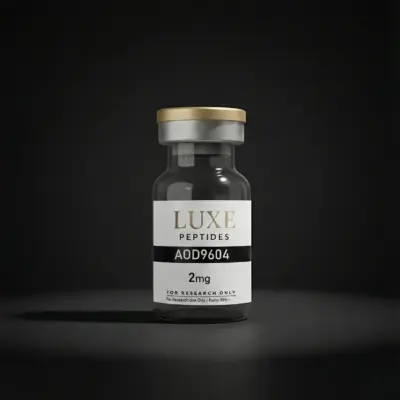
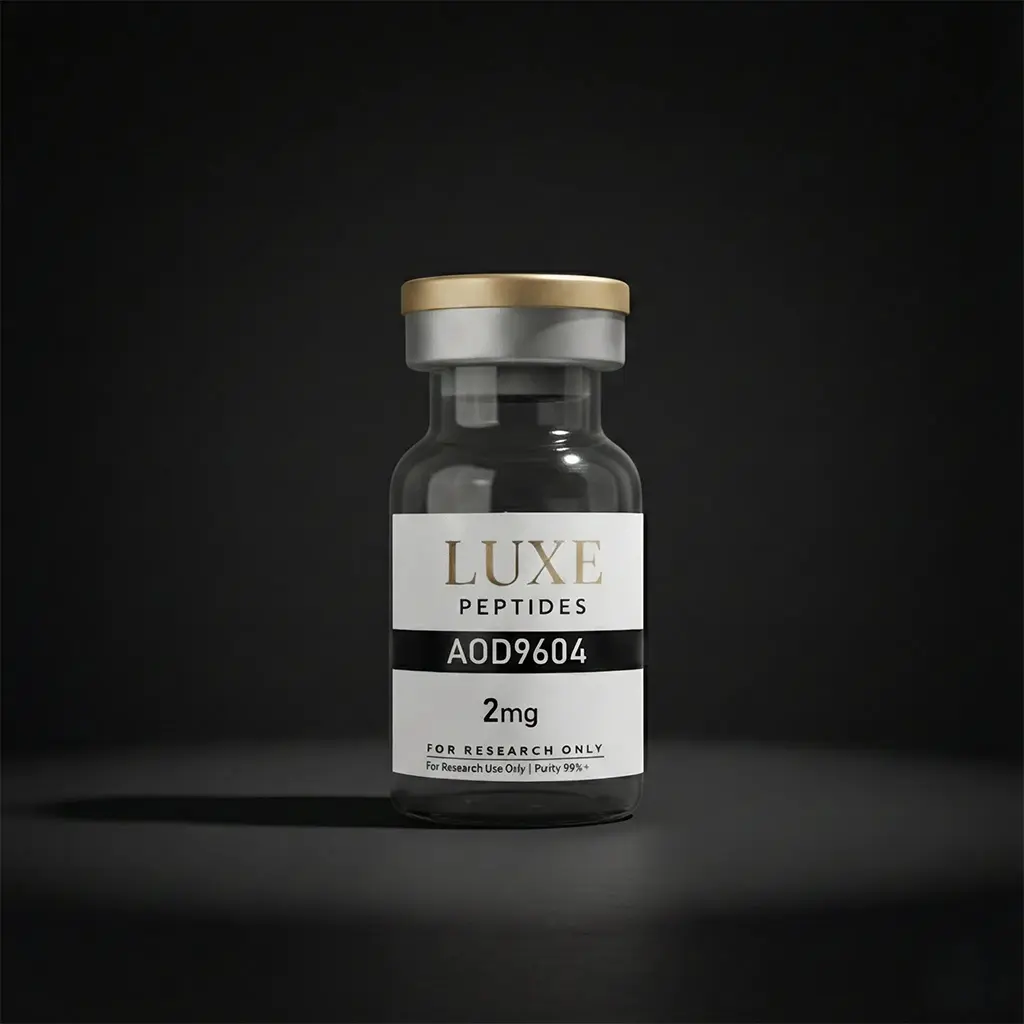
AOD9604
Price range: $30.00 through $80.00
What is AOD9604?
AOD9604 (Anti-Obesity Drug 9604) is a synthetic peptide fragment corresponding to amino acids 177-191 of human growth hormone (hGH), with the addition of a tyrosine residue at the N-terminus. Developed at Monash University in Australia, AOD9604 was designed to isolate the lipolytic activity attributed to the C-terminal region of hGH while excluding the growth-promoting and diabetogenic effects associated with the full-length hormone. The peptide contains an internal disulfide bond between the two cysteine residues, which is critical for its three-dimensional conformation. AOD9604 has been studied in preclinical and early clinical settings, and it received GRAS (Generally Recognized as Safe) designation from the US FDA for use as a food ingredient. More recently, researchers have also investigated AOD9604 in the context of cartilage and joint biology.
Mechanism of Action
AOD9604 has been investigated for its interaction with beta-3 adrenergic receptor pathways in adipose tissue. Researchers observed that the peptide stimulates lipolysis in preclinical adipocyte models through a mechanism distinct from full-length growth hormone signaling. Studies suggest that AOD9604 does not bind the growth hormone receptor and does not activate the JAK2/STAT5 pathway, which accounts for the absence of growth-promoting or IGF-1-elevating effects observed in animal studies. Instead, the peptide appears to modulate lipid metabolism through direct interaction with fat cell signaling cascades. In cartilage biology research, investigators have observed that AOD9604 is associated with proteoglycan synthesis in chondrocyte models, suggesting potential activity in extracellular matrix maintenance. The disulfide bridge between Cys₇ and Cys₁₄ is essential for maintaining the peptide’s bioactive conformation.
Published Research
Lipolytic Activity
Heffernan et al. (2001) investigated AOD9604 in obese Zucker rats and observed that chronic administration was associated with reduced body weight gain without changes in IGF-1 levels or glucose tolerance, distinguishing its activity profile from that of full-length growth hormone [1].
Clinical Investigation
Stier et al. (2013) reported results from a randomized, placebo-controlled clinical study evaluating oral AOD9604 in overweight subjects. The study examined safety parameters and metabolic biomarkers over a 12-week treatment period [2].
Cartilage Biology
Krishnan et al. (2017) investigated AOD9604 in a preclinical model of joint pathology. Researchers observed that intra-articular administration was associated with changes in cartilage matrix composition and chondrocyte activity markers in the treated joints compared to controls [3].
Product Specifications
| Product | AOD9604 Lyophilized Powder |
|---|---|
| Available Sizes | 2mg, 5mg, 10mg |
| Purity | ≥99% (HPLC verified) |
| CAS Number | 221231-10-3 |
| Sequence | Tyr-Leu-Arg-Ile-Val-Gln-Cys-Arg-Ser-Val-Glu-Gly-Ser-Cys-Gly-Phe |
| Molecular Formula | C₇₈H₁₂₃N₂₃O₂₃S₂ |
| Molecular Weight | 1,815.08 g/mol |
| Appearance | White lyophilized powder in glass vial |
| Storage | Store lyophilized at -20°C. Reconstituted solution at 2-8°C, use within 30 days. |
| Testing | Third-party tested — Certificate of Analysis available |
Frequently Asked Questions
AOD9604 is a synthetic peptide corresponding to amino acids 177-191 of human growth hormone, with an added N-terminal tyrosine. It is studied for its lipolytic properties in preclinical research.
The CAS registry number for AOD9604 is 221231-10-3.
In preclinical models, researchers observed that AOD9604 does not stimulate IGF-1 production or activate the growth hormone receptor, distinguishing it from full-length hGH.
Store lyophilized AOD9604 at -20°C. Once reconstituted, store at 2-8°C and use within 30 days.
AOD9604 is commonly studied in the context of lipolysis, adipocyte signaling, hGH fragment biology, and more recently, cartilage and joint biology in preclinical models.
They are closely related. AOD9604 is the hGH fragment 177-191 with an additional tyrosine at the N-terminus, which stabilizes the molecule. Both share similar research applications.
References
- Heffernan MA, et al. The effects of human GH and its lipolytic fragment (AOD9604) on lipid metabolism following chronic treatment in obese mice and beta3-AR knock-out mice. Endocrinology. 2001;142(12):5182-5189. PMID: 11713213
- Stier H, et al. A randomized, double-blind, placebo-controlled study of oral AOD9604 in overweight adults. J Obes Weight Loss Ther. 2013;3:175.
- Krishnan Y, et al. Investigation of the peptide AOD9604 in an ovine osteochondral defect model. J Orthop Res. 2017.
Customer Reviews
Really happy with this. Clean, pure, well-packaged.
Solid product quality. COA checks out perfectly.
Professional packaging, fast delivery, great product.
Solid quality for the price point. Good experience.
This vendor sets the standard. Highly recommend.
Reordering because the first batch was flawless.
Reordering because the first batch was flawless.
Excellent purity. Lab results confirmed. Will order again.
Fast shipping, well-packaged. Product quality is top-notch.
Very pleased with this purchase. Will be a repeat customer.
Purity exceeded expectations. Prompt delivery too.
Professional packaging, fast delivery, great product.
Very pleased with this purchase. Will be a repeat customer.
Quick delivery and the quality is consistently high.
Impressed with the quality. Packaging was professional.
Professional packaging, fast delivery, great product.
Outstanding quality. This is my go-to source now.
Third order from Luxe — always reliable, always pure.
Good purity, fair pricing. Would order again.
Best quality I have found. Quick turnaround on shipping.
Impressed with the quality. Packaging was professional.
Verified purity matches the COA. Excellent.
Consistent quality across multiple orders. Very satisfied.
Outstanding quality. This is my go-to source now.
Five stars earned. Quality speaks for itself.
Excellent purity. Lab results confirmed. Will order again.
Solid product quality. COA checks out perfectly.