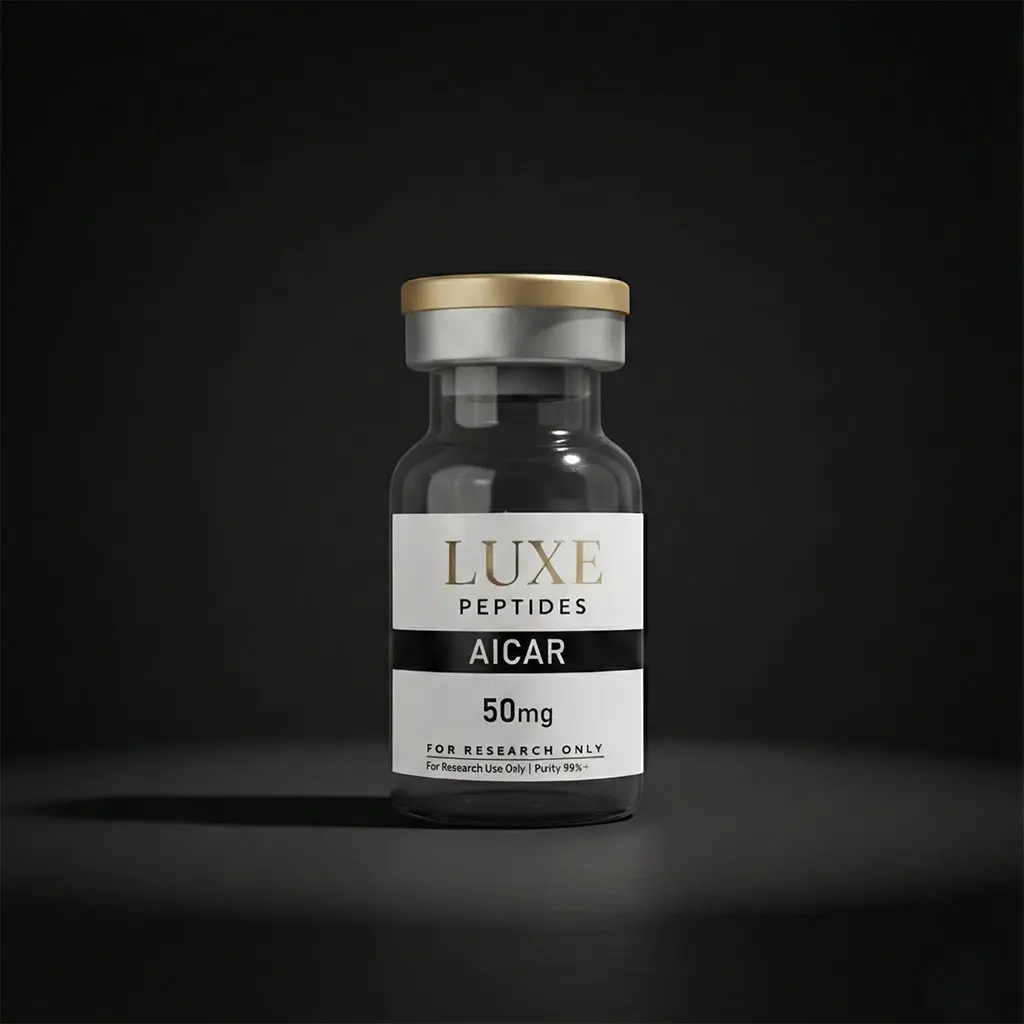
Aicar
$50.00
What is Aicar?
AICAR (5-aminoimidazole-4-carboxamide ribonucleoside), also known as acadesine, is a nucleoside analog that serves as a precursor to ZMP (AICA ribotide) inside cells. ZMP is an intermediate in the de novo purine biosynthesis pathway and acts as an AMP mimetic, activating AMP-activated protein kinase (AMPK). AICAR was originally investigated in the context of cardiac ischemia research in the 1980s and 1990s. It has since become one of the most widely used pharmacological tools for studying AMPK-dependent signaling in cell and animal models. AICAR is cell-permeable and is phosphorylated intracellularly by adenosine kinase to form ZMP. It has been studied extensively in the context of metabolic flux, glucose transport, fatty acid oxidation, and mitochondrial biogenesis in preclinical models.
Mechanism of Action
AICAR has been investigated for its role as an AMPK activator. Upon cellular uptake, AICAR is phosphorylated by adenosine kinase to produce ZMP, which mimics AMP and binds to the gamma subunit of AMPK. Researchers observed that this binding promotes AMPK phosphorylation at Thr172 by upstream kinases including LKB1. Activated AMPK then phosphorylates downstream substrates involved in metabolic switching, including ACC (acetyl-CoA carboxylase), which reduces malonyl-CoA levels and promotes fatty acid oxidation. Studies suggest that AICAR-mediated AMPK activation also increases translocation of GLUT4 glucose transporters in skeletal muscle cells. In preclinical exercise physiology models, researchers observed that AICAR administration was associated with transcriptional changes overlapping with those induced by endurance exercise, including upregulation of PGC-1α and mitochondrial biogenesis genes.
Published Research
Exercise Mimetic Properties
Narkar et al. (2008) investigated AICAR in sedentary mice and observed that chronic administration was associated with transcriptional reprogramming in skeletal muscle resembling endurance training adaptations. The researchers reported increased expression of oxidative metabolism genes and changes in running endurance parameters [1].
AMPK and Glucose Transport
Merrill et al. (1997) demonstrated that AICAR treatment of isolated rat skeletal muscles was associated with increased glucose transport, mediated through AMPK activation independent of insulin signaling. This foundational study established AICAR as a key pharmacological tool for AMPK research [2].
Cardiac Ischemia Research
Mangano et al. (1997) conducted a multicenter clinical investigation of acadesine (AICAR) in the context of coronary artery bypass surgery, examining its effects on perioperative outcomes. The study provided early clinical pharmacokinetic and safety data for the compound [3].
Product Specifications
| Product | Aicar Lyophilized Powder |
|---|---|
| Available Sizes | 50mg |
| Purity | ≥99% (HPLC verified) |
| CAS Number | 2627-69-2 |
| Molecular Formula | C₉H₁₄N₄O₅ |
| Molecular Weight | 258.23 g/mol |
| Appearance | White lyophilized powder in glass vial |
| Storage | Store at -20°C desiccated. Protect from light. Reconstituted solutions at 2-8°C. |
| Testing | Third-party tested — Certificate of Analysis available |
Frequently Asked Questions
AICAR (acadesine) is a nucleoside analog that activates AMP-activated protein kinase (AMPK) after intracellular conversion to ZMP. It is widely used as a pharmacological tool in metabolic research.
The CAS registry number for AICAR is 2627-69-2.
No, AICAR is a nucleoside analog, not a peptide. It is a small molecule that mimics AMP within cells after phosphorylation.
Store AICAR lyophilized at -20°C in a desiccated environment, protected from light. Reconstituted solutions should be kept at 2-8°C.
AMP-activated protein kinase (AMPK) is a cellular energy sensor that regulates metabolic pathways. When activated, it promotes catabolic processes like fatty acid oxidation and glucose uptake.
In preclinical models, researchers observed that AICAR administration was associated with transcriptional changes in skeletal muscle that overlap with those induced by endurance exercise training.
References
- Narkar VA, et al. AMPK and PPARdelta agonists are exercise mimetics. Cell. 2008;134(3):405-415. PMID: 18674809
- Merrill GF, et al. AICA riboside increases AMP-activated protein kinase, fatty acid oxidation, and glucose uptake in rat muscle. Am J Physiol. 1997;273(6):E1107-E1112. PMID: 9435525
- Mangano DT, et al. Acadesine and myocardial function after coronary artery bypass surgery. N Engl J Med. 1997;337(22):1556-1563.
Customer Reviews
Really happy with this. Clean, pure, well-packaged.
Best quality I have found. Quick turnaround on shipping.
Exactly what I needed for my research. Clean product.
Really happy with this. Clean, pure, well-packaged.
Product arrived fast and in perfect condition.
Very pleased with this purchase. Will be a repeat customer.
Five stars earned. Quality speaks for itself.
Happy with the product. Packaging could be improved slightly.
Professional packaging, fast delivery, great product.