
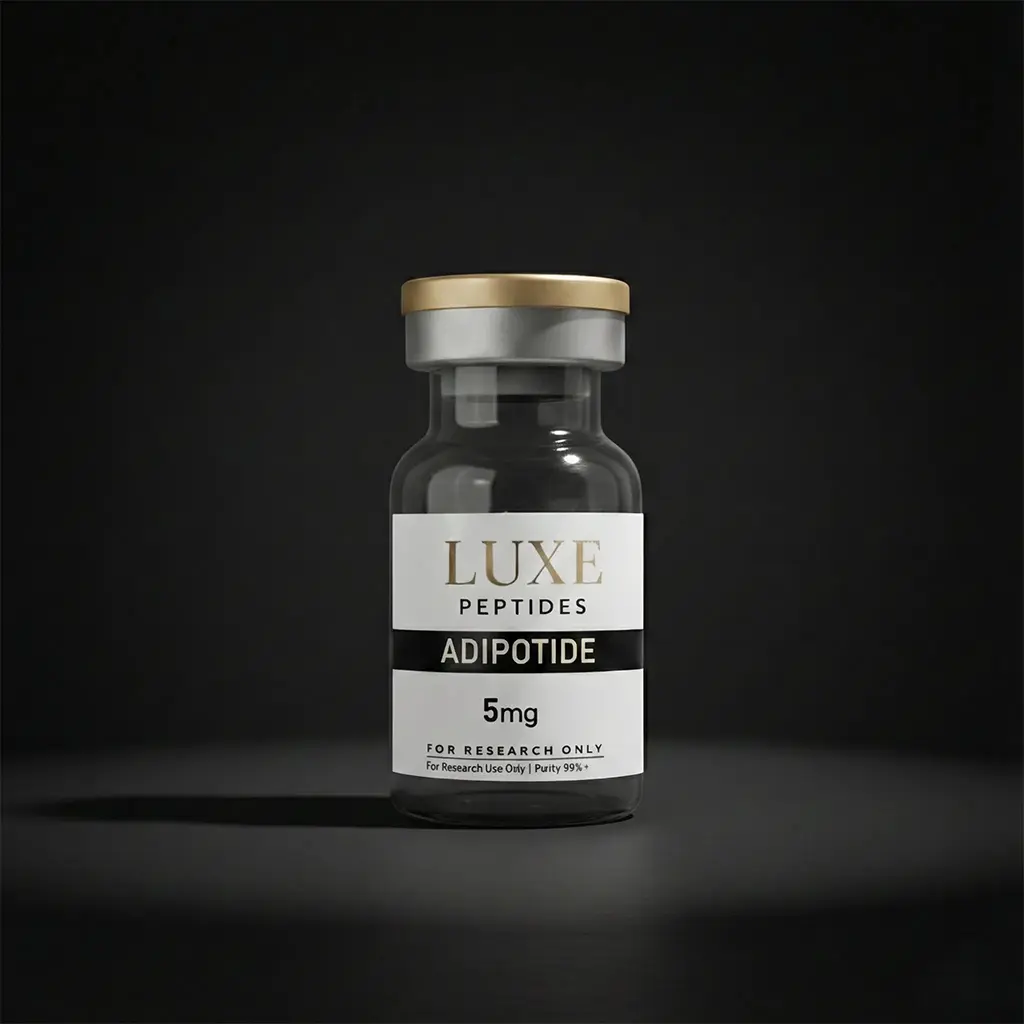
Adipotide (FTTP)
$39.99
What is Adipotide (FTTP)?
Adipotide, also known as FTTP (fat-targeted proapoptotic peptide), is a chimeric peptidomimetic composed of two functional domains. The first domain is a cyclic targeting motif (CKGGRAKDC) that binds prohibitin on the surface of vascular endothelial cells supplying white adipose tissue. The second domain is a proapoptotic sequence D(KLAKLAK)₂ that disrupts mitochondrial membranes upon internalization. Originally developed at the University of Texas MD Anderson Cancer Center, Adipotide was designed to selectively target the vasculature of adipose tissue in preclinical models. It has been studied in both rodent and non-human primate models for its effects on adipose tissue blood supply. The compound represents a vascular-targeting approach to studying fat tissue biology rather than acting directly on adipocytes themselves.
Mechanism of Action
Adipotide has been investigated for its dual-domain mechanism of action. Researchers observed that the cyclic CKGGRAKDC motif binds to prohibitin, a receptor expressed on the luminal surface of blood vessels supplying white adipose tissue. Upon binding, the conjugated proapoptotic D(KLAKLAK)₂ domain is internalized into the endothelial cells. Studies suggest that once inside the cell, this synthetic peptide sequence disrupts mitochondrial membrane integrity, initiating apoptotic cascades in the vascular endothelium. In preclinical primate models, researchers observed that this vascular targeting approach was associated with changes in adipose tissue perfusion. The selectivity of Adipotide is attributed to the differential expression of prohibitin on adipose vasculature compared to other tissue beds. Researchers noted that the compound’s effects were most pronounced in visceral fat depots in the animal models studied.
Published Research
Non-Human Primate Studies
Barnhart et al. (2011) investigated Adipotide in obese rhesus monkeys over a 28-day treatment period. Researchers observed changes in body mass index, abdominal circumference, and MRI-assessed adipose tissue volume. The study also reported renal biomarker changes that were monitored throughout the treatment period [1].
Vascular Targeting in Obesity Models
Kolonin et al. (2004) published foundational work on prohibitin-targeted peptides in murine models. The researchers demonstrated that phage display-identified peptides homing to adipose vasculature could deliver proapoptotic cargo to white fat blood vessels, establishing the proof-of-concept for this vascular targeting approach [2].
Prohibitin as a Vascular Marker
Sharma and bhMisc (2012) reviewed the role of prohibitin in endothelial cell biology and its expression patterns across different vascular beds. This work provided context for understanding why prohibitin-targeted peptides show preferential accumulation in adipose tissue vasculature [3].
Product Specifications
| Product | Adipotide (FTTP) Lyophilized Powder |
|---|---|
| Available Sizes | 5mg |
| Purity | ≥99% (HPLC verified) |
| CAS Number | 1401066-79-2 |
| Sequence | CKGGRAKDC-GG-D(KLAKLAK)₂ |
| Molecular Formula | C₇₅H₁₁₃N₂₁O₂₀ |
| Molecular Weight | 1,680.84 g/mol |
| Appearance | White lyophilized powder in glass vial |
| Storage | Store lyophilized at -20°C. Reconstituted solution at 2-8°C, use within 14 days. |
| Testing | Third-party tested — Certificate of Analysis available |
Frequently Asked Questions
Adipotide (FTTP) is a chimeric peptidomimetic designed to target prohibitin on the vasculature of white adipose tissue. It is studied in preclinical models for its vascular-targeting properties.
The CAS registry number for Adipotide is 1401066-79-2.
Adipotide contains a cyclic peptide motif (CKGGRAKDC) that binds prohibitin on endothelial cells in adipose vasculature. This targeting domain is conjugated to a proapoptotic sequence.
Yes, Adipotide has been investigated in obese rhesus monkey models where researchers observed changes in body composition parameters over a 28-day period.
Store lyophilized Adipotide at -20°C. Once reconstituted, store at 2-8°C and use within 14 days.
Adipotide is classified as a peptidomimetic u2014 a chimeric construct containing two peptide domains linked together for targeted delivery.
References
- Barnhart KF, et al. A peptidomimetic targeting white fat causes weight loss and improved insulin resistance in obese monkeys. Sci Transl Med. 2011;3(108):108ra112. PMID: 22072637
- Kolonin MG, et al. Reversal of obesity by targeted ablation of adipose tissue. Nat Med. 2004;10(6):625-632. PMID: 15133506
- Sharma A, Bhaskaran M. Prohibitin as a multifunctional protein in vascular biology. In: Bhattacharyya S, ed. Vascular Biology. IntechOpen; 2012.




Customer Reviews
Impressed with the quality. Packaging was professional.
Consistent quality across multiple orders. Very satisfied.
Impressed with the quality. Packaging was professional.
Purity exceeded expectations. Prompt delivery too.
Best quality I have found. Quick turnaround on shipping.
Really happy with this. Clean, pure, well-packaged.
Good purity, fair pricing. Would order again.
Professional packaging, fast delivery, great product.