
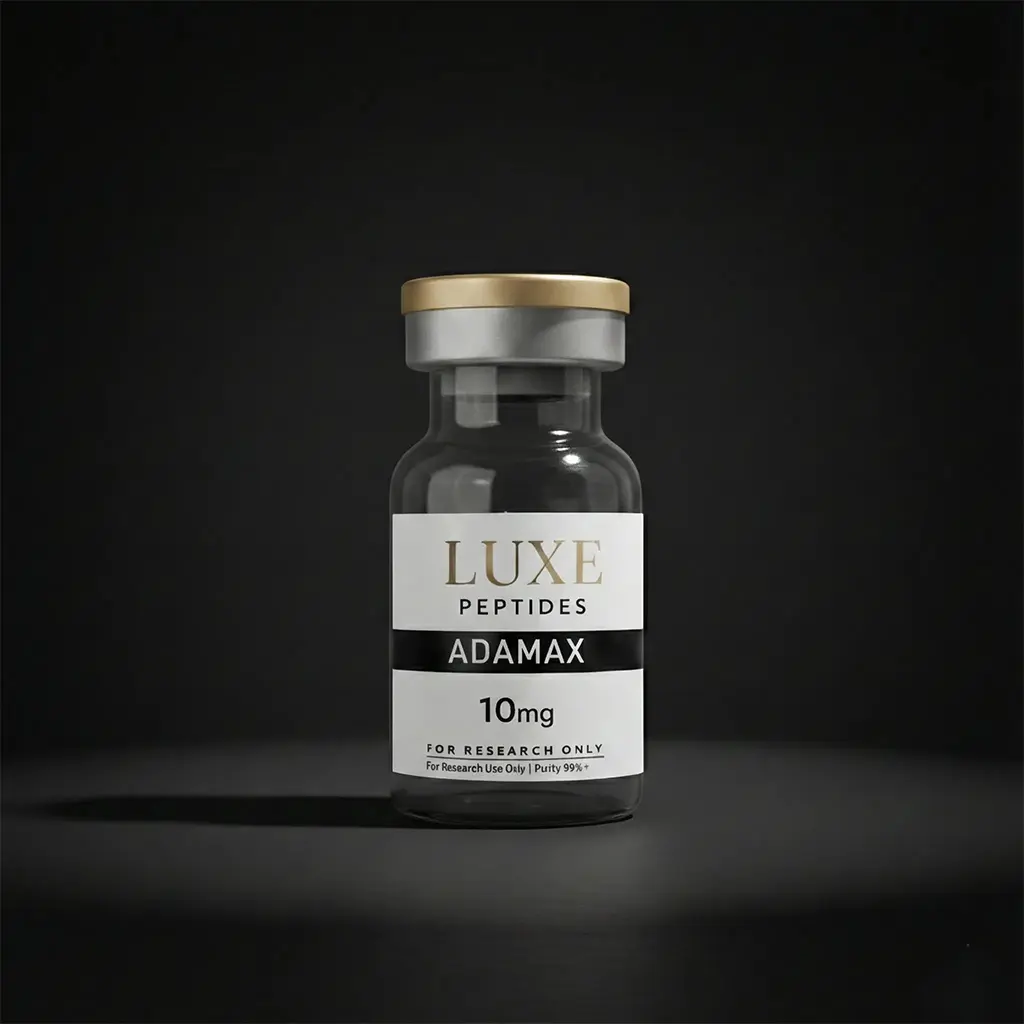
Adamax
$60.00
What is Adamax?
Adamax is a synthetic analog of the heptapeptide Semax (ACTH 4-10), modified with an adamantane group at the C-terminus to enhance metabolic stability and membrane permeability. Like Semax, Adamax is based on the melanocortin ACTH fragment containing the core sequence Met-Glu-His-Phe-Pro-Gly-Pro, which corresponds to the biologically active region of adrenocorticotropic hormone. The adamantane modification is a common medicinal chemistry strategy to improve pharmacokinetic properties by increasing lipophilicity and resistance to enzymatic degradation. Adamax has been investigated in preclinical research as a neuropeptide analog with enhanced bioavailability compared to the parent Semax peptide. It belongs to the family of melanocortin-derived nootropic peptides studied for their interactions with neurotrophic factor expression and synaptic signaling pathways.
Mechanism of Action
Adamax has been investigated for its activity as a modified melanocortin peptide fragment. Like its parent compound Semax, researchers have studied Adamax for its potential interactions with brain-derived neurotrophic factor (BDNF) expression pathways and melanocortin receptor signaling. Studies suggest that ACTH 4-10 analogs modulate TrkB receptor signaling and downstream cascades including MAPK/ERK and PI3K/Akt pathways in neuronal models. The adamantane modification is thought to increase the peptide’s lipophilicity, potentially enhancing its ability to cross biological barriers compared to unmodified Semax. In preclinical models, researchers observed that melanocortin-derived peptides in this class are associated with changes in BDNF and NGF expression in cortical and hippocampal tissue. Adamax retains the core pharmacophore of the ACTH 4-10 sequence while offering improved resistance to aminopeptidase and carboxypeptidase degradation.
Published Research
Semax and Neurotrophic Factors
Dolotov et al. (2006) investigated the effects of Semax (the parent peptide of Adamax) on BDNF and NGF expression in rat brain. Researchers observed increased neurotrophic factor mRNA levels in basal forebrain and hippocampal regions following intranasal administration, supporting the rationale for developing enhanced analogs [1].
ACTH Fragments and Cognition
Ashmarin et al. (1995) reviewed the neuropeptide regulatory cascade involving ACTH fragments, including the Pro-Gly-Pro motif. This work described how melanocortin-derived peptides interact with multiple signaling pathways relevant to synaptic plasticity and memory formation in preclinical models [2].
Adamantane Modifications in Peptide Chemistry
Liu et al. (2011) reviewed the use of adamantane modifications in medicinal chemistry. The adamantyl group increases lipophilicity and metabolic stability of peptide conjugates, providing the chemical rationale for the Adamax modification of the Semax scaffold [3].
Product Specifications
| Product | Adamax Lyophilized Powder |
|---|---|
| Available Sizes | 10mg |
| Purity | ≥99% (HPLC verified) |
| Sequence | Ac-Met-Glu-His-Phe-Pro-Gly-Pro-Adamantane |
| Molecular Formula | C₃₆H₅₁N₉O₁₀ |
| Molecular Weight | 773.85 g/mol |
| Appearance | White lyophilized powder in glass vial |
| Storage | Store lyophilized at -20°C. Protect from light. Reconstituted solution at 2-8°C, use within 14 days. |
| Testing | Third-party tested — Certificate of Analysis available |
Frequently Asked Questions
Adamax is a synthetic analog of Semax (ACTH 4-10) modified with an adamantane group to enhance stability and lipophilicity. It is studied in preclinical nootropic and neuropeptide research.
Adamax contains an adamantane modification at the C-terminus, which increases metabolic stability and lipophilicity compared to the parent Semax peptide while retaining the core ACTH 4-10 pharmacophore.
Store lyophilized Adamax at -20°C protected from light. Reconstituted solutions should be stored at 2-8°C and used within 14 days.
Adamax is commonly studied in the context of nootropic research, BDNF modulation, melanocortin signaling, and neuropeptide pharmacology in preclinical models.
Yes, Adamax is derived from the ACTH 4-10 fragment, which is part of the melanocortin peptide family. It retains the core Met-Glu-His-Phe-Pro-Gly-Pro sequence.
References
- Dolotov OV, et al. Semax, an analog of ACTH(4-10) with cognitive effects, regulates BDNF and trkB expression in the rat hippocampus. Brain Res. 2006;1117(1):54-60. PMID: 16996040
- Ashmarin IP, et al. Regulatory peptides in the brain: new classes and functional interactions. Neurochem Res. 1995;20:1009-1018.
- Liu J, et al. Adamantane derivatives in medicinal chemistry. Curr Med Chem. 2011;18(29):4527-4537. PMID: 21864279


Customer Reviews
Quick delivery and the quality is consistently high.
Happy with the product. Packaging could be improved slightly.
Consistent quality across multiple orders. Very satisfied.
Best quality I have found. Quick turnaround on shipping.
Outstanding quality. This is my go-to source now.
Outstanding quality. This is my go-to source now.
This vendor sets the standard. Highly recommend.
Really happy with this. Clean, pure, well-packaged.
Best quality I have found. Quick turnaround on shipping.
Exactly what I needed for my research. Clean product.
Quality is solid. Wish there were more size options.